English Русский
Български
Беларускі
Український
Српски
Hrvatski
Română
Polski
Slovenský
Magyar
Bookmark Contacts Articles Sitemap
Company vehicles Peugeot Company vehicles Opel Company vehicles Skoda Company vehicles Land Rover Company vehicles Mitsubishi Company vehicles Volkswagen Company vehicles Honda
RenaultBook.ru


Duster   Fluence   Kangoo   Laguna   Logan   Megane   Sandero   Scenic   Symbol   Clio   Other
Symbol 1 (1999-2008, petrol) Symbol 2 (2008-2013, petrol)

Engine oil pump repair (Renault Symbol 2)

  • Main
  • Symbol
  • Symbol 2 (2008-2013, petrol)
  • Power unit
  • Engine repair
  • Engine oil pump repair
0
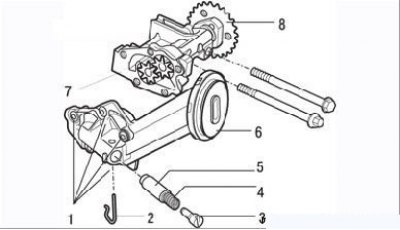
Figure 3.90. Oil pump parts: 1 – bolts; 2 – hairpin; 3 – adjusting screw of the pressure reducing…

Figure 3.90. Oil pump parts: 1 – bolts; 2 – hairpin; 3 – adjusting screw of the pressure reducing valve; 4 – spring; 5 – plunger of the pressure reducing valve; 6 – oil receiver; 7 – pump body; 8 – drive sprocket


Work order:
  • remove the oil pump as described earlier;
  • unscrew the mounting bolts, remove the cover and oil receiver;
  • remove the pin, adjusting screw, spring and plunger of the pressure reducing valve;
  • carefully inspect the pump gears and the pressure reducing valve parts. No external damage or increased wear is allowed;
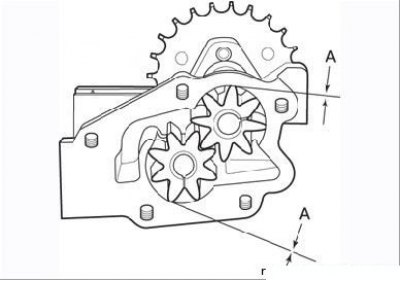
Figure 3.91. Measuring the clearance (A) between the gears and the oil pump housing

Figure 3.91. Measuring the clearance (A) between the gears and the oil pump housing

  • measure the gap between the pump body and the gears (Figure 3.91), it should be within the range of 0.110–0.249 mm;
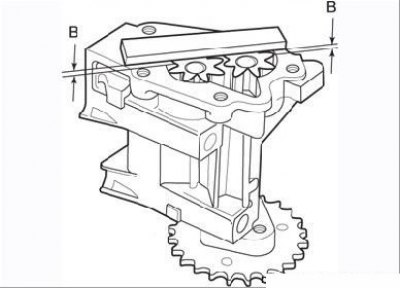
Figure 3.92. Measuring the axial clearance (B) of the oil pump gears

Figure 3.92. Measuring the axial clearance (B) of the oil pump gears


  • measure the axial clearance of the gears (Figure 3.92). The gap should not be more than 0.020–0.086 mm. If the gaps exceed the permissible limits, replace the oil pump;
  • check the flatness of the cover adjacent to the pump body.

[The original can be found on the website RenaultBook.ru]

If the condition of the pump parts is satisfactory, assemble the pump in the reverse order of removal, fill the housing with clean engine oil and install, tightening the bolts to the required torque.

Checking the oil pressure in the lubrication system


Disconnect the wires from the oil pressure warning light sensor, unscrew the sensor and screw in the pressure gauge hose fitting in its place.

Start the engine and warm it up to an oil temperature of 80°C. Measure the oil pressure at idle and at a crankshaft speed of 3000 min⁻¹, which should be 1 and 3 bar, respectively.

Disconnect the control pressure gauge, install the sensor and connect the wires to it.
This article is available on: russian, bulgarian, belarusian, ukrainian, serbian, croatian, romanian, polish, slovak, hungarian
Article has been reviewed by editor: Kupriyanov Sergey
Share with friends:
Previous
Symbol 2: Engine repair
Next

Removal and installation the engine oil pump
Engine lubrication system — design description
Installing the engine oil pan
Removal the engine oil pan
Replacing the toothed belt (timing belt)
Engine connecting rod and piston group — removal
Engine connecting rod and piston group — inspection
Connecting rod and piston group of the engine — assembly and…
Engine Crankshaft — Removal
Engine Crankshaft — Inspection
Other articles on other Renault models

➽ Manual fuel priming pump (K9K engine) Renault Duster 1 (2009-2017)
➽ Vacuum pump (diesel engine) Renault Kangoo 1 (1997-2007)
➽ Oil pump repair Renault Logan 1 (2004-2012, petrol)
➽ Repair of gasoline engines in the engine compartment Renault Megane 1 (1995-2002)
➽ Oil pump repair Renault Sandero 1 (2007-2012, petrol)
Link to this article in different formats
Reviews and comments of visitors
No comments yet


Add two numbers 20 + 48


Symbol 2 (2008-2013, petrol) 
  • General information
  • User manual
  • Maintenance
  • Power unit
  • Engine repair
  • Cooling system
  • Fuel system
  • Exhaust system
  • Ignition system
  • Transmission
  • Clutch
  • Mechanical gearbox
  • Automatic gearbox
  • Drive shafts
  • Chassis, running gear
  • Front suspension
  • Rear suspension
  • Steering
  • Brake system
  • Body and interior
  • Exterior (external elements)
  • Interior (internal elements)
  • Doors, locks and windows
  • Heating and ventilation
  • Electrical equipment
  • Equipment and devices
  • Headlights and lighting
  • Power devices
  • Electrical circuits
Symbol 1 (1999-2008, petrol) 
  • General information
  • User manual
  • Car care
  • Maintenance
  • Power unit
  • Engine repair
  • Cooling and lubrication system
  • Supply system
  • Exhaust system
  • Ignition system
  • Transmission
  • Clutch
  • Mechanical gearbox
  • Automatic gearbox
  • Drive shafts
  • Chassis, running gear
  • Car suspension
  • Steering
  • Brake system
  • Body and interior
  • Exterior (external elements)
  • Interior (internal elements)
  • Doors, locks and windows
  • Restoration and repair
  • Electrical equipment
  • Equipment and devices
  • Headlights and lighting
  • Power devices
  • Heating and ventilation
  • Electrical circuits
RenaultBook.ru © 2018–2026 | Mobile version | News and articles | Sitemap: EN BG BY UA RS HR RO PL SK HU | Administration | Site search | Bookmark
Duster 1 (2009-2017) | Fluence 1 (2009-2020, petrol) | Kangoo 1 (1997-2007) | Laguna 2 (2001-2007) | Logan 1 (2004-2012, petrol) | Logan 2 (2012-2020) | Megane 1 (1995-2002) | Megan 2 (2002-2009, petrol) | Sandero 1 (2007-2012, petrol) | Scenic 1 (1996-2003) | Symbol 1 (1999-2008, petrol) | Symbol 2 (2008-2013, petrol) | Renault 19 (1988-1996) | Espace I and II (1984-1996) | Espace III (1996-2002) | Clio 1 (1990-1998) |
We want your visit to be comfortable 😌 and use cookies 🍪 to do so.