



Contents: Installation of nozzles for cooling…🠛 Installing piston pins 🠛 Preparing the connecting rods 🠛 Connecting rod bearing shells 🠛 Installing the liner into the crank…🠛 Installing the liner in the…🠛 Preparing the piston pins 🠛 Assembling the connecting rod with…🠛 Crankshaft main bearing shells 🠛 Installing piston rings 🠛 Installing piston assemblies into…🠛 Installing crankshaft seals 🠛 Installing the cylinder head 🠛 Setting the valve timing 🠛 Belt tension 🠛 Checking the belt tension 🠛 Checking the correct installation of…🠛 Final operations 🠛
Installation of nozzles for cooling piston bottoms
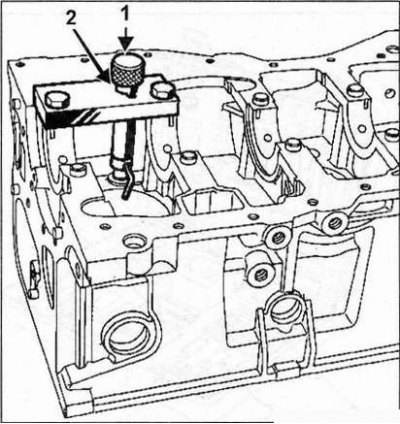
1. Fit the plate (2) of tool Mot. 1494 to the block without tightening the two mounting bolts (1).
2. To center the plate, install the jig (3) into the plate (2) (the end of the conductor should enter the hole for the nozzle).
3. Tighten the two mounting bolts (1).
4. Remove the conductor.
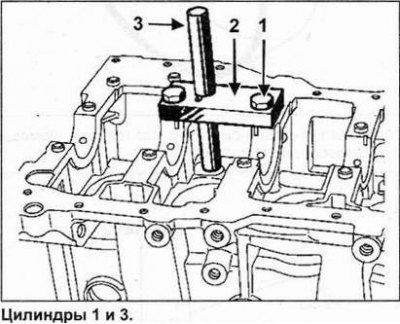
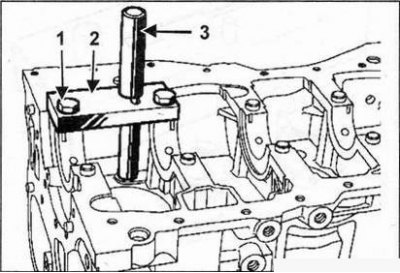
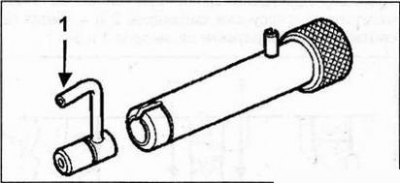
Attention! Pay attention to the direction of installation of the injector. The tip (1) of the injector must be directed towards the center of the cylinder.
6. Install the mandrel instead of the jig.
7. Apply several blows with a hammer to the mandrel until the flange (2) of the mandrel (1) touches the support.
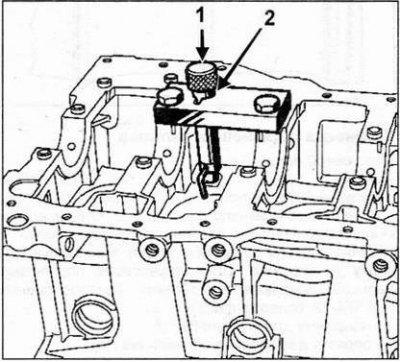
Cylinders 1 and 3.
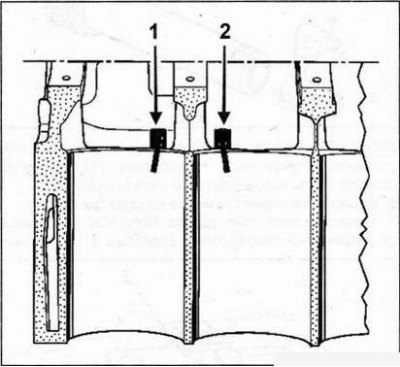
8. Check that the piston bottom cooling nozzles are oriented correctly. Mark (1) corresponds to the nozzles of cylinders 2 and 4, mark (2) corresponds to the nozzles of cylinders 1 and 3.
Installing piston pins
Piston pin:
- Length - 61.7-62 mm
- Outer diameter - 19.986-19.991 mm
- Inner diameter - 11.6 (max) mm
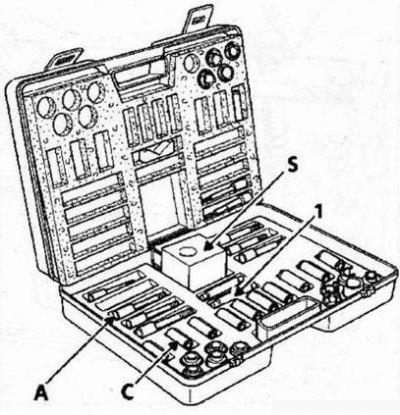
The piston pins are pressed tightly into the upper heads of the connecting rods and have a floating fit in the pistons. To press in the piston pins, use the Mot.574-22 tool kit, which contains:
- piston stand (S);
- finger extractor (1);
- mounting rods (A) with centering devices (C).
Preparing the connecting rods
- Axial clearance of the connecting rod on the crankshaft journal - 0.31 - 0.604 mm
- The distance between the axes of the piston and crank heads of the connecting rod is 128 + 0.035 mm
- Connecting rod crank head diameter - 48.5±0.25 mm
- Connecting rod piston head diameter - 19.945 - 19.958 mm
Caution! Do not use a punch to mark the caps and connecting rods, as this may cause the rod to begin to fail. Use a permanent pencil.
The weight of connecting rods of the same engine should not differ from each other by more than 6 grams.
Connecting rod bearing shells
The engine is equipped with liners that do not have protection against incorrect installation.
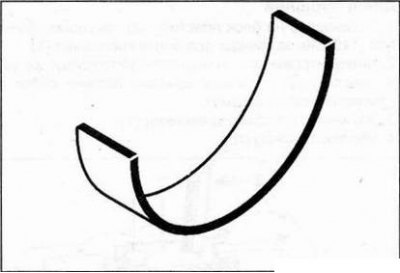
The installation of the liners is carried out using the Mot. 1492 device.
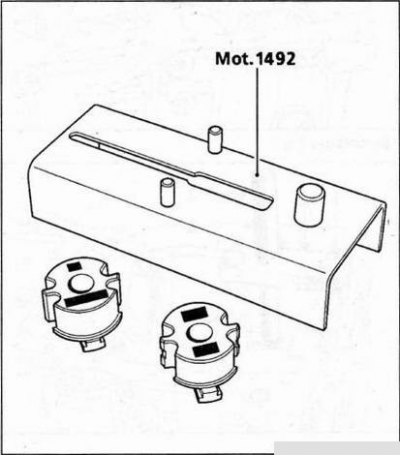
Installing the liner into the crank head
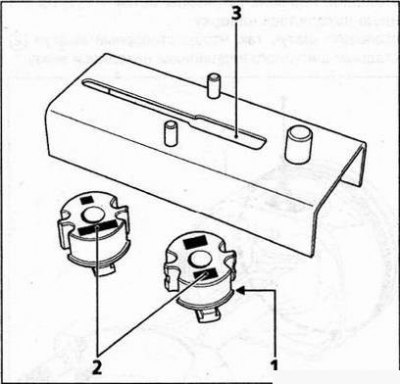
1. Select the appropriate bearing shell holder (1) for the engine (see engine type marking (2) on the holder).
2. Insert the insert holder into the groove (3) of the base of the device.
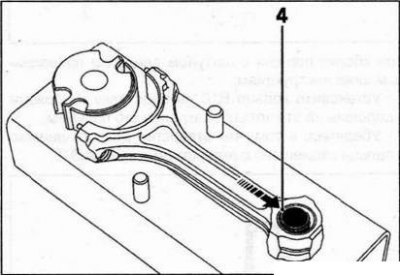
3. Place the connecting rod on the base (as shown in the picture). Make sure that the lower part (4) of the connecting rod piston head contacts the dowel pin.
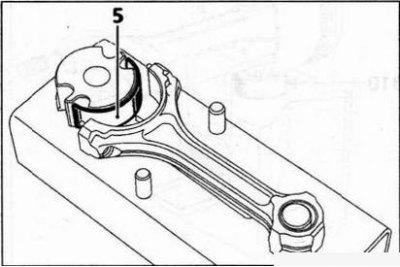
4. Place the insert (5) on the insert holder.
5. Push the bearing shell holder in the direction shown by the arrow in the figure until the bearing shell holder goes all the way into the connecting rod body.
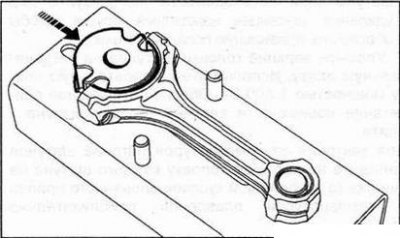
6. Remove the connecting rod holder and perform the same operations with the remaining connecting rods.
Installing the liner in the connecting rod crank cap
1. Install the connecting rod crank cap onto the protrusions (6) of the base, and then place the insert (7) onto the holder.
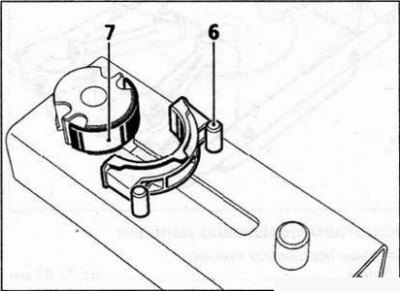
2. Push the bearing shell holder in the direction shown by the arrow in the figure until the bearing shell holder comes to the stop in the connecting rod crank cap.
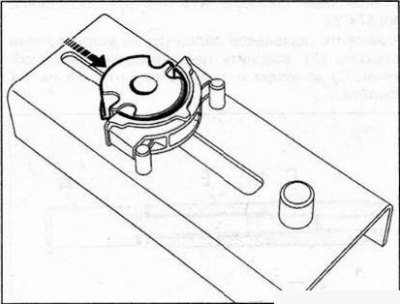
3. Visually check:
- condition of connecting rods (they may be twisted or bent);
- reliability of the bearing caps fit on the connecting rods (if necessary, use a sanding block to remove burrs to ensure proper seating of the caps).
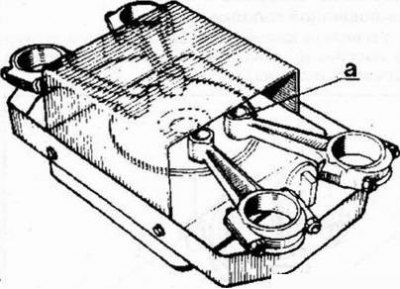
4. Place the connecting rod upper ends on the heating plate. Use a 1500 watt heating plate. Ensure that the surface of the connecting rod upper end is in close contact with the plate.
To control the heating temperature of the connecting rods, place a small piece of tin solder with a melting point of approximately 250°C on the upper head of each connecting rod in area (a).
Heat the top ends of the connecting rods until the solder melts.
Preparing the piston pins
Piston pin dimensions:
- Length - 61.7-62 mm
- Outside diameter - 19.986 - 19.991 mm
- Inner diameter - 11.6 mm
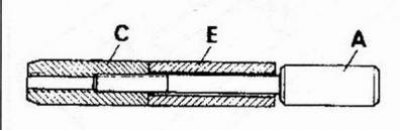
Make sure that the piston pins fit freely into the corresponding new pistons. Use the centring tool C13 and the setting rod A13 or the tool Mot.574-24.
Install the piston pin (E) onto the setting rod (A), screw in the centering tool (C) until it stops, and then back it out 1/4 turn.
Assembling the connecting rod with the piston
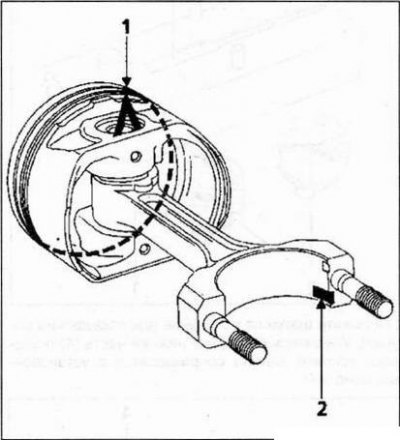
The piston bottoms are marked with "A" markings indicating the direction towards the flywheel.
The location of the pistons relative to the connecting rods
Install the piston so that the mark "A" (1) on its bottom is at the top.
Install the connecting rod so that the locking lug (2) of the connecting rod bearing shell is at the bottom.
When assembling the piston with the connecting rod, follow the instructions below:
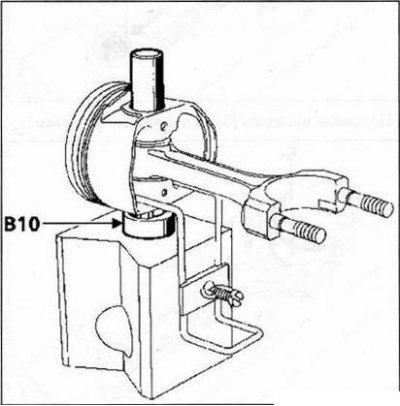
- Place the B10 ring on the stand and place the piston on this ring, securing it with your finger.
- Make sure the piston pin hole is aligned with the hole in the B10 ring.
- Lubricate the centering device and piston pin with engine oil.
- Insert the piston pin so that it fits freely into the piston and, if necessary, re-align the piston.
Caution! The following operations must be performed as quickly as possible to avoid cooling the connecting rod.
When the solder temperature reaches the melting point (the solder will turn into a drop):
- wipe off a drop of solder;
- insert the centering device into the piston;
- insert the connecting rod into the piston;
- insert the piston pin as quickly as possible until the centering device stops in the support.
Make sure the piston pin remains inside the piston in all connecting rod positions in the piston.
Crankshaft main bearing shells
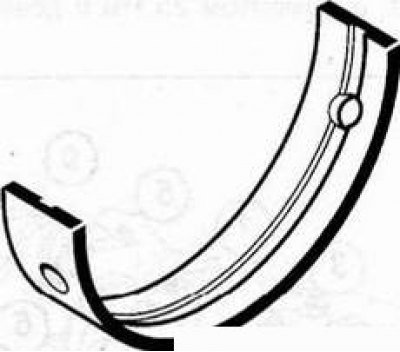
The engine is equipped with liners that do not have protection against incorrect installation.
Installation sequence:
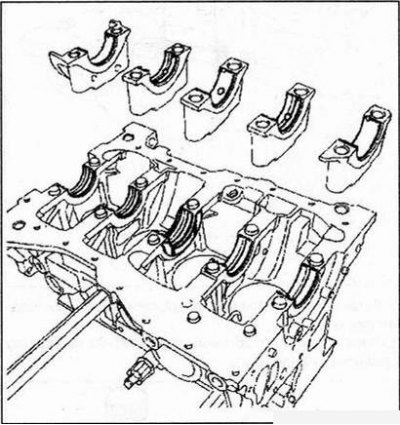
- Install grooved bearing shells into all bearing seats in the crankcase.
- Install the grooved liners on main bearing caps 2 and 4, and the non-grooved liners on main bearing caps 1, 3 and 5.
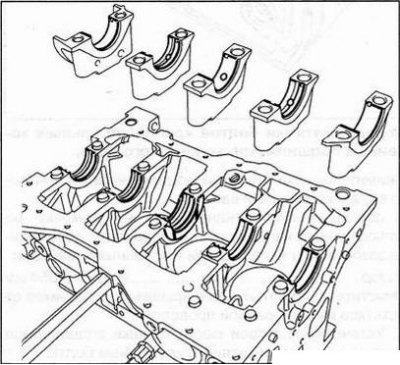
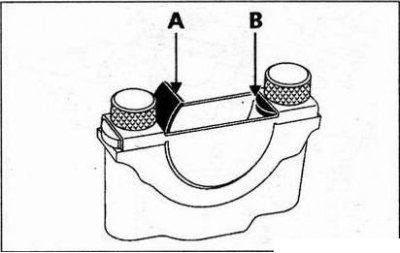
1. Installing the liners in the cylinder block. Install the Mot. 1493-01 device on the main bearing seat on the crankcase.
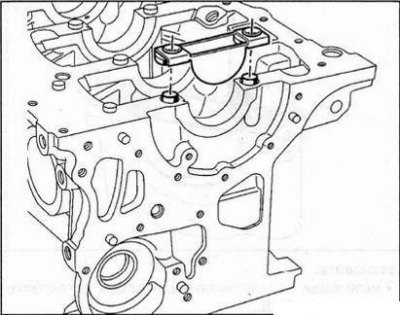
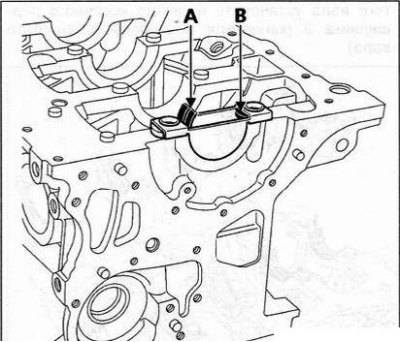
Insert the insert into Mot. 1493-01, then press at point (A) until the insert touches Mot. 1493-01 at point (B).
2. Installing liners into the main bearing caps.
Fit tool Mot. 1493-01 to the main bearing cap.
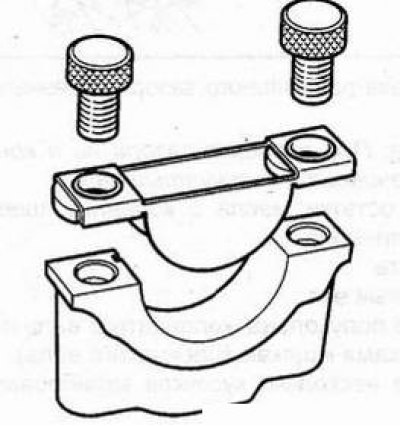
Insert the insert into Mot. 1493-01, then press at point (A) until the insert touches Mot. 1493-01 at point (B).
Install:
- install bearing shells without grooves into covers 1-3-5;
- install bearing shells with grooves into the cylinder block bearings and into bearing caps 2-4;
- install the side adjusting half rings of the crankshaft into the main bearing seat 3 (grooves towards the crankshaft).
3. Checking the radial clearance of the main bearings.
Caution! Do not turn the crankshaft under any circumstances when checking the clearance.
Remove any remaining oil from the main journals and cylinder block bearings.
Install:
- crankshaft;
- crankshaft thrust half rings on the 3rd support (grooves to the crankshaft cheeks). Cut several pieces of calibrated wire.
Place the wire along the axis of the crankshaft main journals (outside the area of the lubrication holes for the supports).
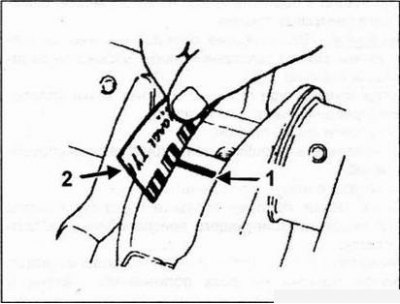
1 - calibrated wire, 2 - scale.
Install the crankshaft main bearing caps (they are marked with numbers from 1 to 5), by installing the cover on the flywheel side. Tighten the mounting bolts in the order shown in the figure to a torque of 25 Nm and turn them further by 47° ±5°.
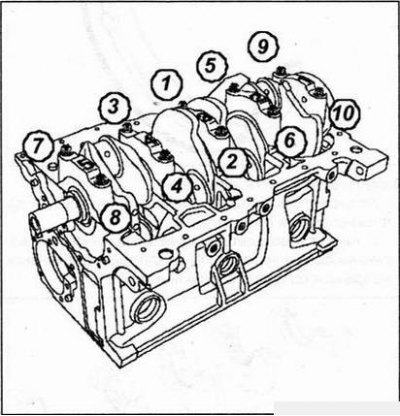
The order of tightening the bolts securing the crankshaft main bearing caps.
Remove the crankshaft main bearing caps and the crankshaft.
Using the scale on the packaging, determine the gap between the bearing shells and the main journals by flattening the calibrated wire
Gap - 0.027-0.054 mm
Clean the crankshaft and bearing caps from any traces of calibrated wire. 4. Install the crankshaft bearing caps in their places and tighten the mounting bolts.
Note: Remember to apply a thin coat of RHODORSEAL 5661 to the N9 1 bearing in area (A).
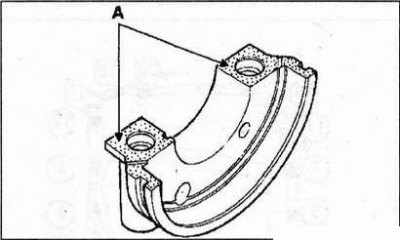
5. Check the axial clearance of the crankshaft, which should be within 0.045 - 0.252 mm if the adjusting half rings are not worn and within 0.045 - 0.852 if they are worn.
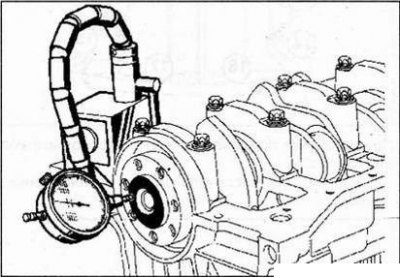
Make sure the crankshaft turns freely.
Installing piston rings
Each piston has three rings.
Ring thickness:
- Upper compression ring - 1.2mm
- Lower compression ring - 1.5 mm
- Oil scraper ring - 2.5 mm
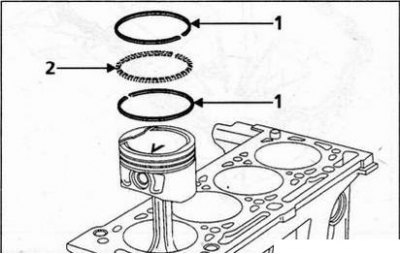
The oil scraper ring consists of three parts: two steel rings (1), a dual-function ring expander (2).
Piston rings installed at the factory should move freely in their piston grooves.
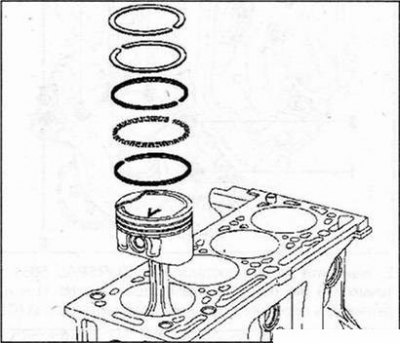
Install the piston rings correctly: the "TOP" mark should be at the top. Orientation of the piston rings on the piston: position the piston rings as shown in the figure below.
Installing piston assemblies into cylinders
1. Lubricate the pistons.
2. Insert the piston assembly with the connecting rod into the cylinder block using a compression clamp (for example: FACOM 750 TV), ensuring the correct direction (mark "A" should face the flywheel).
3. Install the connecting rods onto the lubricated crankshaft cranks.
4. Install the connecting rod lower head caps.
5. Tighten the new lower connecting rod cap nuts to 43 Nm.
6. Reinstall:
- oil pump drive sprocket;
- oil pump drive chain;
- oil pump, tighten its mounting bolts to a torque of 22 - 27 Nm;
- crankshaft seal cover, applying Loctite 518 sealant to it. The bead (B) of sealant should be 0.6 - 1 mm wide, and the sealant should be applied as shown in the figure below.
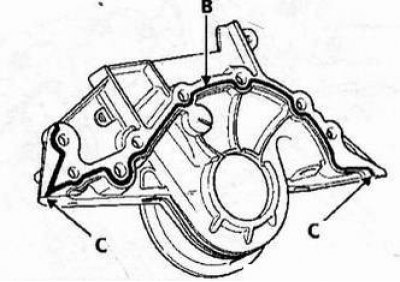
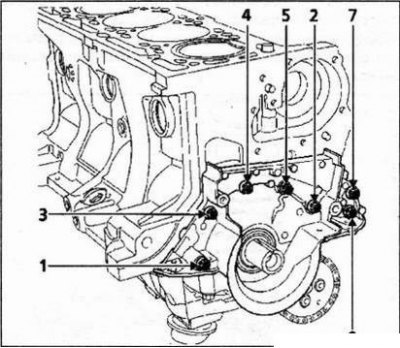
Then tighten the front crankshaft oil seal retainer bolts to 11 Nm in the recommended sequence.
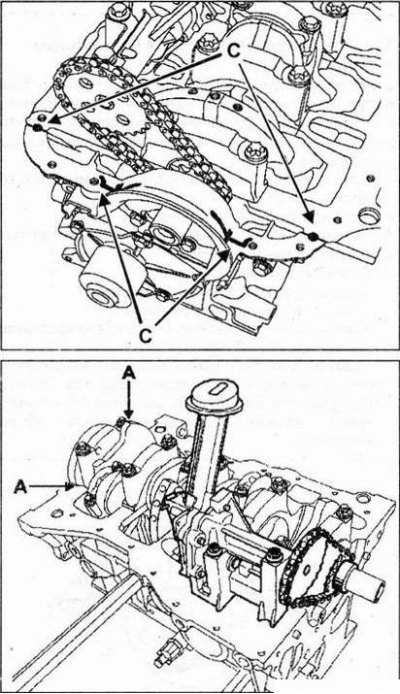
7. Apply a drop of RHODORSEAL 5661 to points (A) (both sides of bearing No.1) and to the front crankshaft oil seal retainer (C).
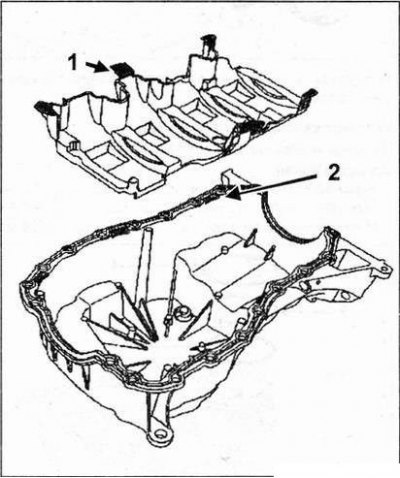
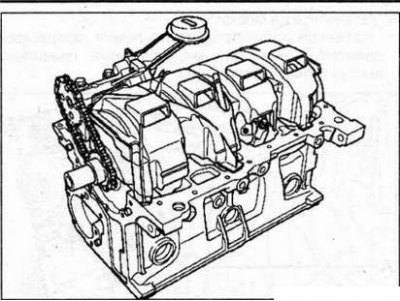
8. Install the oil separator and pan with a new gasket. Tighten the pan mounting bolts in the order shown in the figure to 8 Nm and then tighten them finally to 14 Nm.
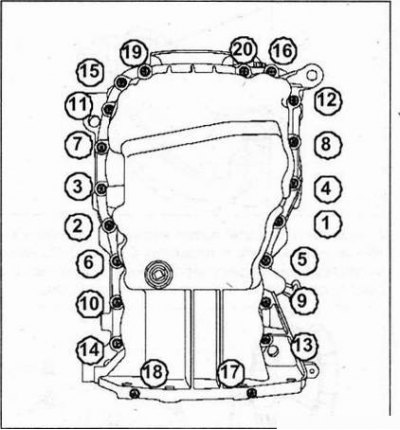
When installing the engine sump, make sure that:
- the projections (1) of the oil separator are installed in the grooves (2);
- the cylinder block and engine sump are aligned on the flywheel side to avoid damage to the clutch housing when connecting the engine to the gearbox.
9. Install the oil level sensor.
- Tightening torque - 20 Nm
10. Install the knock sensor.
- Tightening torque - 20 Nm
11. Install the oil pressure sensor.
- Tightening torque - 32 Nm
Installing crankshaft seals
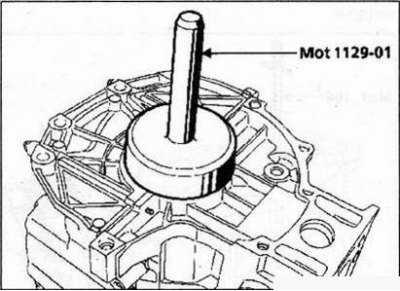
1. Use tool Mot 1129-01 to install the flywheel side seals.
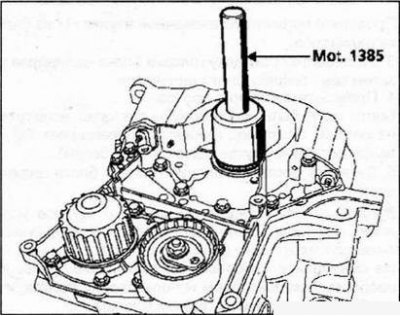
2. Use tool Mot 1385 to install the seals on the timing gear side.
3. Reinstall:
- flywheel, tightening the new bolts of its fastening with a torque of 55 Nm (in a star-shaped sequence);
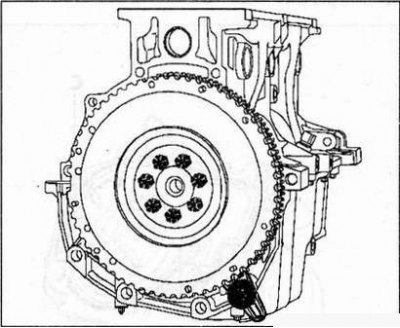
- clutch basket.
Center the driven disk using the drift (Emb. 1581).
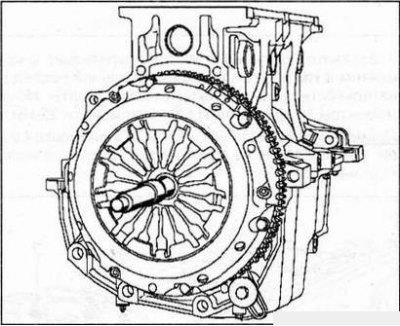
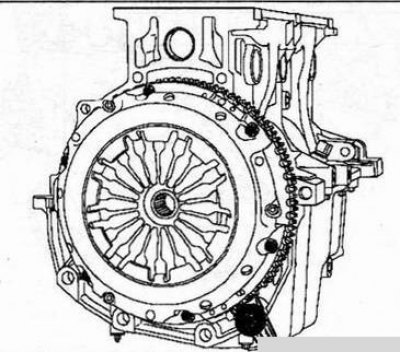
Tighten the clutch housing mounting bolts to 18 Nm and remove the flywheel retainer.
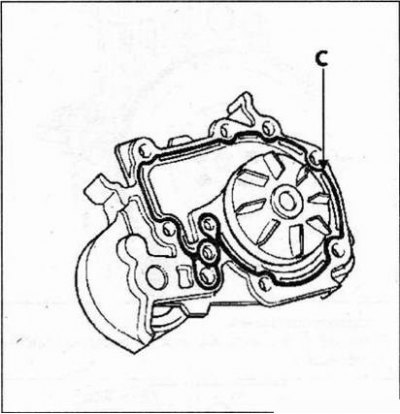
4. Install the water pump in place, sealing its seating surface with Loctite 518 sealant. The width of the bead (C) of the sealant should be 0.6-1 mm, and the sealant should be applied as shown in the figure below.
5. Pre-tighten the M6 and M8 bolts to a torque of 8 Nm and then, in the recommended sequence, finally tighten the M6 bolts to a torque of 11 Nm and the M8 bolts to a torque of 22 Nm.
Note: Apply 1-2 drops of Loctite FRENETANCH to water pump mounting bolts 1 and 4.
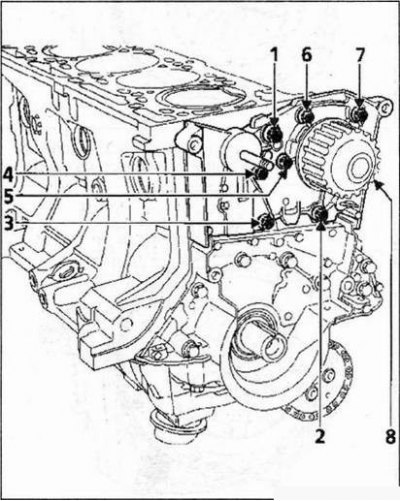
6. Reinstall:
- the timing belt tension roller, correctly installing the pulley protrusion in the groove (A);
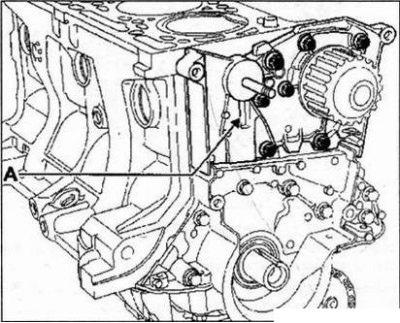
- oil level sensor.
Installing the cylinder head
1. Set the pistons to mid-stroke.
2. Fit tool Mot. 104 to the cylinder block.
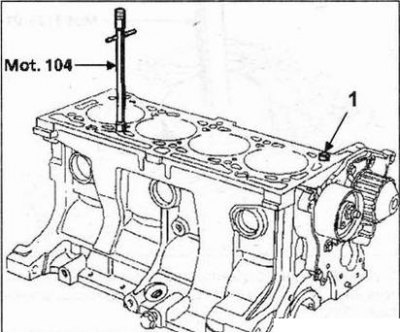
Check the presence of the installation sleeve (1) on the cylinder block.
3. Install the cylinder head gasket and then the cylinder head itself.
4. Check the condition of the bolts.
Bolts may be reused if the length of the bolt shank under the head does not exceed 117.7 mm (otherwise, replace all bolts).
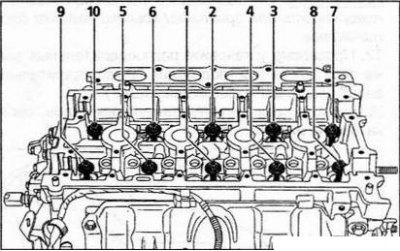
5. Tighten the cylinder head bolts.
Caution: To tighten the bolts correctly, remove any oil remaining in the cylinder head mounting holes with a syringe.
Do not lubricate new bolts with engine oil. Conversely, when reusing bolts, they must be lubricated with engine oil.
Check that all bolts are tightened to a torque of 20 Nm, then turn all bolts in the same order by 240° ±6°.
Note: After performing this procedure, it is not necessary to retighten the cylinder head bolts.
6. Install the fuel rail in place and tighten its mounting bolts to a torque of 20 Nm.
Note.
- Check the alignment of the lower intake manifold with the cylinder head (on the distribution mechanism side).
- Check the alignment of the upper surfaces (1) of the lower intake manifold with the cylinder head.
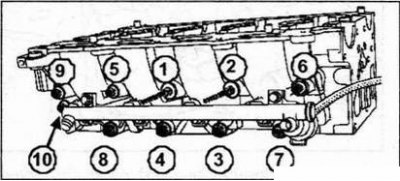
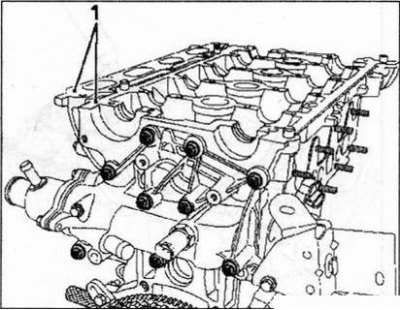
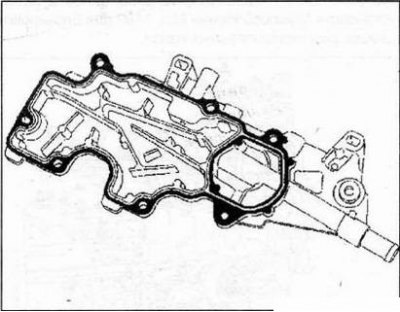
7. Install the removable part of the cooling jacket with a new seal and tighten the mounting bolts to a torque of 10 Nm.
Tighten all bolts to a torque of 20 Nm in the order shown in the figure.
8. Reinstall:
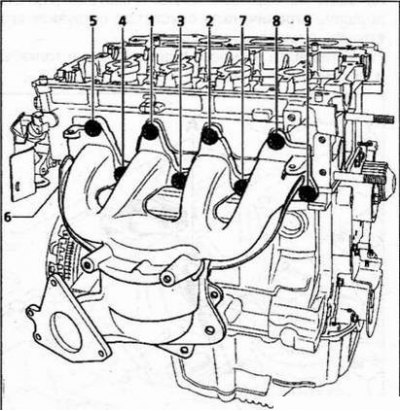
- exhaust manifold with a new gasket, tightening its mounting nuts with a torque of 18 Nm in the recommended sequence;
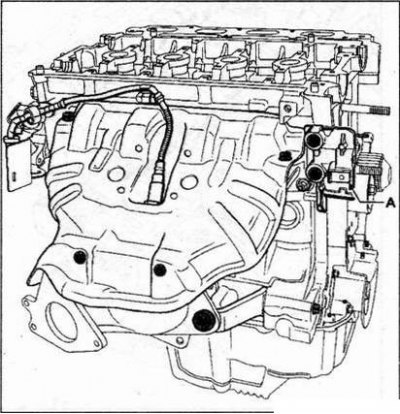
- the upper exhaust heat shield, tightening its mounting bolts to a torque of 10 Nm;
- oxygen sensor, tightening it to 45 Nm;
Note: Make sure the exhaust heat shield is properly installed between the oxygen sensor and the exhaust manifold (this prevents thermal effects that could cause destruction of the oxygen sensor connector).
- brace between the exhaust manifold and the cylinder block;
- spacer piece (A).
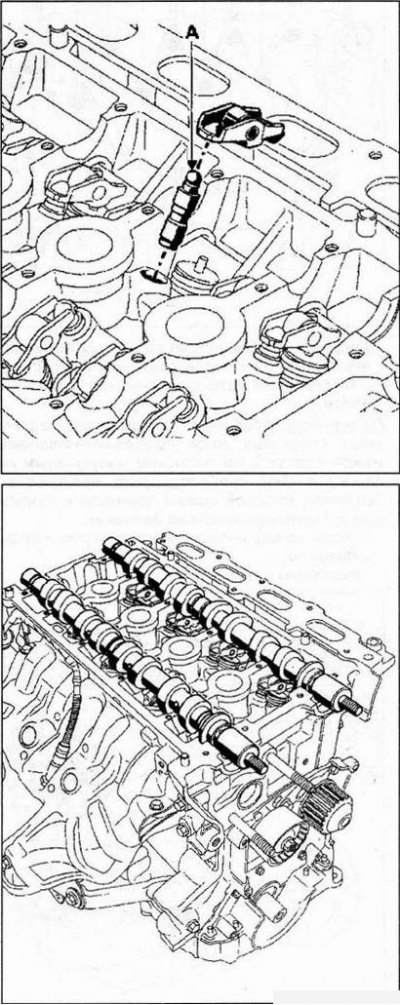
9. Over time, hydraulic lifters will leak fluid and need to be replenished. To check if these lifters require fluid replenishment, press the top of the lifter (A) with your thumb. If the limiter piston drops, immerse it in a container of diesel fuel.
10. Install the hydraulic tappets and valve rocker arms.
11. Lubricate the camshaft bearings.
Note: Do not allow oil to come into contact with the cylinder head cover gasket surface.
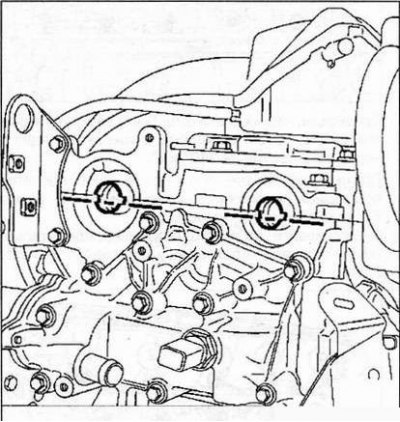
12. Correctly install the camshafts in their places (see the subsection "Camshafts" of the section "Disassembling the engine"). Install the camshaft grooves as shown in the figure below.
Note: Surfaces under the gaskets must be clean, dry and free of grease (especially avoid touching them with your fingers to avoid leaving grease marks).
13. Using a roller, apply Loctite 518 sealant to the cylinder head cover gasket side surface until it turns a reddish color.
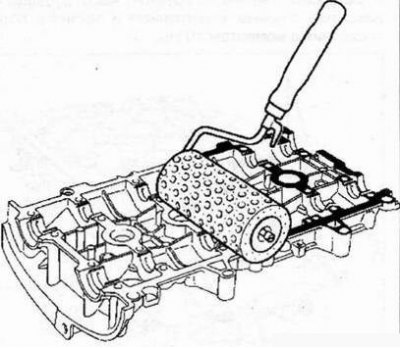
Table: Cylinder Head Cover Bolt Tightening Sequence
| Stage | Bolt tightening sequence | Sequence of loosening bolts | Tightening torque (Nm) |
| №1 | 22-23-20-13 | - | 8 |
| №2 | from 1 to 12; from 14 to 19; from 21 to 24 | - | 12 |
| №3 | - | 22-23-20-13 | - |
| №4 | 22-23-20-13 | - | 12 |
14. Install the cylinder head cover and tighten its mounting bolts to the recommended torque.
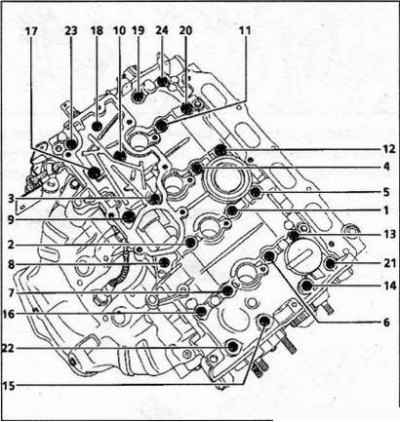
Cylinder head cover bolt tightening sequence.
15. Using a roller, apply Loctite 518 sealant to the surface of the oil sump on the gasket side until it turns reddish.
Note: Surfaces under the gaskets must be clean, dry and free of grease (especially avoid touching them with your fingers to avoid leaving grease marks).
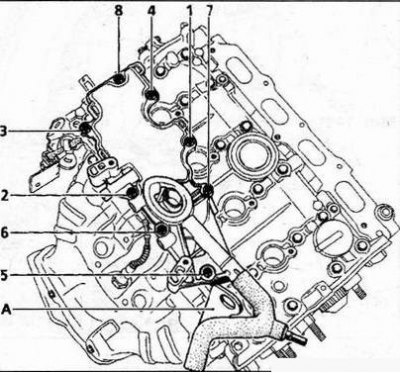
16. Reinstall:
- oil sump, tightening the mounting bolts to 13 Nm in the recommended sequence (self-tapping bolts should be tightened using a torque wrench);
- lifting eye (A).
17. Reinstall:
- ignition coils, tightening the mounting bolts with a torque of 13 Nm;
- intake manifold (with new seals), tightening its mounting bolts to a torque of 9 Nm in the recommended sequence;
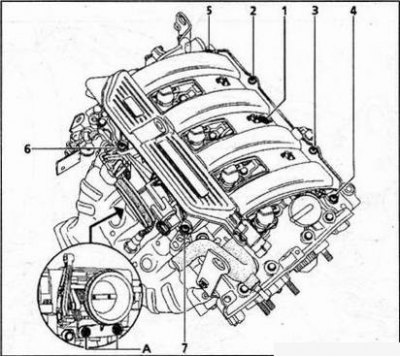
- the throttle body, tightening its mounting bolts (A) to a torque of 13 Nm;
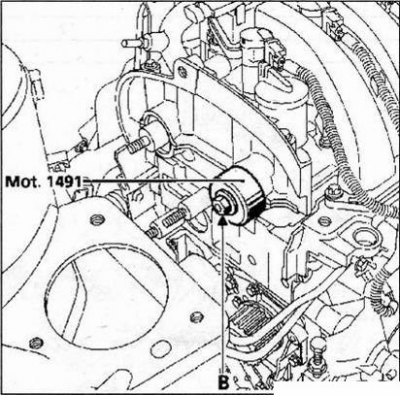
- air filter, tightening its mounting bolts to a torque of 9 Nm, camshaft seals, using tool Mot. 1491 (use old nuts (B)).
Setting the valve timing
Caution! It is necessary to degrease the end journal of the crankshaft, the seating surfaces of the timing gear pulleys and the crankshaft to avoid slippage between the timing gear and the crankshaft, which can lead to engine damage.
1. Install the camshaft pulleys in place, first tightening the new nuts (old nuts should be replaced with new ones, without nuts the axial clearance between the nut and the pulley should be within 0.5-1 mm).
2. Install the camshaft grooves as shown in the figure below.
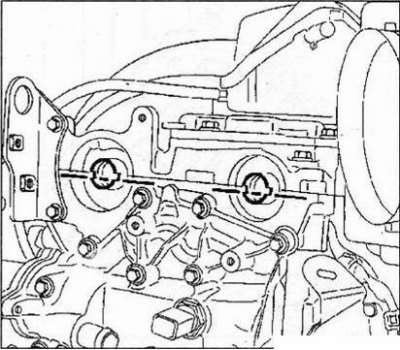
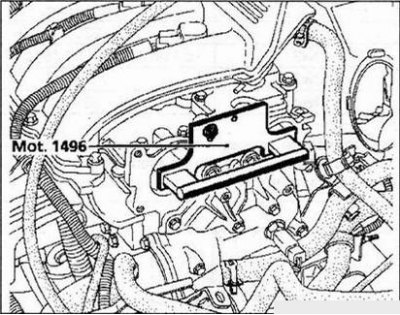
3. Fit tool Mot. 1496, securing it to the ends of the camshafts.
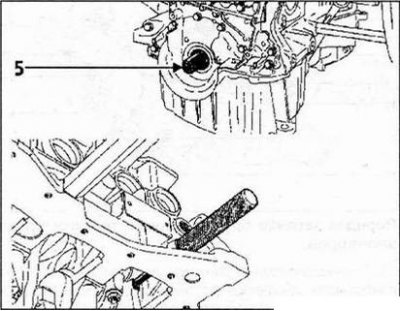
4. Make sure that the crankshaft rests against the TDC position lock (with the groove (5) on the crankshaft in the highest position).
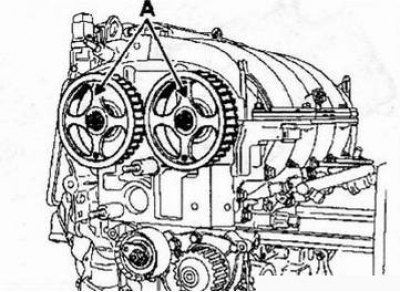
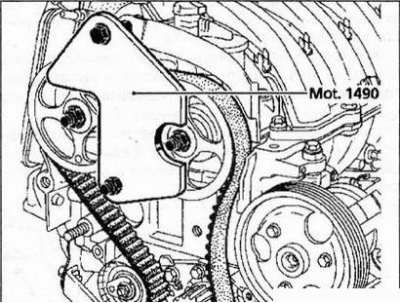
5. Install the camshaft timing pulleys so that the Renault logo on their spokes is oriented vertically upwards. Fit the timing belt of the gas distribution mechanism to the gear pulleys of the camshafts and then install the Mot. 1490 device for locking the camshaft pulleys.
6. Reinstall:
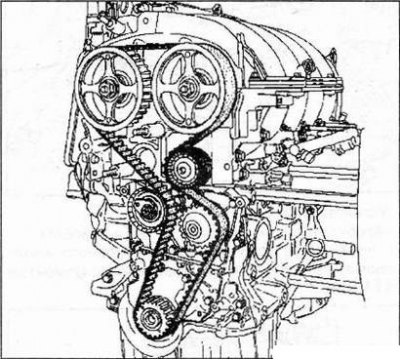
- gas distribution mechanism drive belt;
- pulley, tightening the mounting bolt to a torque of 45 Nm.
Note: The crankshaft accessory drive pulley retaining bolt can be reused if its length under the head does not exceed 49.1 mm; otherwise, replace it with a new one.
7. Install the crankshaft pulley for the auxiliary equipment drive in place, having first tightened its mounting bolt (without tightening the bolt there should be a clearance of 2-3 mm between the bolt head and the pulley).
Note: Do not lubricate the new bolt. However, if you are using an old bolt, lubricate it with engine oil.
Belt tension
1. Make sure that there is still 0.5-1 mm of play between the nuts and the camshaft pulleys.
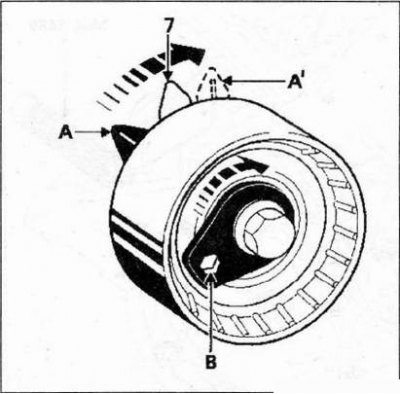
2. Move the movable mark (A¹) tension roller by 7-8 mm relative to the fixed mark (7), using a 6 mm Allen key (B) for this purpose.
Note: Point (A) corresponds to the movable mark in a free position.
3. Pre-tighten the tension roller nut to 7 Nm.
Original publication on the portal [www.renaultbook.ru]
4. Remove tool Mot. 1490 for locking the camshaft pulleys.
5. Turn the exhaust camshaft pulley on the timing side six times using tool Mot. 799-01.
6. Loosen the tensioner pulley nut no more than one turn while holding the pulley with a 6 mm Allen key.
7. Align the movable mark (A') with the fixed mark (7) and tighten the roller nut to a torque of 27 Nm.
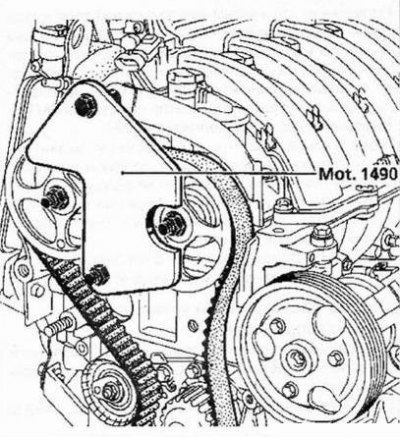
8. Fit tool Mot. 1490 to lock the camshaft pulleys.
10. Tighten the crankshaft accessory drive pulley bolt to a torque of 20 Nm and then screw it in at an angle of 135° ±15° (in this case the crankshaft should rest against the TDC position lock).
11. Tighten the intake camshaft pulley nut to 30 Nm and then turn it in at an angle of 84°.
12. Remove tool Mot. 1496 for correct installation of the camshafts, tool Mot. 1490 for locking the camshaft pulleys and TDC position lock Mot. 1489.
Checking the belt tension
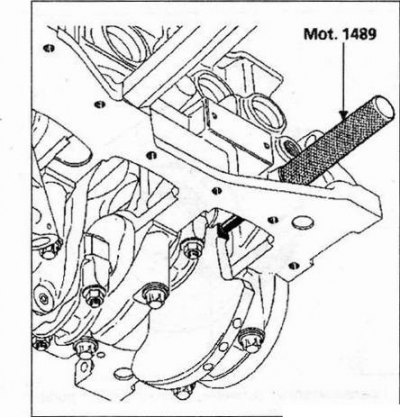
1. Turn the crankshaft clockwise (from the valve timing side) two turns; before the end of the second turn, screw the Mot. 1489 lock into the cylinder block and slowly, without jerking, turn the crankshaft in the same direction until it rests against the TDC position lock.
2. Unscrew the TDC position lock.
3. Make sure that the timing marks on the tension roller are aligned; otherwise, repeat the belt tensioning operation.
4. Loosen the tensioner pulley nut no more than one turn while holding the pulley with a 6mm Allen key.
5. Align the movable mark with the fixed mark and tighten the roller mounting nut to a torque of 27 Nm.
Checking the correct installation of valve timing
1. Before checking the correct installation of the valve timing, make sure that the tension roller marks are in the correct position.
2. Screw the TDC position lock Mot. 1489 into the cylinder block, install and hold the crankshaft in the position in which it rests against the position lock. 3. Install (without any effort) mot. 1496 tool for correct installation of camshafts (the camshaft grooves must be horizontal). If the specified device does not engage, this means that the valve timing must be reset and the belt tension adjusted again.
9. Make sure that the crankshaft rests against the TDC position lock Mot. 1489.
4. Reinstall:
- tDC position lock hole plug;
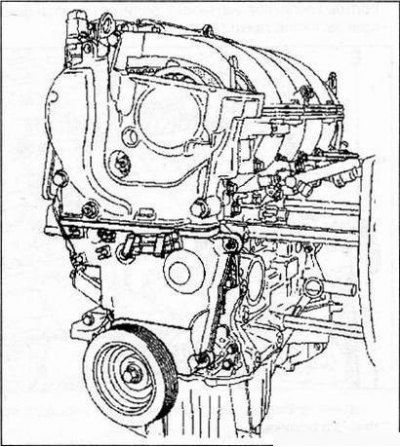
- the top cover of the distribution mechanism, tightening its mounting bolts with a torque of 41 Nm;
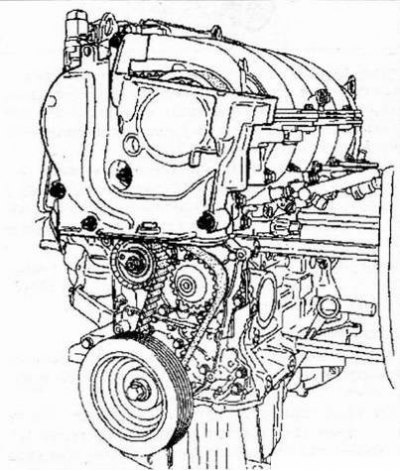
- middle cover of the distribution mechanism.
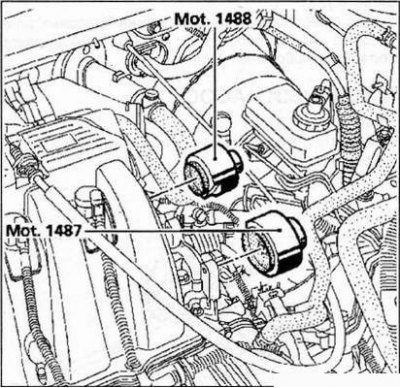
5. Install new plugs:
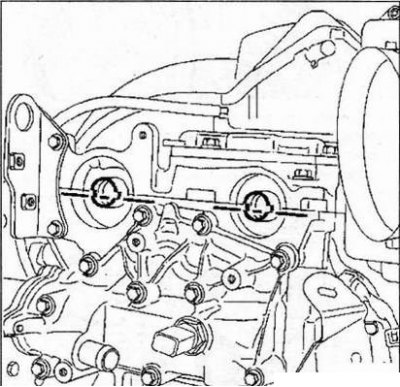
- intake camshaft (Mot. 1487);
- exhaust camshaft (Mot. 1488).
Final operations
1. Reinstall:
- water pipe with new seal;
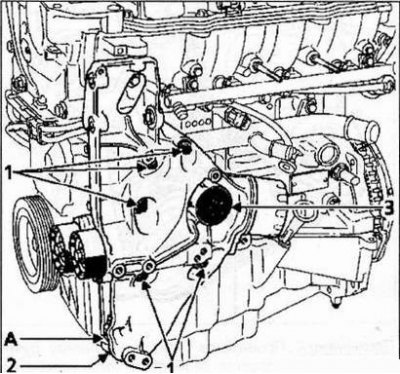
- universal mounting bracket (before tightening its mounting bolts, make sure that it contacts the oil pan at position (A) and then tighten its mounting bolts (see the "Universal Mounting Bracket Mounting Bolt Tightening Torques" table).
Table: Tightening torques for universal mounting bracket bolts
| Bolts | Tightening torques |
| 1 | 53 Nm |
| 2 | 21 Nm |
| 3 | 110 Nm |
2. Reinstall:
- air conditioning compressor, tightening the mounting bolts with a torque of 21 Nm;
- alternator, tightening the mounting bolts to 21 Nm;
- power steering pump, tightening the mounting bolts to 21 Nm;
- accessory drive belt.
3. Attachment drive belt (models with air conditioning).
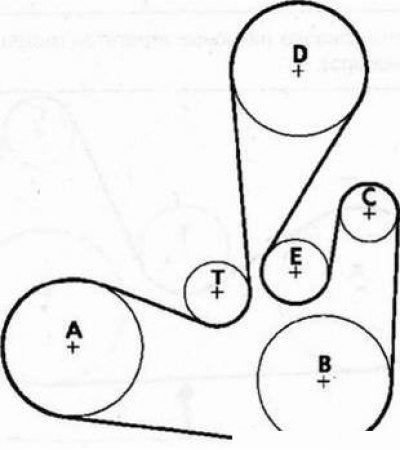
A - Crankshaft pulley, B - Air conditioning compressor pulley, C - Alternator pulley, D - Power steering pump pulley, E - Idler pulley, T - Tensioner pulley.
To put on the belt, turn the wrench to the left.
Lock the tensioner roller using a 6 mm Allen key (1).
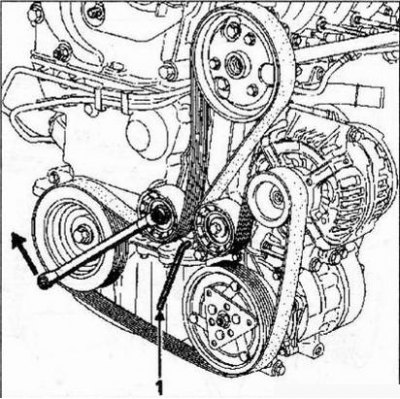
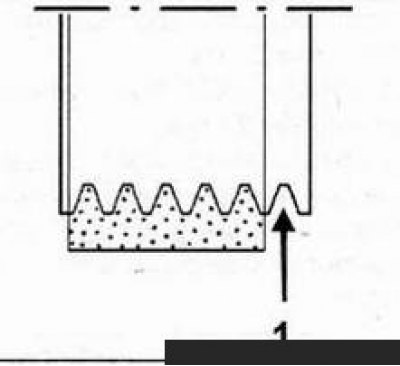
Note: Make sure that the inner groove (1) of the pulleys remains free when installing the belt.
4. Attachment drive belt (models without air conditioning).
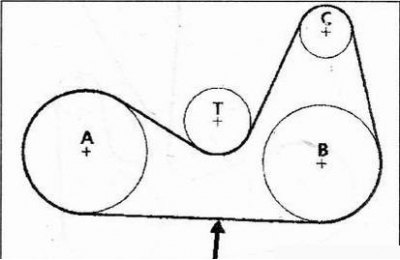
A - Crankshaft pulley, B - Power steering pump pulley, C - Alternator pulley, T - Tensioner roller, Belt tension check point.
The drive belt is tensioned using the bolt (1) (in this case, it is necessary to loosen the two bolts securing the tension rollers) followed by tightening the nut (2).
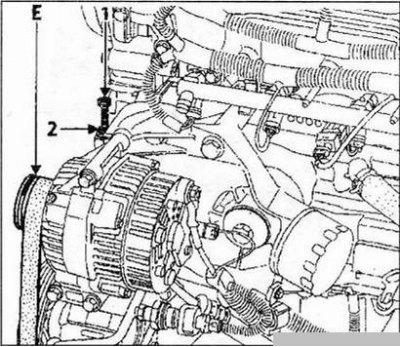
Tighten the automatic tensioner roller mounting bolts.
Note: The accessory drive belt has five wedges, and the alternator pulley and power steering pump pulley are 6-groove; therefore, when installing the timing belt, it is essential to leave the outer groove of the pulleys (E) free.
5. To correctly install the accessory belt on the pulleys, turn the engine crankshaft two revolutions.