



Caution! If the toothed drive belt breaks during operation, it can cause extensive engine damage. Replace the belt at the intervals specified in the Specifications in Chapter Maintenance, or earlier if you have any doubts about its condition.
Removal
F3R Engines
1. Disconnect the ground cable from the battery (refer to Chapter Engine electrical equipment).
Warning: If your car radio is coded, make sure you know the code before disconnecting the battery.
2. Set the handbrake, then jack up the front of the car and place it on axle stands. Remove the right front wheel.
3. Loosen the mounting screws and remove the lower engine shield, then remove the right wheel arch liners.
4. Remove the auxiliary drive belt as described in Chapter Maintenance.
5. Set cylinder #1 to TDC on compression stroke and insert the dowel pin to check the crankshaft position as described in Section Top Dead Center (TDC) Position for Piston #1.
6. Support the engine with a jack, placing a piece of wood between them. Raise the jack to support the engine's weight.
7. Remove the bolts and plastic cover from the right engine mount, then remove the mounting nut and bolts and remove the upper mount bracket. Unbolt the travel limiter/rubber engine mount assembly from the body.
8. Loosen the fasteners and remove the upper toothed drive belt cover.
9. Temporarily remove the crankshaft dowel pin and remove the crankshaft pulley bolt. To hold the crankshaft stationary, remove the flywheel/drive plate reinforcing bracket cover and lock the ring gear from rotating using the method shown (refer to the illustrations). On manual transmission models, with the engine in the vehicle, the crankshaft can be locked by engaging a high gear and depressing the brake pedal. Do not attempt to use the crankshaft dowel pin for this purpose (refer to Section Top Dead Center (TDC) Position for Piston #1). Remove the crankshaft pulley, then install the pulley bolt onto the end of the crankshaft. Insert the dowel pin into the hole.
10. Loosen the mounting bolts and remove the lower outer toothed drive belt cover.
11. Loosen the mounting bolts and remove the support stand from the front engine support bracket on the cylinder block. Loosen the bolts and remove the support bracket.
F7R Engines
1. Follow the steps described in Section Top Dead Center (TDC) Position for Piston #1, to set cylinder No.1 to TDC on compression stroke and insert the dowel pin to check the crankshaft position.
All engines
1. Loosen the nut and bolt, turn the timing belt tensioner clockwise to reduce the belt tension, and tighten the nut again.
2. Remove the belt from the camshaft timing gear, intermediate shaft and crankshaft timing gear.
3. Clean the gears and tensioners and wipe them dry. Do not use excessive amounts of solvent when cleaning the tensioner pulleys, otherwise the bearing grease may be contaminated. Also clean the ends of the cylinder head and block.
Note: Renault recommends changing the timing belt after each removal. If the belt tension is checked using a special tool, it will only be suitable for further use if the tension is within the tolerances specified in the Specifications. If the tension is in the lower range of tolerances, the belt must not be tensioned further and must be replaced.
Inspection
1. Carefully inspect the toothed drive belt along its entire length, especially at the base of the teeth. Replace the belt if it is contaminated with oil or grease. Replace any leaking seals. The belt should be replaced if the maximum mileage presented in Chapter Maintenance. Also inspect the gears and tensioner mechanism as described in the next Section.
Adjusting the drive belt tension - F7R engines
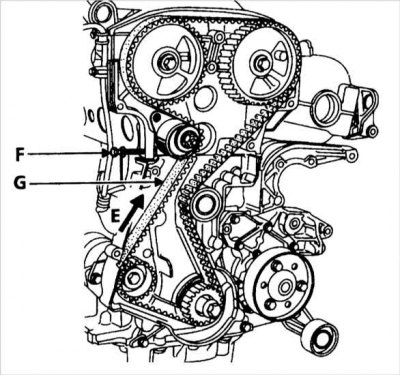
E — Designation of the direction of rotation on the belt
F — Bolt - thread diameter - 6 mm, length - 45 mm
G — Place for checking the tension of the toothed drive belt
Toothed Drive Belt and Timing Marks - F3R Engines
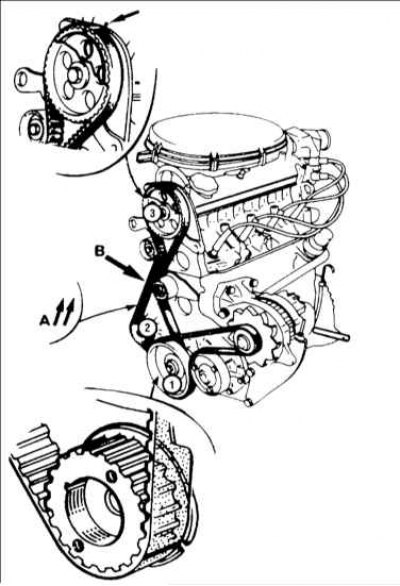
1 - Crankshaft pulley; 2 - Intermediate shaft gear; 3 - Camshaft gear; A - Arrows show the direction of belt rotation; B - Timing belt tension check point
Installation
1. To allow adjustment of the tensioner, screw a 6mm bolt into the tapped hole in the inner timing belt cover. The bolt will rest against the rear of the tensioner pulley and allow adjustment of the belt tension (refer to the illustration "Adjusting Drive Belt Tension - F7R Engines" above).
2. Make sure that the piston of cylinder No.1 is in the TDC position, with the installation pin in the working position.
3. Make sure that the timing mark on the camshaft timing gear is aligned with the corresponding mark on the inner timing belt cover or on the valve cover.
4. Align the timing strips on the belt with the timing marks on the sprockets. Remember that the direction of rotation arrows on the belt must be positioned between the intermediate shaft sprocket and the tensioner pulley. The mark on the crankshaft sprocket is in the form of a notch on the inside edge of the guide. There is no timing mark on the intermediate shaft sprocket. Install the timing belt first on the intermediate shaft sprocket, then on the intermediate shaft sprocket, and finally on the camshaft sprocket (refer to the illustration "Timing Belt and Timing Marks - F3R Engines" above).
5. Make sure all timing marks are aligned and remove any slack in the timing belt by pressing the bolt screwed into the inner timing belt cover.
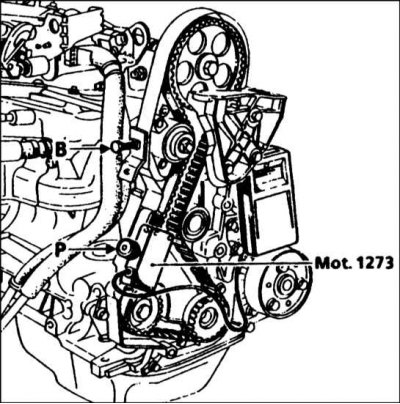
6. Now it is necessary to adjust the belt tension, this can only be done accurately using the Renault Mot. 1273 tool (SEEM C. Tronic 105.6) (refer to the accompanying illustration). If this equipment is not available, adjust the belt tension as far as possible using the method described below and then contact a Renault service centre as soon as possible to have the tension checked. Do not drive long distances or at high speed until the toothed belt tension has been checked.
7. If the adjustment is incorrect, the tensioner will need to be repositioned. The tensioner nut must be tightened to the torque specified in the Specifications.
8. Remove the crankshaft dowel pin and rotate the crankshaft clockwise at least three full turns - never rotate the crankshaft counterclockwise.
9. Insert the crankshaft dowel pin and ensure that the timing marks on the timing gear are in their original position. Recheck the belt tension as described in paragraph 6. If necessary, loosen the tensioner pulley nut and repeat the procedures in paragraph 7.
10. After tensioning the belt, remove the crankshaft locating pin and install the plug. Loosen the bolt used to locate the tensioner pulley and securely tighten the tensioner mounting bolt.
F3R Engines
1. Install the engine mount bracket and support stand to the cylinder block and tighten the mounting bolts to the torque specified in the Specifications.
2. Install the lower outer timing belt cover and tighten the mounting bolts securely.
3. Fit the crankshaft pulley and tighten the mounting bolt to the torque specified in the Specifications. Where necessary, fit the flywheel/drive plate reinforcement bracket/cover and tighten the mounting bolts to the torque specified in the Specifications.
4. Install the upper outer timing belt cover and tighten the mounting bolts securely.
5. Attach the travel limiter/rubber engine mount assembly to the body, but do not fully tighten the bolts at this stage. Install the upper mount bracket and tighten the mounting nut and bolts to the torque specified in Specifications. Ensure that the travel limiter/rubber cushion assembly is centered in the upper bracket, then tighten the mounting bolts to the torque specified in Specifications. Remove the support beam (where is available).
6. Install the auxiliary drive belt as described in Chapter Maintenance.
7. Replace the lower engine shield and wheel arch liners and install the wheel.
8. Lower the vehicle to the ground and tighten the wheel bolts to the torque specified in the Specifications. Connect the battery.
F7R Engines
1. Install all the removed components described in Section Top Dead Center (TDC) Position for Piston #1.