



Contents: Oil seal on the drive belt side 🠛 Oil seal housing on the drive belt…🠛 Flywheel/drive disc side oil seal 🠛
Oil seal on the drive belt side
1. Remove the crankshaft timing gear as described in Section Removal, inspection and installation of the toothed drive belt gear and tensioner mechanism.
2. Note the correct position of the old oil seal, then use a screwdriver to remove it from the housing. Do not damage the surface of the crankshaft, spacer gasket or oil seal housing.
Note: On some models it may be necessary to remove the lower inner timing belt cover. In this case, remove the intermediate shaft sprocket/pulley and the intermediate pulley (refer to Section Removal, inspection and installation of the toothed drive belt gear and tensioner mechanism), and then unscrew the lid.
3. Clean the seal housing and sand away any burrs or burrs that could cause seal damage. On late F3R 750 and F3R 751 engines that have a separate spacer gasket on the end of the crankshaft, remove the gasket - if it is worn where the old seal contacted, unfold it and reinstall it so that the new seal contacts the unworn area. If the spacer gasket is excessively worn, replace it.
4. Lubricate the sealing lips of the new seal and position it on the end of the shaft with the closed side facing outwards. Press the seal into the housing by hand, then use a socket or metal pipe to drive it in to the previously marked depth - work very carefully so as not to damage the seal lips. If the shaft surface has been badly worn, drive the new seal into the housing a little deeper so that the sealing lip contacts the unworn area of the shaft. On engines with a separate spacer gasket, lubricate it, then slide it onto the crankshaft and carefully insert it into the seal.
5. Where necessary, fit the lower inner drive belt cover and install the idler pulley and sprocket/roller as described in Section Removal, inspection and installation of the toothed drive belt gear and tensioner mechanism.
6. Install the crankshaft timing gear as described in Section Removal, inspection and installation of the toothed drive belt gear and tensioner mechanism and a new toothed drive belt as described in Section Removal, inspection and installation of the toothed drive belt.
Oil seal housing on the drive belt side
Original version on our portal: renaultbook.ru
1. Remove the toothed drive belt as described in Section Removal, inspection and installation of the toothed drive belt, from the crankshaft gear and intermediate shaft or intermediate pulley, refer to Section Removal, inspection and installation of the toothed drive belt gear and tensioner mechanism. Remove the woodruff key from the slot in the crankshaft, then unscrew the lower inner drive belt cover from the cylinder block.
2. Unscrew the bolts securing the oil seal housing to the pan.
3. Remove the mounting bolts and carefully separate the oil seal housing, marking the dowel pins near the two lower bolt holes. If the oil pan gasket is damaged, (f3R engines), the sump must be removed and the gasket replaced. On engines without a layshaft, note the presence of an oil pump drive chain guide and two dowel pins. Check that the guide is suitable for further use and replace it if in doubt. On late model F3R 750 and F3R 751 engines, also note the presence of a separate spacer gasket on the end of the crankshaft.
4. The seal should be replaced each time the housing is removed. Note the location of the old seal, then use a screwdriver to remove it and wipe the bearing surface. Grease the outer edge of the new seal and insert it into the housing with the closed side facing out. Place the housing on a wooden block, then use a socket or metal pipe to drive the seal into place.
5. When installing, clean the mating surfaces of the casing, pan and block from sealant. Make sure that the chain guide (where it is applied) is installed correctly and the locating pins are in place in the housing.
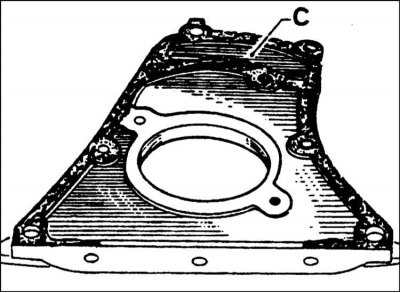
6. Apply a bead of sealant with a diameter of 0.6 - 1.0 mm (Renault recommends CAF 4/60 THIXO or Rhodorseal 5661) on the surface of the casing gasket, around the inner edges of the bolt holes, and also on the threads of the two bolts (closest to the gland). Make sure that the sealant seals the oil channel at the top end of the housing (refer to the accompanying illustration). Install the housing onto the cylinder block in the pan, tightening the bolts evenly.
7. Install a separate spacer gasket (where it is applied) as described in paragraph 4 (SEAL ON THE DRIVE BELT SIDE) above. On all engines, install the woodruff key into the slot in the crankshaft, then install the lower inner drive belt cover and tighten the mounting bolts securely.
8. Install the crankshaft and intermediate shaft gears or intermediate pulley. Then install the new timing belt, refer to Sections Removal, inspection and installation of the toothed drive belt gear and tensioner mechanism and Removal, inspection and installation of the toothed drive belt.
Flywheel/drive disc side oil seal
1. To replace the left crankshaft oil seal, you need to remove the transmission from the engine compartment so that you can remove the clutch (where it is applied) and flywheel/drive plate - refer to Chapter Transmission and Chapter Clutch. Remove the flywheel/drive plate as described in Section Engine/Transmission Mounts - Inspection and Replacement current Chapter.
2. Use a screwdriver to remove the old seal.
3. Inspect the seal contact surface on the crankshaft. If it is rough or has grooves in the area where the seal was in contact, the new seal will need to be installed at a slightly shallower depth.
4. Wipe the contact surface with the seal, then dip the new seal in oil and place it on the crankshaft with the closed side facing out.
5. Using a metal tube, drive the seal to the marked depth.
6. Install the flywheel/drive plate, refer to Section Engine/Transmission Mounts - Inspection and Replacement current Chapter. Install the clutch as described in Chapter Clutch, then install the transmission assembly and attach it to the engine as described in the appropriate Part of the Chapter.