



Note: When installing, use new head bolts, a new head gasket and a new timing belt.
Removal
F3R Engines
1. Disconnect the ground cable from the battery (refer to Chapter Engine electrical equipment).
2. Drain the cooling system as described in Chapter Maintenance.
3. Remove the toothed drive belt.
4. Remove the air cleaner housing and air intake duct as described in Chapter Power and exhaust systems.
5. Remove the intake manifold and exhaust manifold as described in Chapter Power and exhaust systems.
6. Remove the ignition coil high voltage and spark plug high voltage wires as described in Chapter Engine electrical equipment.
7. Disconnect the wiring from the coolant temperature sensor on the cylinder head, the pressure sensor in the pipe and the knock sensor. Release the wiring harness from the mounting brackets, noting its direction and location.
8. Remove the two bolts securing the inner upper timing belt cover to the cylinder block. The cover is free and can be removed together with the cylinder head.
9. Loosen the retaining clips and disconnect the coolant hoses from the thermostat housing at the left end of the cylinder head.
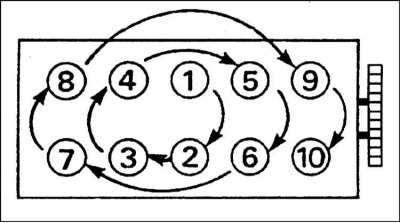
10. Working in the reverse order to that shown in the illustration, gradually loosen the cylinder head bolts one-half turn at a time until all the bolts can be loosened by hand and removed. Discard the bolts.
11. Lift the head off the cylinder block. If the dowel pins are loose, remove them and store them with the head for safekeeping.
F7R Engines
1. Disconnect the ground cable from the battery (refer to Chapter Engine electrical equipment).
2. Drain the fluid from the cooling system.
3. Remove the toothed drive belt.
4. Remove the air cleaner housing and air intake duct as described in Chapter Power and exhaust systems.
5. Remove the ignition coil as described in Chapter Engine electrical equipment.
6. Disconnect the electrical wiring connectors from the following components:
- a) Camshaft position sensor.
- b) Fuel injectors.
- c) Coolant temperature sensor.
- d) Pipeline pressure sensor.
- e) Exhaust gas recirculation valve.
- f) Throttle potentiometer.
7. Disconnect the vacuum hoses from the throttle body and the line pressure sensor, including the coolant system vacuum hose, then remove the bolts securing the coolant pipe to the left side of the engine.
8. Disconnect the cooling system hoses from the thermostat housing and from the throttle body.
9. Disconnect the gas pedal cable from the rod and bracket.
10. Remove the upper generator bracket.
11. Unscrew the support posts and the dipstick tube from under the intake manifold.
12. Release the starter wiring from the fasteners on the cylinder head.
13. Unscrew the exhaust system support stand and the fuel line heat-insulating shield from the engine.
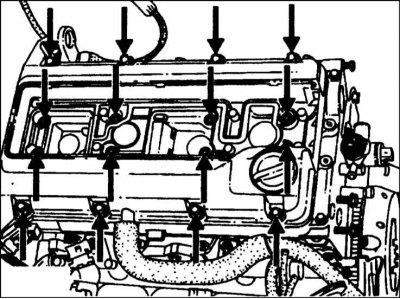
14. Disconnect the crankcase ventilation hose from the valve cover, then unscrew the bolts and remove the cover (refer to the accompanying illustration).
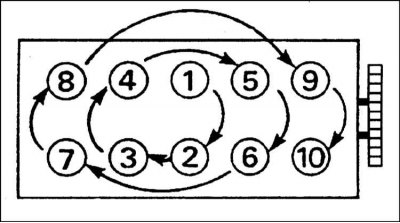
15. Working in the reverse order to that shown in the illustration, successively loosen the cylinder head bolts one-half turn at a time until all the bolts can be loosened by hand and removed. Discard the bolts.
16. With the help of an assistant, lift the head up off the cylinder block. If the dowel pins are loose, remove them and store them with the head for safekeeping.
Inspection
1. The mating surfaces of the cylinder head and block must be completely clean. Use a scraper to remove all traces of gasket and carbon deposits, and clean the tops of the pistons. Work especially carefully with the aluminum cylinder head, as the soft metal can be easily damaged. Also, be careful not to let dirt get into the oil and water passages - this is especially important for the lubrication circuit, as carbon deposits can block the oil supply to the camshaft and crankshaft bearings or rocker arms. Use masking tape and paper to isolate the water oil passages and the bolt holes in the cylinder block. Clean the piston crowns in the same way.
2. Check the block and head for nicks, deep scratches and other damage. If there are small scratches, they can be carefully removed with a file. More serious damage can be eliminated by resharpening, but this work should be entrusted to a specialist.
3. Using a ruler placed on its edge, check the cylinder head for warpage.
4. Clean all bolt holes in the block. Make sure there is no oil left in them, otherwise there is a risk that the block may crack under hydraulic pressure when tightening the bolts.
5. Inspect the bolt threads and the threads in the cylinder block for damage. If necessary, use a tap of the appropriate size to renew the threads in the block and use a die to clean the threads on the bolts. It is recommended to replace the bolts after each removal.
Installation
1. Make sure the mating surfaces of the cylinder block and head are spotlessly clean.
2. Make sure that the piston of cylinder No.1 is still at TDC and that the timing mark on the camshaft gear is aligned with the mark on the cover (refer to Section Removal, inspection and installation of the toothed drive belt).
3. Make sure the dowel pins are seated correctly in the block. Install the new cylinder head gasket, making sure it is oriented correctly.
4. Carefully lower the head onto the block, sliding it onto the pins. Make sure that the inner upper timing belt cover is correctly positioned on the cylinder block.
5. Lightly lubricate the new cylinder head bolts. Allow excess oil to drain, then insert the bolts with washers and tighten them finger tight. Tighten the bolts as described in the appropriate subsection.
F3R Engines
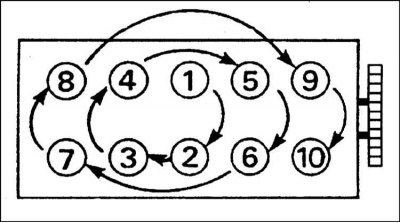
1. Tighten the cylinder head bolts in the sequence shown to the torque specified in Specifications by effort (refer to the accompanying illustration). The initial stages are a preliminary compression of the gasket, and the remaining stages are the main compression procedure. When tightening the bolts, make paint marks on the cylinder head to ensure the correct angle, or purchase a special tightening tool. If the bolts are tightened exactly as specified, there is no need to re-tighten them after the first engine start.
2. Connect the cooling system hoses to the thermostat housing and secure them securely with clamps.
3. Install the bolts securing the inner upper timing belt cover to the cylinder block and tighten them securely.
4. Make sure the wiring is properly routed and connected to the line pressure sensor, coolant temperature sensor, and knock sensor.
5. Install the ignition coils and wiring as described in Chapter Engine electrical equipment.
6. Install the intake manifold and exhaust manifold as described in Chapter Power and exhaust systems.
7. Install the air cleaner housing and air intake duct as described in Chapter Power and exhaust systems.
8. Install the new timing belt as described in Section Removal, inspection and installation of the toothed drive belt.
9. Connect the battery and fill the cooling system as described in Chapter Maintenance.
10. Finally, check the oil level (see Schedule of current maintenance).
F7R Engines
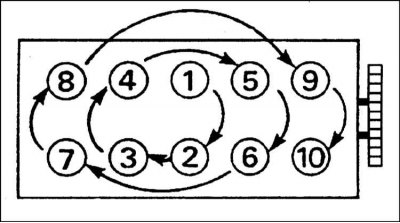
1. Tighten the cylinder head mounting bolts in the sequence shown in the illustration to the specified Specifications force. When tightening the bolts, make paint marks on the bolt heads and cylinder head to ensure the correct angle, or purchase a special tightening tool. After the engine has warmed up to normal operating temperature and then cooled completely, additional tightening will be required. To do this, proceed as follows:
2. Install all disturbed components in the reverse order of removal.
3. Make sure everything is connected and the cooling system is filled (refer to Chapter Maintenance), and then start the engine. Let the engine warm up (the fan should turn on), and then turn it off and let it cool completely.
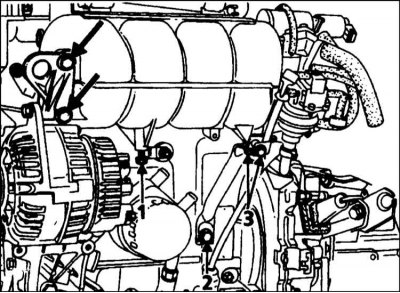
4. From underneath the intake manifold, loosen the support stand bolt and the manifold mounting bolt and remove the dipstick tube bolt. Also loosen the two bolts securing the brake booster vacuum tube and the upper alternator bracket (refer to the accompanying illustration).
5. Remove the ignition coil assembly and valve cover to gain access to the cylinder head mounting bolts.
6. Once the engine has cooled completely, perform the remaining tightening steps as outlined in Specifications, in one go in the sequence shown in the illustration in paragraph 1.
7. Install the valve cover and ignition coil, then tighten the bolts that were previously loosened.