



Inspection
1. Set the handbrake, then jack up the front of the car and support it on axle stands. Where fitted, remove the engine undershield.
2. Check the condition of the rubber pad to ensure there are no cracks, hardening or separation of the rubber from the metal base; replace the support if any damage or contamination is noted.
3. Make sure the support fasteners are securely tightened; use a torque wrench to check the tightening torques.
4. Using a large screwdriver or crowbar, check for signs of wear in the mount by gently pushing it to one side. Where possible, have an assistant move the engine/transmission back and forth or side to side while observing the mount's behaviour. If there is excessive play, first check that all fasteners are properly tightened before replacing any worn components as described below.
Front right support
Tightening torques (in Nm) for engine/transmission mounts - F3R engines
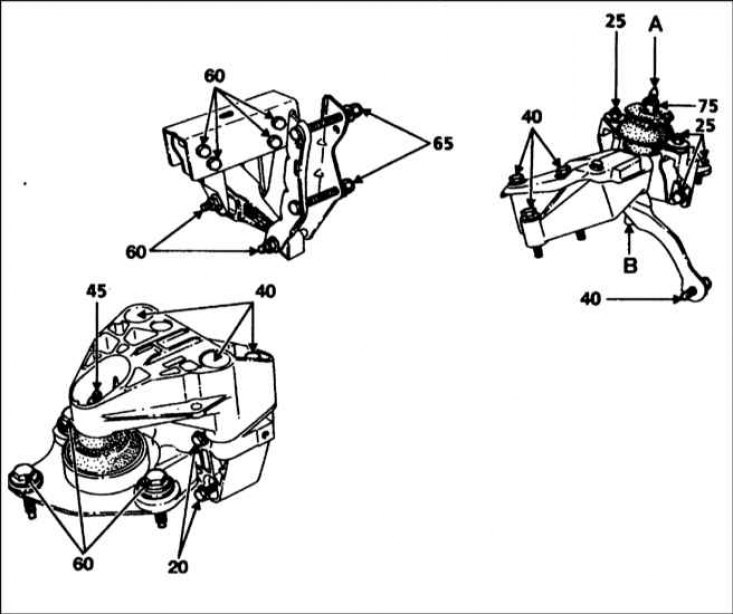
A - Tighten the stud to 60 Nm
B - Tighten the nut to 40 Nm
Tightening torques (in Nm) for engine/transmission mounts - F7R engines
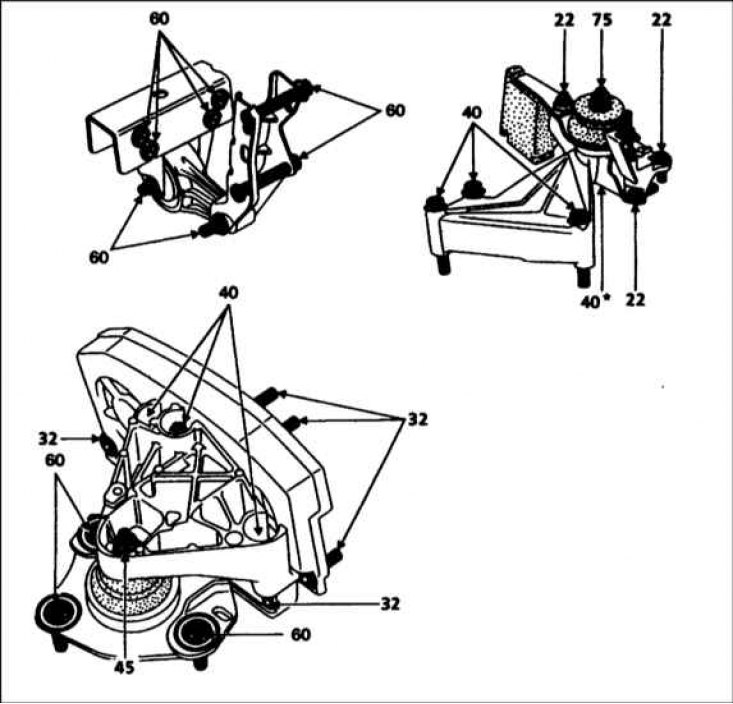
* Refers to the nut under the rubber cushion
1. Disconnect the ground cable from the battery (refer to Chapter Engine electrical equipment).
Warning: If the car radio in your car is coded, make sure you know the code before disconnecting the battery.
2. Support the engine with a jack, placing a piece of board between them (remove the bottom shield to make it easier to access the pan). Raise the jack to support the weight of the engine.
3. Remove the mounting cover, then remove the three bolts securing the right engine mount upper bracket to the main bracket on the engine block. Remove the nut securing the upper bracket to the ride limiter/rubber cushion assembly on the body and remove the upper bracket.
4. Remove the three mounting bolts and lift the travel limiter/rubber cushion assembly from the body. If necessary, remove the main bracket and support strut and lift them off the end of the cylinder block.
5. Carefully check all components for damage and signs of wear and replace them where necessary.
6. When assembling, install the main bracket and support post (where removed) on the cylinder block and tighten the mounting bolts to the specifications given in Specifications by effort (refer to the illustrations above).
7. Attach the ride limiter/rubber cushion assembly to the body, but do not tighten the mounting bolts completely.
8. Install the upper bracket and tighten the bolts securing it to the main bracket as shown in Specifications force. The travel limiter/rubber cushion assembly must now be centred before tightening the mounting bolts. Renault technicians use a special forked grip Mot. 1289-03, which is inserted through the slots in the brackets. If this tool is not available, it can be made from metal strips. Once the support is centred, tighten its fasteners to the torque specified in Specifications effort.
9. Remove the jack from under the engine and connect the ground cable to the battery.
Front left support
1. Place a jack under the transmission with a piece of wood between them. Raise the jack to support the weight of the transmission.
2. Unscrew the central nut and two bolts securing the rubber cushion and remove the support.
3. If necessary, loosen the rubber mount bolts and remove the support bracket from the top of the transmission case.
4. Carefully check all components for damage and signs of wear and replace them where necessary.
5. Install the stud into the support bracket and tighten it to the specified Specifications effort - refer to the illustrations above.
Information is located on the website (RENAULTBOOK.ru)
6. Install the bracket on the transmission, tightening the mounting bolts as shown in Specifications effort.
7. Install the rubber cushion on the bracket and tighten the mounting bolts and the central nut to the specified Specifications effort.
8. Remove the jack from under the transmission.
Rear support
1. If not already done, set the handbrake, then jack up the front of the vehicle and support it securely on axle stands.
2. Support the pan with a jack, placing a piece of wood between them. Raise the jack to support the weight of the engine.
3. Remove the nut and bolt from each end of the tie rod and remove the tie rod from underneath the vehicle. If necessary, remove the mounting nuts and bolts and remove the mount bracket and mount rod from the engine/transmission.
4. Carefully check all components for damage and signs of wear and replace them where necessary.
5. When assembling, install the support bracket on the rear of the transmission and tighten the mounting bolts to the specified Specifications force - refer to the illustrations above. Install the support rod.
6. Install the mounting tie and tighten both bolts to the specified Specifications effort.
7. Lower the vehicle to the ground.