
Note. The check is not included in the maintenance schedule. It should be done if noise is heard from the timing mechanism, or if it is suspected that the loss of power is due to incorrect valve clearances. Installation may require a new valve cover gasket.
Examination
1. Release the plastic cover of the wiring harness, which is located between the intake manifold and the cylinder head, from the fasteners.
2. Where applicable, disconnect the crankcase ventilation hose from the valve cover.
3. Turn away nuts of a valvate cover and get a cover (refer to accompanying illustration).
4. Remove the spark plugs as described in Section Replacing spark plugs and checking the ignition system.
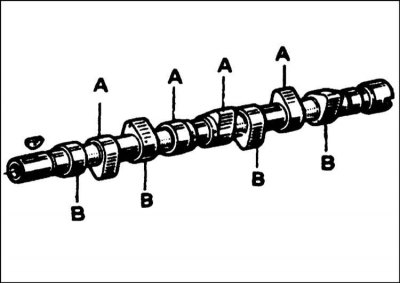
5. Draw the location of the valves on a piece of paper, numbering them from 1 to 8 from the side of the transmission (refer to accompanying illustration).
6. To facilitate access to the crankshaft pulley, cock the handbrake, then jack up the front of the car and place it on axle stands. Loosen the mounting screws and remove the lower motor shield.
7. Turn the crankshaft until the valves of cylinder No. 1 are in an intermediate position - i.e. the exhaust valve will close and the intake valve will open. The piston of cylinder #4 will be at the top of the compression stroke and both of its valves will be completely closed - now you can check the gaps for both valves of cylinder #4.
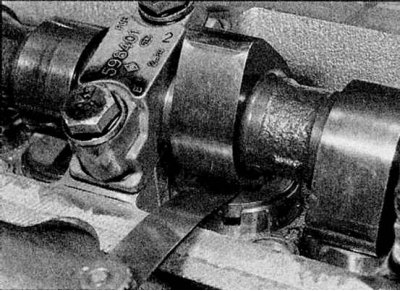
8. Insert the correct gauge (refer to Specifications) between the cam lobe and the washer on the top of the follower (refer to accompanying illustration). If the feeler gauge enters freely or does not enter at all, selecting feeler gauges of different thicknesses, determine the exact gap and write it down so that you can later calculate the required thickness of the new washer. Note that the intake and exhaust valve clearances are different.
9. After checking the valve clearances of cylinder #4, turn the crankshaft half a turn so that the valves of cylinder #3 are in an intermediate position, then check the valve clearances of cylinder #2. Also check the clearances of the remaining valves in the following sequence:
| Valves in an intermediate position on the cylinder | Check on cylinder |
| 1 | 4 |
| 3 | 2 |
| 4 | 2 |
| 2 | 3 |
You will need a micrometer to adjust.
Adjustment
1. If the valve clearance differs from the regulated value, it is necessary to replace the adjusting washer.
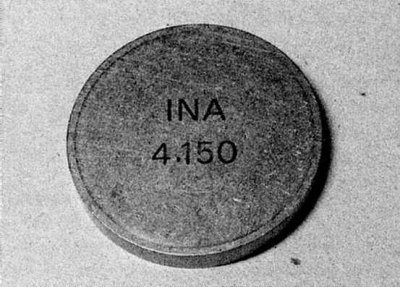
2. The thickness of the washer is indicated on its underside, but it is better to determine it with a micrometer, as it may be less than indicated as a result of wear (refer to accompanying illustration).
3. The required washer thickness is calculated as follows. If the gauge gap is less than the Specs, subtract the measured gap from the Specs, and then subtract that difference from the thickness of the existing washer.
For example:
Calculation example - gap too small
- Measured clearance (A) = 0.15 mm
- Required clearance (IN) = 0.20 mm
- Difference (B-A) = 0.05 mm
- Installed washer thickness = 3.70 mm
- Required washer thickness + 3.70 - 0.05 = 3.65 mm
4. If the measured clearance is greater than Specified, subtract the Specified clearance from the measured clearance and add the result to the thickness of the existing washer.
For example:
Calculation example - clearance too large
- Measuring gap (A) = 0.50 mm
- desired clearance (IN) = 0.40 mm
- Difference (A - B) = 0.10 mm
- Installed washer thickness = 3.45 mm
- Required washer thickness = 3.45+0.10=3.55 mm
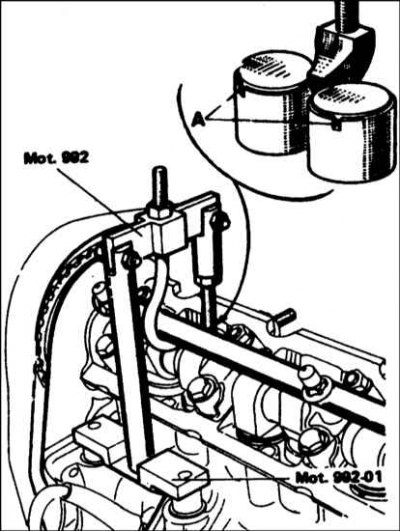
5. The washer can be removed from the tappet without removing the camshaft if a Renault special tool is available (refer to accompanying illustration).
6. To remove the washer, the pusher must be pressed against the pressure of the valve spring. Theoretically, this can be done by resting the lever against the camshaft between the working surfaces of the cams with a suitable screwdriver, pressing the pusher with the shim down, but this is not recommended by the manufacturer. If you do use this method, be very careful not to damage the camshaft, cylinder head or tappet.
7. When the pusher is pressed, the working protrusions of the cams should be directed upwards, and the pushers themselves should be turned so that their notches are perpendicular to the camshaft axis. Install the washer with the thickness marking facing down.
8. If a Renault tool is not available and a suitable replacement cannot be made, the camshaft will need to be removed to remove the washers as described in Section Description of the compression test.
9. Remove the head or wrench from the crankshaft pulley bolt. Install the engine undershield and lower the vehicle to the ground.
10. Install spark plugs as described in Section Replacing spark plugs and checking the ignition system, then install the valve cover with a new gasket (if it is needed).
11. Connect the crankcase ventilation hose to the cover and install any components that were removed or disconnected.