



Cars with a diesel engine with a capacity of 64 hp. (with BOSCH injection pump).
Correctly adjusted idle speed is essential for a diesel engine. An engine with incorrectly set idle speed will run rough at idle or when accelerating. Adjusting the idle speed should be done in the following sequence.
1. Perform a test drive to warm up the engine to operating temperature. After the test drive, let the engine idle until the radiator fan cycles on and off at least twice.
2. Disconnect all consumers of the on-board electrical network (light, air conditioning).
3. Check the idle speed. The nominal value should be 825±25 rpm.
Checking the idle speed and the volume of the injection pump
The engine must be warmed up to operating temperature.
4. Unlock screw 3, which regulates the fuel supply volume of the high-pressure fuel pump at idle speed, and unscrew it two turns (see illustration).
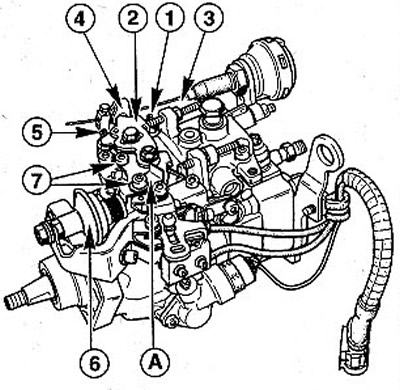
4.4 Unlock screw 3, which regulates the fuel supply volume of the high-pressure fuel pump at idle speed, and unscrew it two turns
5. Make sure that the adjusting lever 2 is properly seated against the screw 3 (see illustration 4.4).
View the original source on this resource (www.renaultbook.ru)
6. Loosen screw 1 and rotate it until the engine idle speed is equal to the nominal value of 825±25 rpm. Then tighten the lock nut of adjusting screw 1 (see illustration 4.4).
7. Insert a gauge or 4 mm thick spacer between screw 3 and adjusting lever 2 (see illustration 4.4).
8. Turn bolt 3 to increase engine speed to 1150±25 rpm (see illustration 4.4). After this, remove the gasket and tighten the lock nut of the adjusting screw 3 (see illustration 4.4).
9. Give "Full throttle" several times, and then check the idle speed again. If necessary, repeat the adjustment. If the engine idles at a lower speed than required, then loosen the adjusting bolt 3 by 1/4 turn (see illustration 4.4).
If the number of revolutions decreases too slowly after the "Full throttle" mode, then tighten the adjusting screw 3 by 1/4 turn (see illustration 4.4).
Attention! Do not use the "Full throttle" mode for more than five seconds. If you cannot set the required idle speed, contact the service department.
10. Tighten the locknuts of bolts 3 and 1 (see illustration 4.4).
Adjusting the extended idle speed
Increased idle speed is needed for stable, smooth operation of a cold engine. Increased speed is achieved thanks to a thermoelement installed in the coolant circulation circuit. When starting a cold engine, this thermoelement activates the corresponding lever on the high-pressure fuel pump via a cable.
To perform the adjustment, the engine must be warmed up to operating temperature. The idle speed must be set correctly.
11. Press lever 4 all the way to screw 5, which sets increased idle speed(see illustration 4.4). Use screw 5 to set the speed to 950±25 rpm. To adjust the speed, loosen the screw lock nut, and tighten it after setting.
12. Adjust the gap between the clamp (holder) cable and lever 4 to increase idle speed (see illustration 4.4). To do this, press lever 4 all the way to screw 5 and measure the gap. With the cable taut, the gap should be 6±1 mm, for cars with air conditioning - 2±1 mm when measured between the cable clamp and the lever. If the specified values are not maintained, loosen the screw on the clamp and move it to one side or the other.
Adjusting the idle speed retarder
13. Slightly loosen the screws 7 of lever A so that the lever can be moved (see illustration 4.4).
14. Insert a 6 gauge or 1 mm thick spacer between lever A and the retarder (see illustration 4.4).
15. Press lever A until it stops with the gasket inserted. At the same time, adjusting lever 2 must maintain contact with screw 3 (see illustration 4.4).
16. Tighten screws 7 (see illustration 4.4).
17. Remove the gasket. Adjusting lever 2 should still be in contact with screw 3 (see illustration 4.4).