



Cars with diesel engine capacity 64/90n.c.(F8Q)
Faulty injectors can cause loud knocking noises in the engine, which usually suggests a bearing defect. If such faults occur, start the engine at idle speed and loosen the union nuts of the high-pressure fuel lines one by one. If the knocking noise disappears after loosening each nut, this is evidence of a faulty injector.
A faulty injector is also found by loosening the union nuts of the high-pressure fuel lines one by one, leaving the engine running at increased idle speed. If the rotation speed remains unchanged after loosening the next nut, this indicates a faulty injector. The injector can be checked using a pressure gauge (in the workshop). The nominal value of the injector injection pressure is 125-138 bar.
The first signs of injector malfunctions are:
- a) misfires;
- b) knocking in one or more cylinders;
- c) engine overheating;
- d) loss of engine power;
- d) too much black smoke from the exhaust pipe;
- e) high fuel consumption.
Removal
1. Clean the high pressure fuel lines from the outside with cold cleaner or diesel fuel.
2. Remove the high-pressure fuel lines. To do this, use a wrench, for example, IIAZET 4550, to loosen the union nuts securing the lines to the high-pressure fuel pump and to the valve injectors. Attention! Do not change the shape of the bends in the fuel lines.
3. Unscrew the injectors using an extended 27 mm socket head, e.g. HAZET 4555-1 (see illustration).
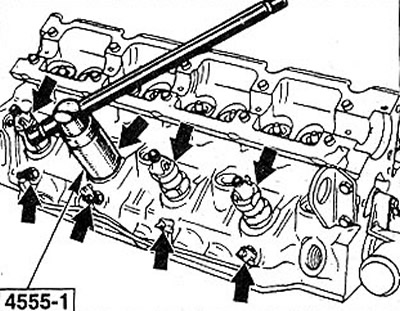
7.3 Unscrew the injectors using an extended 27 mm socket head, e.g. HAZET 4555-1
4. Turbocharged cars. The 4th cylinder injector has a needle stroke sensor with a wire connected to it. Therefore, before unscrewing this injector, disconnect the sensor wire or use a socket head with a slot for the wire.
Each nozzle has a heat-protective gasket.
5. Remove the heat shield from the hole in the cylinder head.
Attention! When installing valve injectors, be sure to replace the heat-protective gaskets with new ones.
6. Clamp the nozzle in a vice with soft metal pads and disassemble it (see illustration).
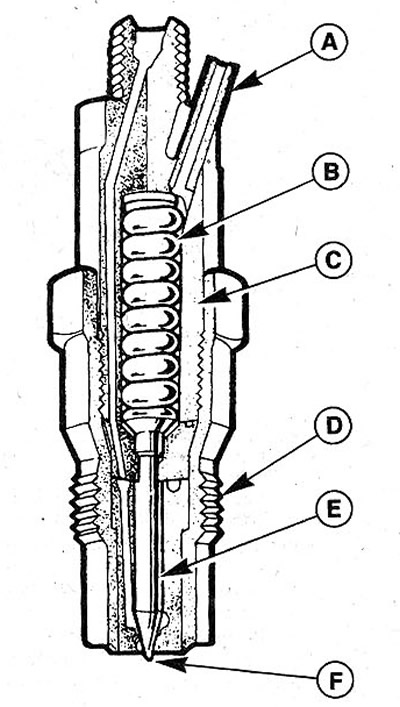
7.6 Injector components: A - fuel return channel; B - spring; C - nozzle body; D - base; E - nozzle sprayer; F - spray tip
7. Check the sprayer and the condition of the sprayer seat. Use a wooden spatula to clean the sprayer from carbon deposits. The sprayer should fit into the nozzle hole under its own weight and move freely in it.
Warning! Do not clean the injector nozzle or sprayer with wire, file or emery cloth. Do not mix up the injector parts. The injector injection pressure can be adjusted in the workshop by selecting and installing washers of different thicknesses.
8. Assemble the injector. The tightening torque of the upper and lower parts of the injector is 70 Nm.
Installation
In the cylinder head, in the hole for the injector, there is a flameproof sleeve 1 with a sealing ring 3, as well as a heat-protective gasket 2. Heat-protective gaskets and sealing rings between the cylinder head and the fuel injector should be replaced with new ones before installing the injectors (see illustration 7.9).
9. Place the new heat-shielding gasket 2 into the nozzle hole with the recess facing up (see illustration).
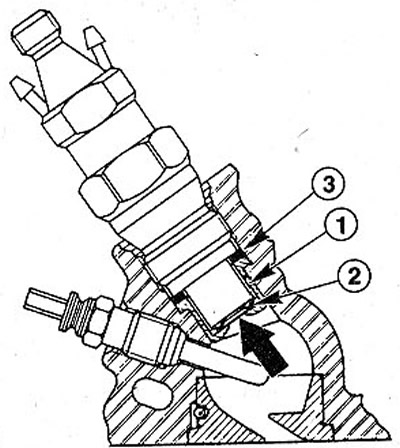
7.9 Place the new heat-shielding gasket 2 into the nozzle hole with the recess facing upwards
10. Tighten the injectors to 70 Nm.
11. Connect the high-pressure fuel lines to the injectors and tighten the union nuts to 25 Nm.
Original of this article on the website www.RenaultBook.ru
Cars with F9Q engine with 98 hp.
12. Disconnect the high-pressure fuel lines and the injector mounting flange from the injectors. The tightening torque of the injector holder is 27 Nm.
After removing the injectors, the sealing gaskets between the injector and the cylinder head must be replaced with new ones.
The fuel injector of this type of engine is double-spring. This means that two pressure levels are created when fuel is injected (see illustration).
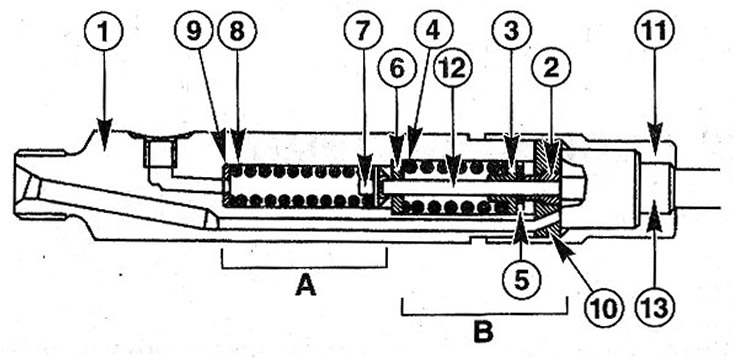
7.12 Fuel injector for F9Q engine: 1- nozzle holder; 2 - thrust sleeve; 3 - spring support cup; 4 - second pressure level spring; 5 - adjusting washer of the second pressure level; 6 - guide gasket; 7 - thrust washer; 8 - first pressure level spring; 9 - first pressure level adjusting washer; 10 - intermediate gasket; 11 - lower body (part) of the injector; 12 - pusher; 13 - sprayer; A - 1st pressure level; B - 2nd pressure level
Adjustment of the injectors is not possible. You can only check the pressure of the 1st level, which should be 200±2 bar. If this pressure is not achieved, the injector must be replaced.
After replacing one of the injectors on the cylinder head, the return hose bar should also be replaced.