



Contents: F3R Engines 🠛 F7R Engines 🠛
Caution: The referenced dowel pins are intended ONLY for checking crankshaft position during various engine rebuild procedures. DO NOT use them as locking tools to hold the crankshaft still while loosening or tightening pulley or flywheel/drive plate bolts.
TDC is the highest point in the cylinder that the piston reaches during a revolution of the crankshaft. Each piston is at TDC at the end of the compression stroke and also at the end of the exhaust stroke. However, for ignition timing purposes, TDC at the end of the compression stroke is used. On all engines covered in this manual, cylinder #1 is at the transmission end of the engine.
1. Disconnect the battery ground cable. Set the handbrake, then jack up the front right side of the vehicle and support it securely on axle stands. Remove the front right wheel.
Attention! If the radio in your car is coded before
when disconnecting the battery, make sure you know the code.
2. Remove the right wheel arch liners to gain access to the crankshaft pulley bolt, then proceed as described in the following subsections depending on the engine.
F3R Engines
1. Remove the air filter housing as described in Chapter Power supply and exhaust systems, to gain access to the flywheel/drive plate inspection hole in the clutch housing.
2. Now rotate the crankshaft until the timing mark on the camshaft gear is at the 12 o'clock position and the mark on the flywheel/drive plate is aligned with the TDC (0°) mark on the transmission clutch housing. To view the timing mark on the camshaft pulley, on most models you will need to loosen the fasteners, release the clamps (where are they applied) and remove the upper outer timing belt cover. Note that on some models it may be possible to align the mark on the pulley with the pointer in the timing belt cover hole.
3. The crankshaft can be turned with a wrench on the pulley bolt. Note that the crankshaft should always rotate clockwise when viewed from the right side of the car.
4. Rotate the crankshaft while observing the mark on the camshaft gear. When the timing mark on the pulley is positioned correctly, the mark on the flywheel/drive plate should be aligned with the TDC (0°) mark on the transmission. Piston #1 is now set at TDC on compression.
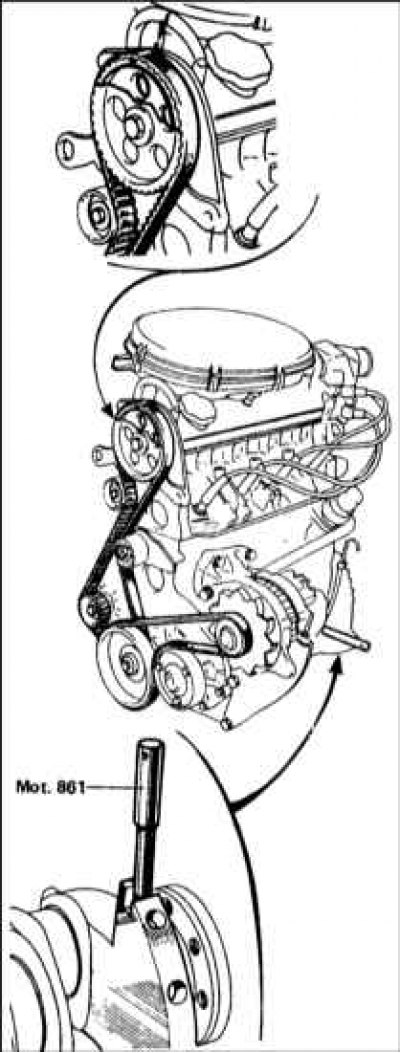
5. The exact position of the crankshaft can be checked by inserting the installation pin - Renault Mot. 861 tool (early version) or Mot. 1054 (the latest version). To do this, unscrew the plug from the front left end of the cylinder block, near the base of the oil dipstick tube, and insert the dowel pin so that it fits into the groove in the crankshaft. You may have to turn the crankshaft forward or backward slightly (refer to the accompanying illustration).
Note: Do not attempt to rotate the motor with the pin installed.
If the engine needs to be left in this state for a long period of time, it is recommended to leave a warning light in the engine compartment.
F7R Engines
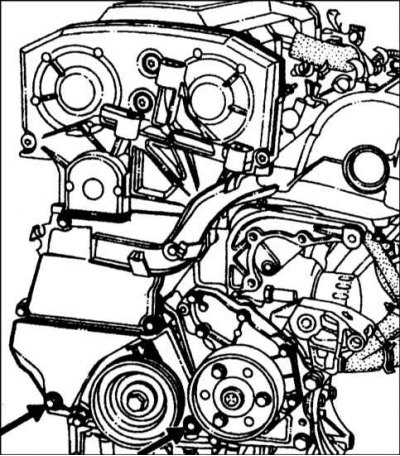
Lower Outer Timing Belt Cover Retaining Bolts - F7R Engines
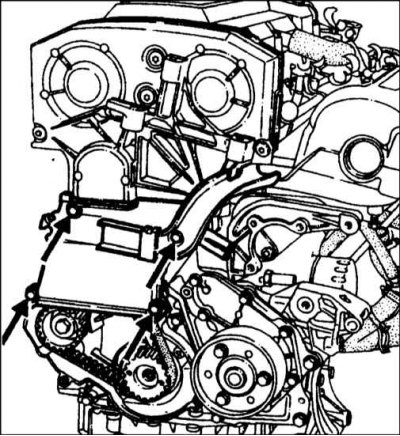
Intermediate Outer Timing Belt Cover Fastening Bolts - F7R Engines
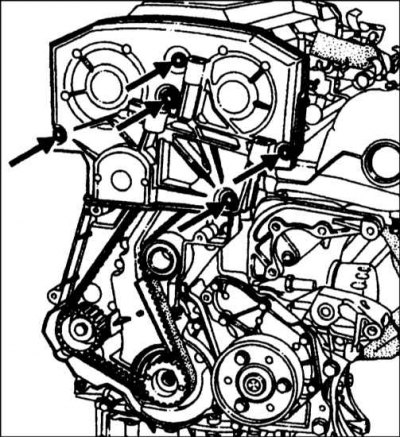
Upper Outer Timing Belt Cover Retaining Bolts - F7R Engines
1. Remove the auxiliary drive belt as described in Chapter Maintenance.
2. Loosen the bolts and remove the plastic cover from the right engine mount, then disconnect the engine ground cable.
3. Remove the reinforcement rod (where is available) between the front suspension domes.
4. Release the power steering fluid reservoir and move it to the side.
5. The upper right engine mount bracket must be removed to allow the upper outer timing belt cover to be removed; therefore, the engine must be supported with a jack or winch.
6. Check that the engine/gearbox assembly is securely supported, then remove the nut securing the upper bracket to the travel limiter/rubber pad assembly - refer to Section Engine/Transmission Mounts - Inspection and Replacement.
7. Disconnect the fuel supply and return hoses from the fuel line. Then plug the ends of the hoses.
8. Release the fuel hoses from the mounting on the intermediate outer drive belt cover.
9. Ask your assistant to engage 4th gear and press the brake pedal.
10. Loosen the bolts and remove the lower, intermediate and upper outer toothed drive belt covers (refer to the illustrations above).
11. Temporarily install the crankshaft pulley bolt so that the crankshaft can be turned.
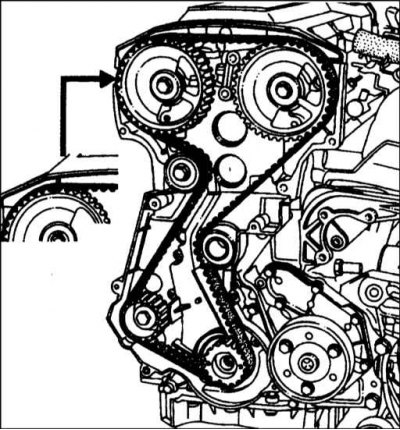
12. Turn the crankshaft until the timing mark on the camshaft gear is at the 12 o'clock position (align with the mark on the inner timing belt cover) (refer to the accompanying illustration).
13. Turn the crankshaft, watching the mark on the camshaft gear. When the timing marks on the pulley are each in place, piston No.1 will be set at TDC on the compression stroke.
14. The crankshaft position can be checked with absolute certainty by inserting the dowel pin - refer to paragraph 5 above and the illustrations therein. It may be necessary to remove the air cleaner assembly and various tubes and hoses to gain access to the plug.
15. Install all disturbed components in the reverse order of removal. Tighten all nuts and bolts to the specified Specifications effort where given.