



2. Jack up the rear of the vehicle and place it on axle stands.
3. Remove the brake drums.
4. Disconnect the drive cable from the brake mechanism.
5. Unhook the upper tension spring using pliers.
6. Remove both anchor pins by turning the spring plate with pliers until the pin head comes out through the slot.
7. Press the lever indicated by the arrow to the inside (see illustration) and simultaneously press down the small toothed segment (left arrow). Remove the brake pads.
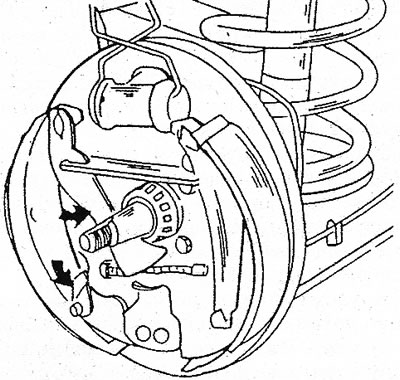
10.7 Removing the brake pads. Press the lever against the end of the axle. The lower arrow indicates the toothed segment
8. Remove the push rod at the top once it is free.
9. Set the toothed segment to its original position (when the lever is moved inward, the segment will pop up) and rotate the brake shoes with the lever and toothed segment by 90° so that the lower tension springs can be unhooked with a screwdriver (see illustration).
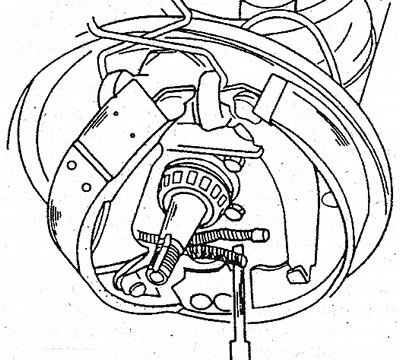
10.9 Removing the brake pads
Original article is on the portal RENAULTBOOK
10. A rubber band must be wound around the piston to prevent the piston from slipping out of the brake cylinder. Wire clamps can also be used for this purpose.
11. Clean all parts, including the shield, thoroughly. If gasoline is used for cleaning, it should not get on the rubber covers of the wheel cylinder piston. If the coating is worn to a thickness of 0.5 mm below the rivet heads (or the thickness of the linings together with the material of the brake pads themselves is 2.5 mm), install new brake pads.
12. The pads can be changed separately, but it is still better not to do this.
13. If the wheel cylinder piston shows signs of leakage, it must be replaced as described in chapter 12.