



2. Remove the dust ring.
3. Turn the piston until it can be turned freely (see illustration 13.7).
4. Place a wooden block between the piston and the caliper port and blow out the piston with compressed air (see illustration 7.2 from this section). Do not disassemble the piston.
5. Remove the sealing ring from the inside of the channel using a blunt object. A flat measuring probe can be used for this purpose.
6. Treat all parts with alcohol, check the cylinder and piston for wear, deformation or surface corrosion. If such damage is present, the components must be replaced.
7. Install a new sealing ring into the cylinder bore groove, lubricate the piston and ring with clean brake fluid.
8. Push the piston all the way in and tighten it with a screwdriver as shown illustrations 13.7, while mark (1) (see illustration) is positioned exactly over the bleed nipple bolt (2). This ensures the prescribed caliper bleeding and correct installation of the brake pads.
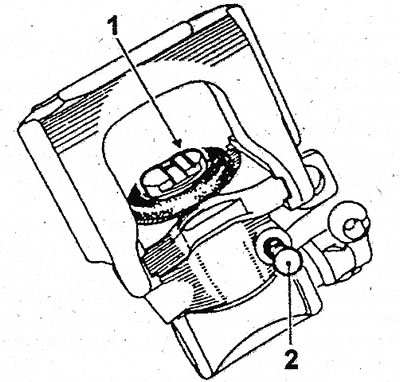
15.8 The mark (1) on the end surface of the cylinder must be parallel to the bleed nipple plug (2)
9. Install the dust ring.