



2. To access the brake booster, remove the master cylinder. Also, depending on the vehicle design, remove all other components. Use a spring clip and a bolt with a hole for a cotter pin to secure the push rod to the brake pedal. Disconnect the vacuum hose from the booster.
3. Replace the filter on the end of the push rod. To do this, stick a pointed tool into the filter and pry it out. Cut out a new filter and install it on the push rod.
4. If a new brake booster is to be installed, the push rod must be positioned between the fork head hole and the support surface of the new brake booster:
5. Disconnect the push rod from the brake pedal and from the control lever and set the value "A" to 112.5±0.5 mm. Tighten the lock nut again. Length "L" (see illustration 19.5a) should be 105.0 mm. On the other side of the brake booster, measure the protruding portion of the master cylinder actuator pushrod ("X" in Illustration 19.5b). The value should be 22.3 mm, and cannot be adjusted.
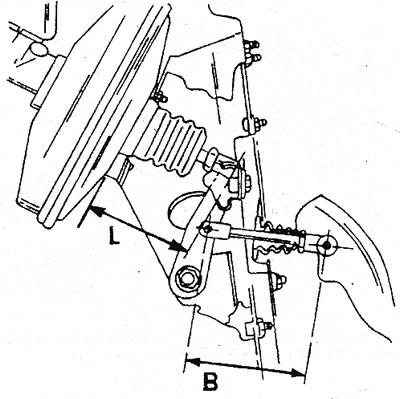
19.5a Adjusting the brake booster (see text)
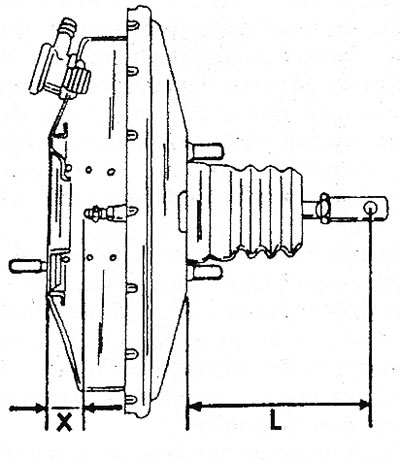
19.5b Installing the brake booster. The "X" dimension cannot be adjusted. The "L" dimension is set when adjusting the fork head
Material taken from an online portal renaultbook
6. For second generation vehicles, set the "b" value to 161.0 mm for 4-cylinder engines, or 149.0 mm for a V6 engine (see illustration 19.5b). To do this, loosen the lock nut and move the fork head. Tighten the lock nut again. The "X" dimension is also not adjustable and should be 22.3 mm on all models.