



Contents: Removal the crankshaft 🠛 Installing the crankshaft 🠛 Checking the crankshaft and…🠛 Upper main bearing shells 🠛 Lower main bearing shells 🠛 Combinations 🠛
Removal the crankshaft
1. Remove the pistons with connecting rods from the engine (see section above).
2. Loosen the mounting bolts (1) and remove the crankshaft thrust plate (2).
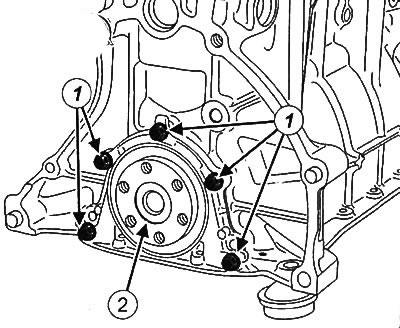
3. Make sure that the marks applied to the crankshaft main bearing caps at the factory are legible (bearing No.1 is located on the flywheel side).
Caution: Do not mark the crankshaft main bearing caps with punches or etchings as this may cause cracks. Use a marker only.
4. If necessary, mark the crankshaft main bearing caps with a marker. Also mark the direction of installation of the caps.
Note: Be sure to mark the position of each main bearing shell with a marker in accordance with the main bearing numbers.
5. Loosen the crankshaft main bearing cap mounting bolts and remove the caps from the cylinder block.
6. Remove the crankshaft from the cylinder block.
7. Remove the main bearing shells and support half rings.
Installing the crankshaft
Attention:
- Be sure to replace the main bearing cap bolts with new ones after each removal.
- To ensure the required tightness, the sealing surfaces must be clean, dry and free of grease (avoid any fingerprints).
Note: Do not strike or distort the contact surfaces of the main bearing caps to prevent damage.
1. Clean the crankshaft, main bearing caps, main bearing shell seats in the cylinder block and the contact surfaces of the cylinder block with the main bearing caps using a cleaning agent.
Caution: Use glasses with protective side shields to perform the following operation.
2. Dry all parts with compressed air.
Note: When replacing the crankshaft or crankshaft main bearing shells, be sure to determine the thickness grade of each shell to ensure the proper crankshaft main bearing clearance (see below). Incorrect crankshaft main bearing clearance may cause engine damage.
3. Select main bearing shells of the corresponding size groups (see below).
4. Install the main bearing shells with grooves into the cylinder block sockets:
- Install the main bearing shell installation tool (Mot. 1493-02) on the cylinder block.
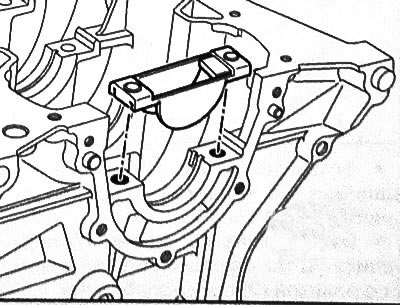
- Insert the main bearing shell with the groove into the fixture (Mot. 1493-02).
- Press the main bearing shell (6) so that it comes into contact with the bar (7) of the device.
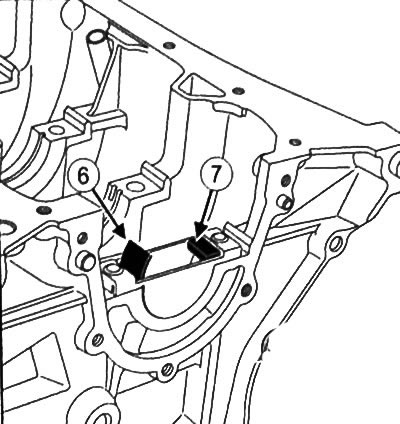
Note: Thrust half rings are built into the main bearing shell No.3.
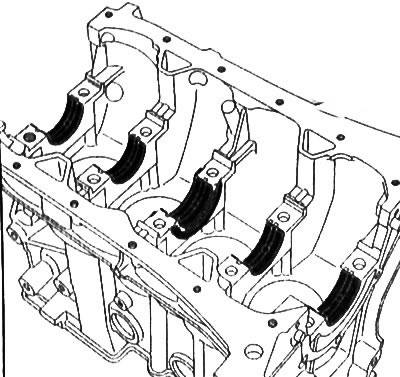
5. Insert the main bearing shells without grooves into the main bearing caps:
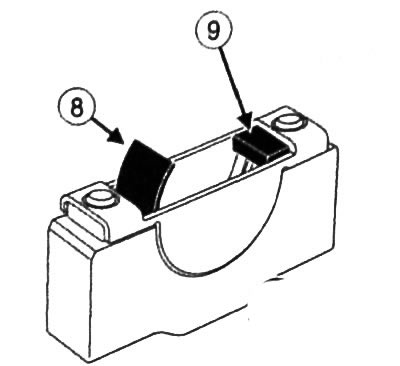
- Install the main bearing shell installation tool (Mot. 1493-02) on the main bearing cap.
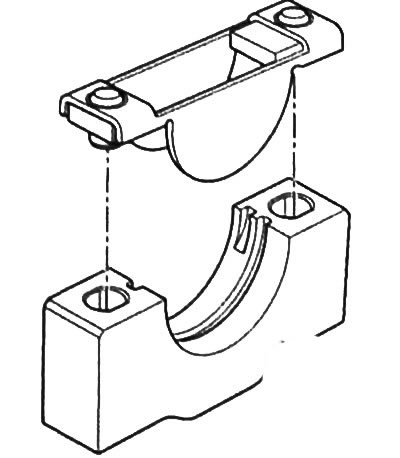
- Insert the main bearing shell with the groove into the fixture (Mot. 1493-02).
- Press the main bearing shell (8) so that it comes into contact with the bar (9) of the device.
6. Apply oil to the crankshaft main bearing shells (only on surfaces in contact with the crankshaft).
7. Install the crankshaft into the cylinder block.
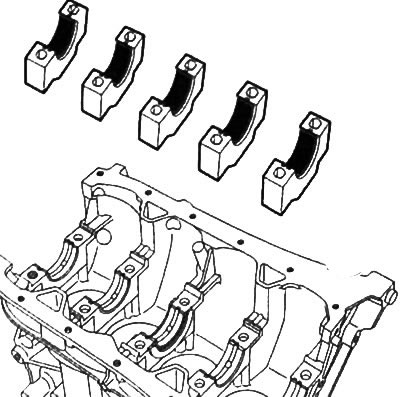
8. Install the main bearing caps, placing cap No.1 on the flywheel side.
Note: The arrows on the main bearing caps must point towards the flywheel.
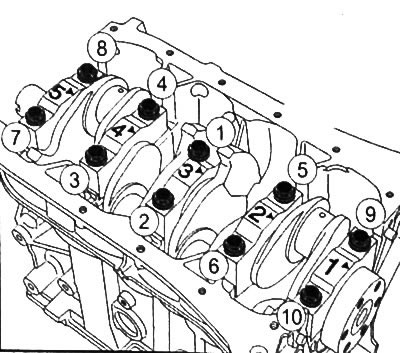
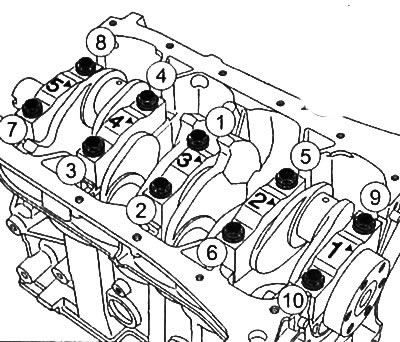
9. Tighten the main bearing cap bolts in the sequence shown in the figure to a torque of 20 Nm, and then tighten each bolt another 76° ±6°.
10. Make sure that the crankshaft rotates easily and without jamming.
11. Install pistons with connecting rods (see the relevant section in this chapter).
12. Install the crankshaft thrust plate:
- Apply a 1.3 mm thick bead of MASTIXO sealant (3) to the contact surfaces of the thrust panel as shown in the figure.
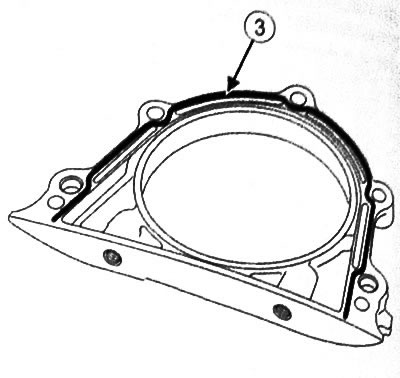
Attention:
- Excess sealant applied may be squeezed out when tightening threaded connections. Sealant getting into the coolant may cause damage to some components (engine, radiator, etc.).
- Install the crankshaft thrust plate onto the cylinder block and tighten the mounting bolts in the sequence shown in the figure to a torque of 9 Nm.
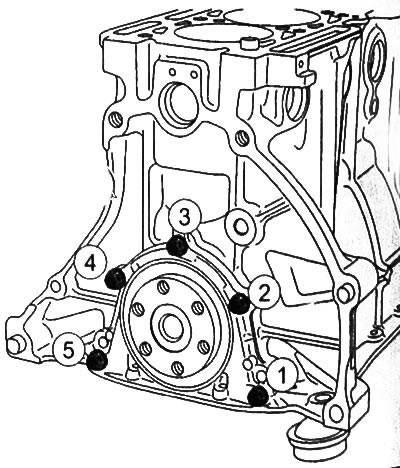
Note: Further assembly is described in the section "Installing pistons with connecting rods".
Checking the crankshaft and selecting main bearing shells
1. Remove the crankshaft from the engine.
2. Clean the crankshaft with a cleaning agent and dry with compressed air.
3. Make sure the crankshaft is free of scratches, impact marks or abnormal wear. If any defects are found, replace the crankshaft with a new one.
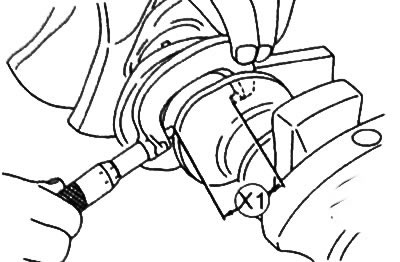
4. Use a micrometer to measure the diameter of the crankshaft main journals (X1). This value should be 44±0.01 mm.
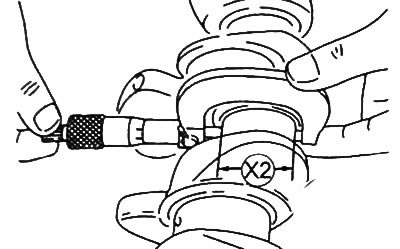
5. Use a micrometer to measure the diameter of the crankshaft connecting rod journals (X2). This value should be 39.985-40 mm.
Note:
- The main bearing shells do not have any mounting protrusions or grooves.
- Bearing shells are marked with letters according to color (B = blue, J = yellow, M = brown, R = red, V = green).
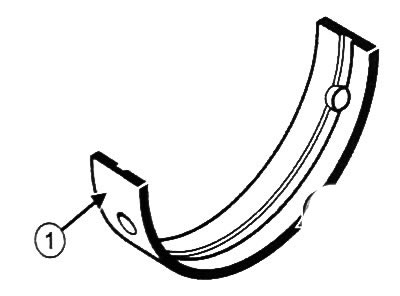
- To install the main bearing shells (1), use a special tool (Mot. 1493-02).
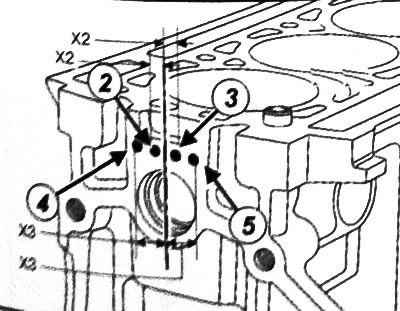
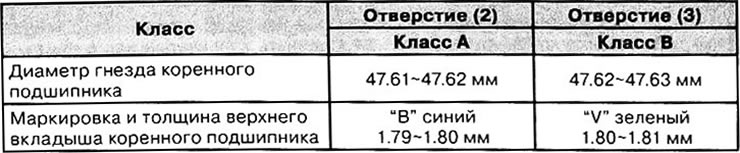
Note: Holes (2) and (3) indicate classes A and B of the upper main bearing shells respectively and are located at a distance of (X2) - 5 mm from the vertical axis of the crankshaft. In addition to single holes (A or B) corresponding to the class of the upper main bearing shells, there may be holes (4) or (5) used for production purposes and located at a distance of (X3) - 12 mm from the vertical axis of the crankshaft.
Upper main bearing shells
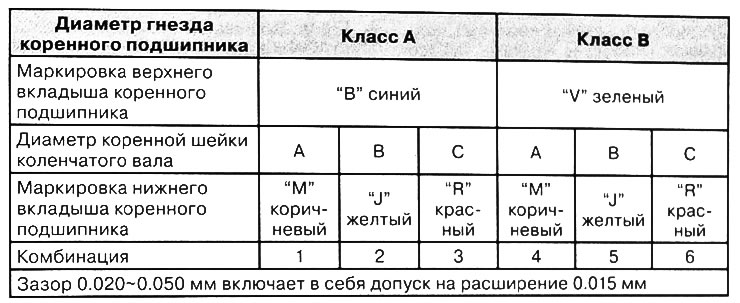
Lower main bearing shells

Combinations
6. Install the crankshaft main bearing shells using a special tool (Mot. 1493-02).
7. Remove oil from the crankshaft main journals and from the main bearing shells in the cylinder block.
8. Install the crankshaft without lubrication.
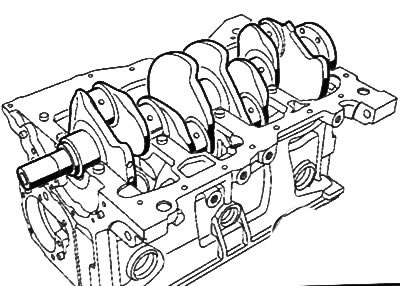
Note: Do not rotate the crankshaft during inspection.
9. Place a piece of round gauge parallel to the axis of the crankshaft main journal.
10. Install the main bearing caps without lubrication, placing cap No.1 on the flywheel side.
Note: The arrows on the main bearing caps must point towards the flywheel.
11. Tighten the main bearing cap bolts in the sequence shown in the figure to a torque of 20 Nm, and then tighten each bolt another 76° ±6°.
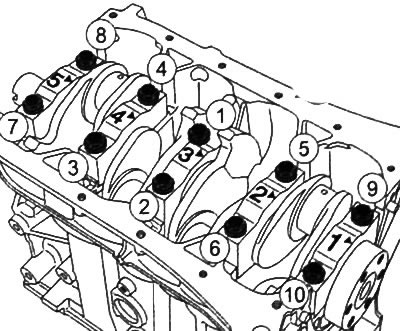
12. Remove the crankshaft main bearing caps.
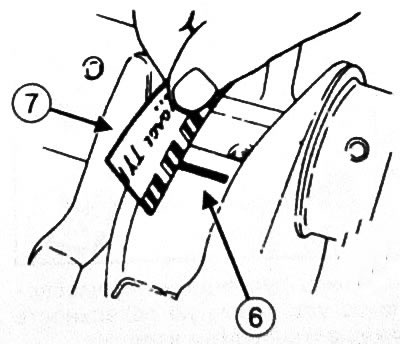
13. Measure the width of the most flattened part of the round feeler gauge (6) using the scale on the round feeler gauge packaging (7). The gap value should be 0.020-0.045 mm.
14. Remove the remains of the round feeler gauge from the crankshaft main journals and main bearing caps.
15. Apply oil to the crankshaft main bearing shells (only on surfaces in contact with the crankshaft).
16. Install the thrust half rings and crankshaft.
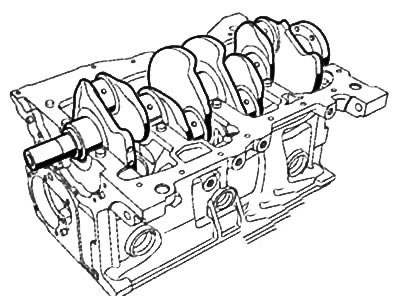
17. Install the main bearing caps, placing cap No.1 on the flywheel side.
Note: The arrows on the main bearing caps must point towards the flywheel.
18. Tighten the main bearing cap bolts in the sequence shown in the figure to a torque of 20 N·m, and then tighten each bolt another 76° ±6°.
19. Make sure that the crankshaft rotates easily and without jamming.
20. Install the dial indicator with the support as shown in the figure.
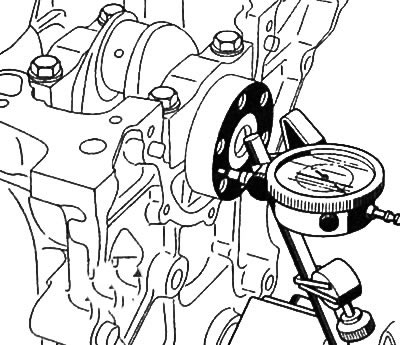
21. Place the dial indicator feeler gauge on the flywheel mounting surface on the crankshaft.
22. Press the crankshaft against the thrust half ring by pushing it towards the dial indicator.
23. Reset the hour indicator.
24. Move the crankshaft to the opposite side (from a clock indicator).
25. Read the crankshaft axial play value from the dial indicator. The crankshaft axial play should not exceed 0.275 mm