



Attention:
Before performing any work on the injection system circuit, the following must be checked using diagnostic equipment:
- Make sure the fuel rail is not under pressure.
- Make sure the fuel temperature is not too high.
Working with elements of the power supply system while the engine is running is strictly prohibited.
Note: Use protective gloves when performing work.
Provide suitable containers to collect the liquid and take measures to protect surrounding components from liquid spills.
1. Place the vehicle on a two-post lift.
2. Disconnect the negative battery terminal.
3. Drain the liquid from the cooling system.
4. Place the lower crossmember (Mot. 1672) under the vehicle to support the engine.
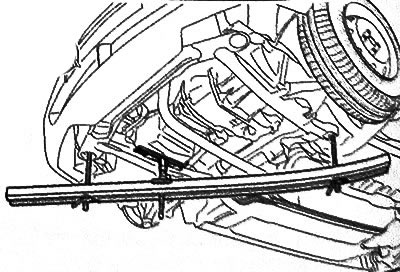
5. Remove the damper valve.
6. Remove the timing belt of the gas distribution mechanism drive.
7. Remove the high-pressure fuel lines between the high-pressure fuel pump and the fuel rail (see chapter "Power supply system").
8. Remove the high-pressure fuel lines between the high-pressure fuel pump and the fuel injectors (see chapter "Power supply system").
9. Remove the return fuel line from the rail (see chapter "Power supply system").
[Text published on the website: renaultbook]
10. Remove the fuel injectors (see chapter "Power supply system").
11. Remove the fuel rail (see chapter "Power supply system").
12. Disconnect the glow plug connectors.
13. Disconnect the high pressure fuel pump connector.
14. Remove the rocker arm cover (see above).
15. Remove the turbocharger exhaust outlet pipe.
16. Remove the exhaust gas recirculation system components.
17. Remove the turbocharger.
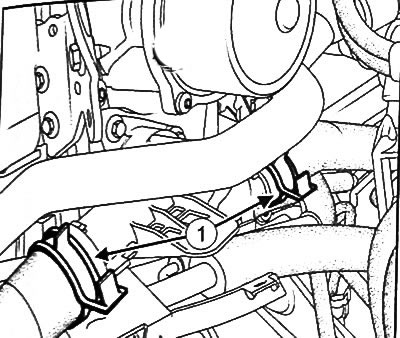
18. Disconnect the water hoses (1) from the cooling system chamber.
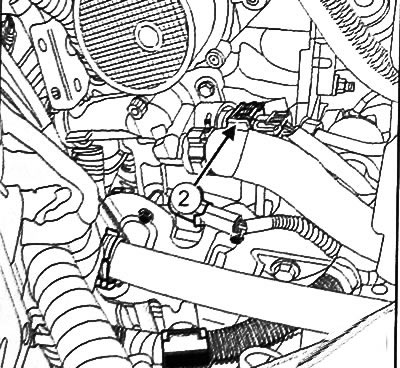
19. Disconnect the coolant temperature sensor connector (2).
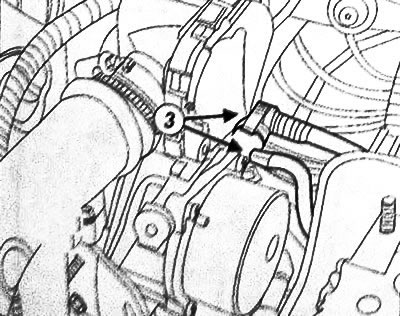
20. Disconnect the pipes (3) from the vacuum pump.
21. Loosen the bolts (4) securing the cylinder head.
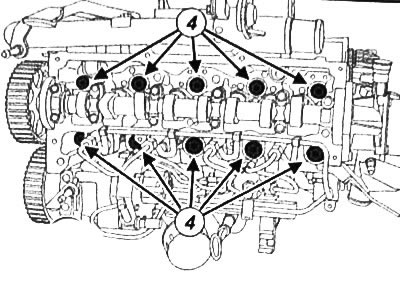
22. Remove the cylinder head with the gasket.