



Attention:
When working in the engine compartment, to avoid injury, it is necessary to take precautions, since the electric fan of the engine cooling system may turn on unexpectedly.
To avoid getting severe burns when the engine is hot, you must follow these rules:
- do not open the expansion tank cap,
- do not drain the fluid from the engine cooling system,
- do not open the lids to remove air.
Note: When performing work, be prepared for liquid leakage, so prepare a tray to collect the liquid and cover the surrounding components.
Removal and installation the water chamber
D4F Engine
Removal the water chamber
1. Place the vehicle on a two-post lift.
2. Disconnect the negative battery terminal.
3. Loosen the mounting bolts and remove the engine protective pan.
4. Drain the coolant from the engine cooling system.
5. Using special pliers (Mot. 1448), remove the hose clamps connected to the water chamber.
Note: To prevent coolant from getting on the gearbox, cover the TDC sensor with a cloth.
6. Disconnect the hoses from the water chamber.
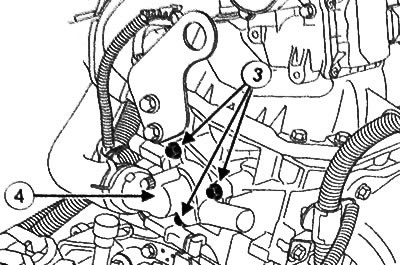
7. Loosen the bolts (3) and remove the water chamber (4) with the gasket
Installing a water chamber
Attention:
- Do not scratch the connecting aluminum surfaces, any damage to the contact surfaces may result in leaks.
- When performing work, use glasses with side protection.
- To ensure the required tightness, the sealing surfaces must be clean, dry and free of grease (avoid any fingerprints).
- Replace the water chamber gasket with a new one.
1. Place the water chamber with a new gasket on the engine.
2. Tighten the water chamber mounting bolts without tightening.
3. Tighten the water chamber bolts to 10 Nm.
4. Connect the hoses to the water chamber.
5. Using special pliers (Mot. 1448) install hose clamps.
6. Connect the negative battery terminal.
7. Fill and bleed the engine cooling system.
8. Install the engine oil pan
Engine K7M
Removal the water chamber
1. Place the vehicle on a two-post lift.
2. Disconnect the negative battery terminal.
3. Loosen the mounting bolts and remove the engine protective pan.
4. Drain the coolant from the engine cooling system.
5. Disconnect the wiring from the holders (1) and (2).
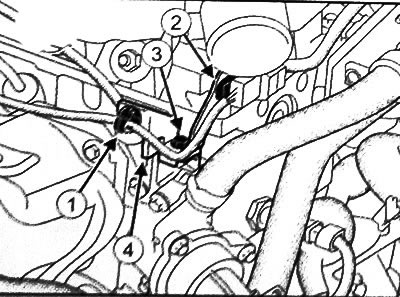
6. Loosen the bolt (3) and remove the rack (4).
7. Remove the water chamber (see the general view drawing at the beginning of the chapter).
Installing a water chamber
1. Using a cleaning agent, clean and degrease the contact surfaces of the cylinder head and water chamber.
Attention:
- Do not scratch the connecting aluminum surfaces, any damage to the contact surfaces may result in leaks.
- To ensure the required tightness, the sealing surfaces must be clean, dry and free of grease (avoid any fingerprints).
2. Using a roller, apply an even layer of sealant to the contact surfaces of the water chamber.
Caution: Excess sealant may be squeezed out when tightening threaded connections. Sealant in contact with coolant may cause damage to some components (engine, radiator, etc.).
3. Install the water chamber on the engine cylinder head and use a cloth to remove any protruding excess sealant.
4. Further installation is carried out in the reverse order of removal.
5. Fill and bleed the engine cooling system.
Engine K4M
Removal the water chamber
1. Place the vehicle on a two-post lift.
2. Disconnect the negative battery terminal.
3. Remove the air resonator.
4. Drain the coolant from the engine cooling system.
5. Disconnect the upper radiator hose (1) from the water chamber.
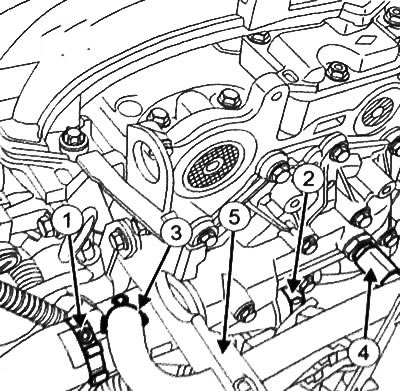
6. Disconnect the heater hose (2).
7. Disconnect the expansion tank hose (3).
8. Disconnect the coolant temperature sensor (4).
9. Unhook the hose from the support (5)
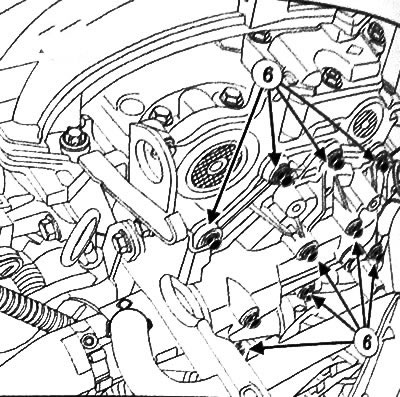
10. Loosen the bolts (6) and remove the water chamber.
Installing a water chamber
Note: Be sure to replace the water chamber gasket with a new one.
Attention:
- Do not scratch the connecting aluminum surfaces, any damage to the contact surfaces may result in leaks.
- To ensure the required tightness, the sealing surfaces must be clean, dry and free of grease (avoid any fingerprints).
1. Using a cleaning agent, clean and degrease the contact surfaces of the cylinder head and the water chamber if it is reused.
2. Install the water chamber.
3. Tighten the water chamber mounting bolts without tightening.
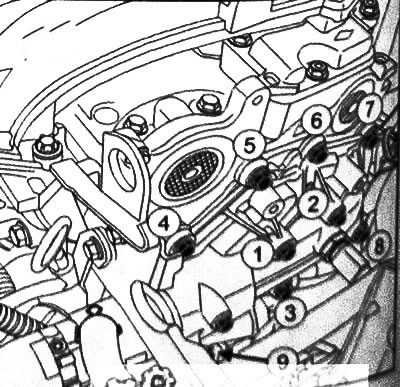
4. Tighten the water chamber bolts in the sequence shown in the figure to the specified tightening torques:
- coolant outlet bolts (initial tightening torque): 4 Nm;
- water chamber bolts: 12 Nm
5. Connect the coolant temperature sensor.
6. Connect the expansion tank hose.
7. Connect the heater hose.
8. Connect the upper water chamber hose.
9. Fill the engine cooling system.
10. Install the air resonator.
11. Connect the battery.
12. Start the engine and bleed the cooling system.
Engine K9K
Removal the water chamber
1. Place the vehicle on a two-stop lift.
2. Remove the air intake duct.
3. Loosen the mounting bolts and remove the engine protective pan.
4. Remove the front bumper from the car.
5. Drain the coolant from the engine cooling system.
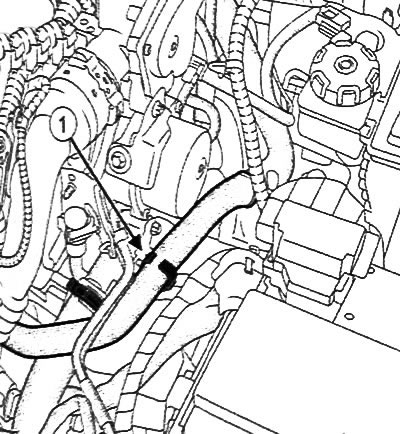
6. Disconnect the cooling system hose from the holder (1) and set it aside.
7. Disconnect the coolant temperature sensor connector.
8. Disconnect the hoses from the water chamber.
9. Remove the water chamber with the gasket.
10. If necessary, remove the coolant temperature sensor from the water chamber.
Installing a water chamber
Attention:
- Do not scratch the connecting aluminum surfaces, any damage to the contact surfaces may result in leaks.
- To ensure the required tightness, the sealing surfaces must be clean, dry and free of grease (avoid any fingerprints).
Using a cleaning agent, clean and degrease the contact surfaces of the cylinder head and the water chamber, if it is reused.
Installation is carried out in the reverse order of removal.
Fill and bleed the cooling system.
[View the original source on this resource: www.renaultbook.ru]