
English Русский
Български
Беларускі
Український
Српски
Hrvatski
Română
Polski
Slovenský
Magyar
Bookmark Contacts Articles Sitemap
Company vehicles Peugeot Company vehicles Opel Company vehicles Skoda Company vehicles Land Rover Company vehicles Mitsubishi Company vehicles Volkswagen Company vehicles Honda
RenaultBook.ru


Duster   Fluence   Kangoo   Laguna   Logan   Megane   Sandero   Scenic   Symbol   Clio   Other
Logan 1 (2004-2012, petrol) Logan 2 (2012-2020)

Draining and filling the cooling system (Renault Logan 2)

  • Main
  • Logan
  • Logan 2 (2012-2020)
  • Power unit
  • Cooling system
  • Draining and filling the cooling system
0
Contents: Draining the coolant 🠛 Cleaning the cooling system 🠛 Filling the cooling system 🠛
Attention:
When working in the engine compartment, to avoid injury, it is necessary to take precautions, since the electric fan of the engine cooling system may turn on unexpectedly.
To avoid getting severe burns when the engine is hot, you must follow these rules:
  • do not open the expansion tank cap,
  • do not drain the fluid from the engine cooling system,
  • do not open the lids to remove air.


Note: When performing work, be prepared for liquid leakage, so prepare a tray to collect the liquid and cover the surrounding components.


Attention:
  • Do not use ordinary water for the engine cooling system. Normal engine operation is ensured only by using a coolant.
  • If coolant is leaking through the expansion tank cap, the expansion tank cap vapor valve must be replaced.


Draining the coolant


1. Place the vehicle on a two-post lift.

2. Remove the cap from the expansion tank.

3. Loosen the mounting bolts and remove the engine protective pan.

4. Remove the front bumper from the car.

5. Place a coolant collection tray under the vehicle.

6. Remove the clamp of the lower radiator hose using special pliers (Mot. 1202-01), (Mot 1202-02) or (Mot. 1448).

7. Open the cooling system circuit by disconnecting the lower radiator hose using trim removal tools (Car 1363).

8. By supplying compressed air to the cooling system through the opening of the expansion tank, remove as much coolant as possible.

Cleaning the cooling system


1. Supply water to the cooling system through the expansion tank.


2. Wait until the water flowing out of the lower radiator hose is clear.

3. By supplying compressed air to the cooling system through the opening of the expansion tank, remove as much water as possible from the cooling system.

4. Connect the lower radiator hose.

Filling the cooling system


Note:

There are two ways to fill the engine cooling system:
Using the device (Mot. 1700) recommended by Renault, it provides a significant time saving as it does not require opening the plugs to remove air. A method without the use of a special device.


Refueling using a device (Mot. 1700)


[View the original on the specified resource: RENAULTBOOK]

Fill the engine cooling system with the fluid recommended by the manufacturer using the tool (Mot. 1700).

Filling without using a special device


Attention:
  • Be sure to remove all drain bolts to remove as much air as possible from the cooling system.
  • Failure to perform this operation may result in the cooling system not being completely filled and may cause engine damage.


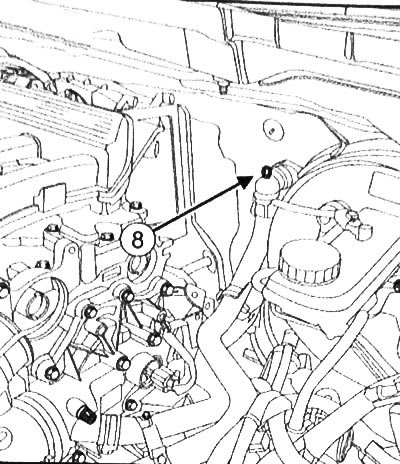
1. Open all air bleed nipples.
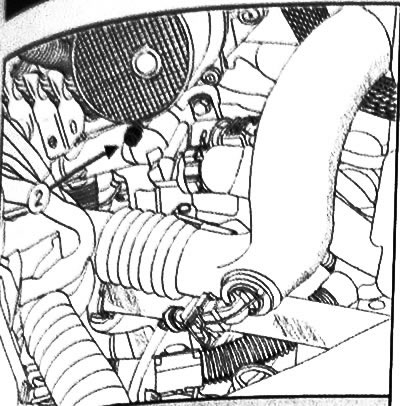
2. Air bleed nipple for the version with the K9K engine.
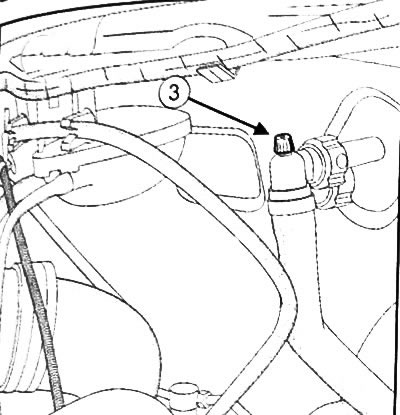
2. Air bleed nipple for the version with the K9K engine.


3. Air bleed nipple, versions with K9K engine.
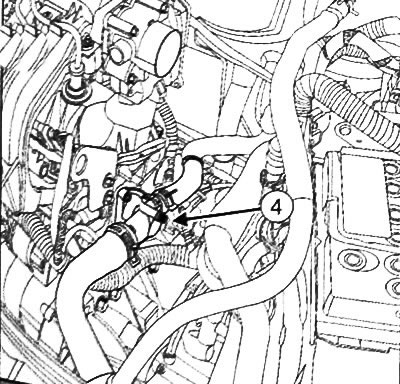
3. Air bleed nipple, versions with K9K engine.


4. Air bleed nipple, versions with D4F engine.
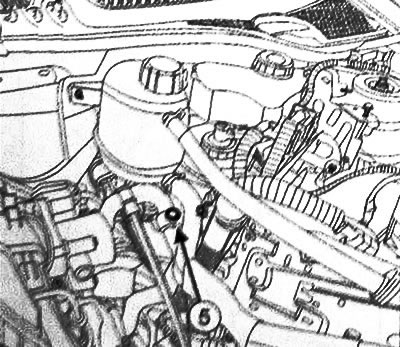
4. Air bleed nipple, versions with D4F engine.


5. Air bleed nipple, versions with D4F engine
5. Air bleed nipple, versions with D4F engine


8. Air bleed nipple, versions with K4M engine

8. Air bleed nipple, versions with K4M engine


2. Fill the engine cooling system with the liquid recommended by the manufacturer, pouring it into the expansion tank up to the top edge of the neck.

3. Close all the air bleed nipples as soon as the liquid starts to flow out in a continuous stream.


4. Create pressure in the system using a device (Ms. 554-07) to check for leaks.

5. Install the expansion tank cap.

6. Clean surfaces that have been exposed to coolant.

Caution: Do not open the air bleed nipple while the engine is running to avoid engine damage.


7. Start the engine.

Versions with petrol engines


8. Let the engine run at 2500 rpm until the electric fan of the engine cooling system turns on for the third time (time required for automatic air removal).

Diesel engine versions


9. Maintain the engine speed at 1500 rpm, sharply increasing the speed to maximum 2 - 3 times approximately every 2 minutes until the electric fan of the engine cooling system turns on for the second time.

10. Check the heater's functionality.

11. Allow the engine to cool down to a coolant temperature below 50°C.

12. Bring the coolant level up to the "Maximum" mark.

13. Install the expansion tank cap.

14. Remove the coolant collection pan from under the vehicle.

16. Install the engine oil pan guard.
This article is available on: russian, bulgarian, belarusian, ukrainian, serbian, croatian, romanian, polish, slovak, hungarian
Article has been reviewed by editor: Petrovsky Roman
Share with friends:
Previous
Logan 2: Cooling system
Next

Checking the cooling system
General information about the cooling system
Cooling system fan
Radiator of the cooling system
Water chamber, thermostat and cooling system pipes
Removal and installation the thermostat
Removal and installation the water pump inlet pipe
Other articles on other Renault models

➽ Draining and filling the cooling system Renault Fluence 1 (2009-2020, petrol)
➽ Draining and filling the cooling system Renault Megan 2 (2002-2009, petrol)
➽ Cooling system — draining and filling Renault Espace I and II (1984-1996)
➽ Filling the cooling system Renault Kangoo 1 (1997-2007)
➽ Draining and filling engine oil Renault Duster 1 (2009-2017)
Link to this article in different formats
Reviews and comments of visitors
No comments yet


Add two numbers 31 + 16


Logan 2 (2012-2020) 
  • General information
  • Faults en route
  • Daily checks
  • Governing bodies
  • Maintenance
  • Power unit
  • Petrol engines 1.2 l
  • Petrol engines 1.6 l
  • Diesel engines 1.5 l
  • Cooling system
  • Lubrication system
  • Power and control system
  • Intake and exhaust system
  • Engine electrical equipment
  • Transmission
  • Clutch
  • Car gearbox
  • Drive shafts
  • Chassis, running gear
  • Suspension and wheels
  • Brake system
  • Steering
  • Body and interior
  • Exterior (external elements)
  • Interior (internal elements)
  • Safety system
  • Heating and air conditioning
  • Electrical equipment
  • Equipment and devices
  • Wiring diagrams (sedan)
  • Wiring diagrams (wagon)
Logan 1 (2004-2012, petrol) 
  • General information
  • Vehicle device
  • User manual
  • Faults en route
  • Daily maintenance
  • First maintenance
  • Second maintenance
  • Driver tips
  • Power unit
  • Engine repair
  • Lubrication system
  • Cooling system
  • Power and exhaust system
  • Transmission
  • Clutch
  • Car gearbox
  • Drive shafts
  • Chassis, running gear
  • Front suspension
  • Rear suspension
  • Steering
  • Brake system
  • Wheels and tires
  • Body and interior
  • Exterior (external elements)
  • Interior (internal elements)
  • Doors, locks and windows
  • Body Care
  • Electrical equipment
  • Equipment and devices
  • Headlights and lighting
  • Power devices
  • Electrical circuits
RenaultBook.ru © 2018–2026 | Mobile version | News and articles | Sitemap: EN BG BY UA RS HR RO PL SK HU | Administration | Site search | Bookmark
Duster 1 (2009-2017) | Fluence 1 (2009-2020, petrol) | Kangoo 1 (1997-2007) | Laguna 2 (2001-2007) | Logan 1 (2004-2012, petrol) | Logan 2 (2012-2020) | Megane 1 (1995-2002) | Megan 2 (2002-2009, petrol) | Sandero 1 (2007-2012, petrol) | Scenic 1 (1996-2003) | Symbol 1 (1999-2008, petrol) | Symbol 2 (2008-2013, petrol) | Renault 19 (1988-1996) | Espace I and II (1984-1996) | Espace III (1996-2002) | Clio 1 (1990-1998) |
We want your visit to be comfortable 😌 and use cookies 🍪 to do so.