English Русский
Български
Беларускі
Український
Српски
Hrvatski
Română
Polski
Slovenský
Magyar
Bookmark Contacts Articles Sitemap
Company vehicles Peugeot Company vehicles Opel Company vehicles Skoda Company vehicles Land Rover Company vehicles Mitsubishi Company vehicles Volkswagen Company vehicles Honda
RenaultBook.ru


Duster   Fluence   Kangoo   Laguna   Logan   Megane   Sandero   Scenic   Symbol   Clio   Other
Renault 19 (1988-1996) Espace I and II (1984-1996) Espace III (1996-2002)

Cooling system — draining and filling (Renault Espace I)

  • Main
  • Renault
  • Espace I and II (1984-1996)
  • Power unit
  • Cooling system
  • Cooling system — draining and filling
0
1. The coolant should be changed every 60,000 km. Transparent coolant can be reused.

2. If the system has been containing antifreeze for a long time, flush it. To do this, unscrew the cap of the expansion tank and insert a hose into the hole. Disconnect the lower radiator hose to facilitate flushing. Supply water and wait until it appears from the lower radiator hose.

3. The percentage composition of the coolant depends on the local climate. A mixture of 35% antifreeze and 65% water is suitable for temperatures down to - 23°C. 50% antifreeze and 50% water protects the cooling system at temperatures down to - 40°C.

4. To avoid air locks when filling the system, pay attention to the following:

a) Replace the drain plug and connect the lower radiator hose. Be sure to install the sealing gaskets.

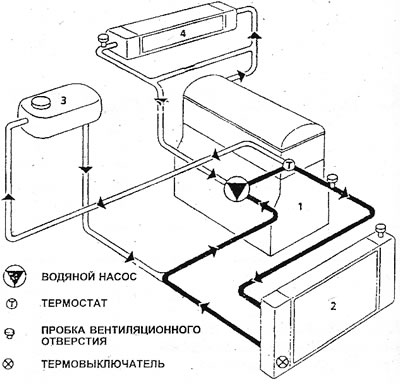
b) Set the heater control lever to the warm air supply position. When pouring coolant, the air vent plugs must be opened so that the liquid is distributed evenly (see illustrations). These plugs are located in different places on different engines. On carburetor models with an engine capacity of 2.0 liters, an additional plug is installed - it is located in the device that doses an additional amount of fuel when the carburetor is turned on. On these models, the radiator plug is usually not installed.

2.4a Cooling system of injection engines with a volume of 2.0 and 2.2 l; on models with a…

2.4a Cooling system of injection engines with a volume of 2.0 and 2.2 l; on models with a carburetor engine, only one vent plug is used (in the carburetor); 1. Engine; 2. Radiator; 3. Expansion tank; 4 Heater matrix
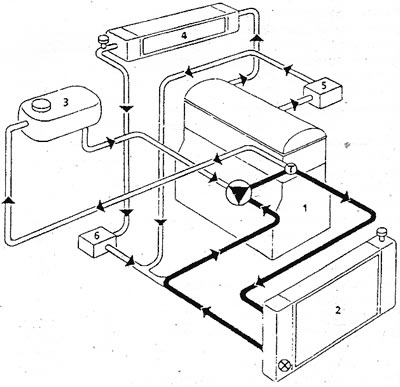


2.4b Cooling system of a turbocharged diesel engine, (for legend, see Illustration 2.4a).; 1.…

2.4b Cooling system of a turbocharged diesel engine, (for legend, see Illustration 2.4a).; 1. Engine; 2. Radiator; 3. Expansion tank; 4. Heater matrix; 5. Cold engine starting device; 6. Oil cooler


Material is located on the source website www.renaultbook.ru

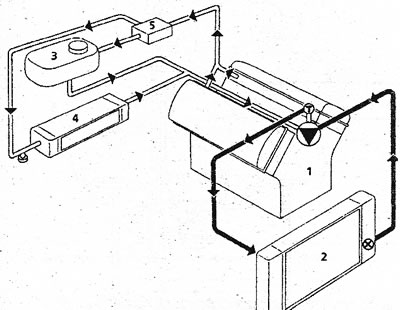
2.4c V6 Engine Cooling System (the symbols are identical to those shown in Illustration 2.4a); 1.…

2.4c V6 Engine Cooling System (the symbols are identical to those shown in Illustration 2.4a); 1. Engine; 2. Radiator; 3. Expansion tank; 4. Heater matrix; 5. Antechamber


5. On later models, a new modification of the expansion tank is installed.

6. Cooling systems of all models are filled through the filler hole of the expansion tank with the radiator cap closed. If you have an old radiator hose at hand, insert one end of it into the opening of the expansion tank. Insert a funnel into the other end of the hose and pour in the coolant. Antifreeze cannot be added in this way. Place the tank cap and the vent plugs in the working position. Feed in the liquid until it starts to come out from under the plugs without bubbles. Tighten the plugs and screw on the radiator cap.

7. Start the engine and let it run for a while at 1500 rpm. If necessary, add coolant up to the "Max" mark on the tank wall. Screw in the cap of the expansion tank. Let the engine run until the cooling fan turns on, then turn it off. Let the engine cool down and check the coolant level. If necessary, add more liquid. Do not open the vent plugs while the engine is running.
This article is available on: russian, bulgarian, belarusian, ukrainian, serbian, croatian, romanian, polish, slovak, hungarian
Article has been reviewed by editor: Fedoseev Denis
Share with friends:
Previous
Espace I and II: Cooling system
Next

General description of the cooling system
Cooling system — specification
Radiator and fan — removal and installation
Radiator — checking the serviceability of the tank cap valve and the…
Fan — removal and installation
Fan Motor — Replacement
Thermal switch — checking serviceability
Other articles on other Renault models

➽ Draining and filling the cooling system Renault Fluence 1 (2009-2020, petrol)
➽ Draining and filling the cooling system Renault Logan 2 (2012-2020)
➽ Draining and filling the cooling system Renault Megan 2 (2002-2009, petrol)
➽ Filling the cooling system Renault Kangoo 1 (1997-2007)
➽ Draining and filling engine oil Renault Duster 1 (2009-2017)
Link to this article in different formats
Reviews and comments of visitors
No comments yet


Add two numbers 20 + 16


Renault 19 (1988-1996) 
  • General information
  • Maintenance
  • Power unit
  • Engine repair
  • Exhaust system
  • Cooling system
  • Supply system
  • Single-point injection
  • Multi-point injection
  • Diesel injection system
  • Transmission
  • Clutch
  • Car gearbox
  • Chassis, running gear
  • Car suspension
  • Steering
  • Brake system
  • Wheels and tires
  • Body and interior
  • Exterior (external elements)
  • Interior (internal elements)
  • Heating and ventilation
  • Electrical equipment
  • Equipment and devices
  • Headlights and lighting
  • Ignition system
  • Power devices
  • Electrical circuits
Espace I and II (1984-1996) 
  • General information
  • Introduction to the guide
  • Troubleshooting
  • Power unit
  • Engine repair
  • Cooling system
  • Carburetor fuel system
  • Injection fuel system
  • Diesel fuel system
  • Ignition system
  • Transmission
  • Clutch
  • Car gearbox
  • Drive shafts
  • Chassis, running gear
  • Brake system
  • Steering
  • Front suspension
  • Rear suspension
  • Body and interior
  • Exterior (external elements)
  • Interior (internal elements)
  • Doors, locks and windows
  • Electrical equipment
  • Equipment and devices
  • Electrical circuits
Espace III (1996-2002) 
  • General information
  • Introduction to the manual
  • User manual
  • Power unit
  • Petrol engines F3R
  • Petrol engines Z7X
  • Diesel engines G8T
  • Diesel engines G9T
  • Transmission
  • Clutch
  • Mechanical gearbox
  • Automatic gearbox
  • Drive shafts
  • Chassis, running gear
  • Steering
  • Front suspension
  • Rear suspension
  • Brake system
  • Body and interior
  • Exterior (external elements)
  • Interior (internal elements)
  • Doors, locks and windows
  • Heating and ventilation
  • Electrical equipment
  • Equipment and instruments
  • Power devices
  • Electrical circuits
RenaultBook.ru © 2018–2026 | Mobile version | News and articles | Sitemap: EN BG BY UA RS HR RO PL SK HU | Administration | Site search | Bookmark
Duster 1 (2009-2017) | Fluence 1 (2009-2020, petrol) | Kangoo 1 (1997-2007) | Laguna 2 (2001-2007) | Logan 1 (2004-2012, petrol) | Logan 2 (2012-2020) | Megane 1 (1995-2002) | Megan 2 (2002-2009, petrol) | Sandero 1 (2007-2012, petrol) | Scenic 1 (1996-2003) | Symbol 1 (1999-2008, petrol) | Symbol 2 (2008-2013, petrol) | Renault 19 (1988-1996) | Espace I and II (1984-1996) | Espace III (1996-2002) | Clio 1 (1990-1998) |
We want your visit to be comfortable 😌 and use cookies 🍪 to do so.