



Removal and installation the radiator
Attention:
When working in the engine compartment, to avoid injury, it is necessary to take precautions, since the electric fan of the engine cooling system may turn on unexpectedly.
To avoid getting severe burns when the engine is hot, you must follow these rules:
- do not open the expansion tank cap,
- do not drain the fluid from the engine cooling system,
- do not open the lids to remove air.
Note: When performing work, be prepared for liquid leakage, so prepare a tray to collect the liquid and cover the surrounding components.
Removal the radiator
1. Place the vehicle on a two-post lift.
2. Disconnect the negative battery terminal.
3. Loosen the mounting bolts and remove the engine protective pan.
4. Remove the front bumper from the car.
5. Remove the radiator fan assembly.
Caution: To prevent atmospheric moisture from entering the air conditioning system circuit, it is necessary to immediately plug any openings in the air conditioning system components. Fuel line plugs can be used for this purpose (catalog numbers 7 701 208 229 or 7 701 476 857). The plugs must be clean. Do not use plugs that have already been used to plug fuel lines.
6. Empty the air conditioning system circuit using a refrigerant charging station.
7. Remove the air conditioning system condenser.
8. Drain the coolant from the engine cooling system.
9. Using special pliers with remote grip (Mot.1448), disconnect all hoses from the radiator.
10. Remove the engine cooling system radiator through the bottom of the car.
Installing a radiator
Installation is carried out in the reverse order of removal.
Fill the air conditioning system with refrigerant from a special filling station.
Check the functionality of the air conditioning system.
Fill and bleed the cooling system.
Check for leaks.
Removal and installation an oil radiator (only versions with diesel engines K9K)
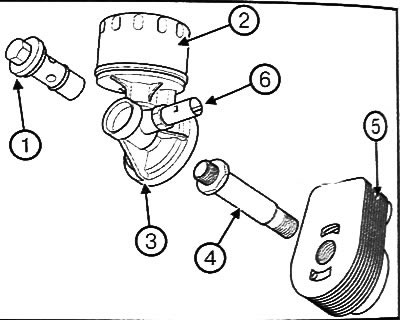
1. Oil filter bracket bolt. 2. Oil filter. 3. Oil filter holder. 4. Oil cooler bolt. 5. Oil cooler. 6. Oil pressure sensor.
Removal the oil radiator
1. Place the vehicle on a two-post lift.
2. Loosen the mounting bolts and remove the protective tray.
3. Drain the coolant from the cooling system.
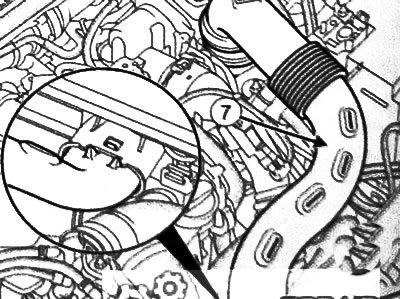
4. Remove the air intake duct (7) of the air filter and the outlet pipe of the intermediate air cooler.
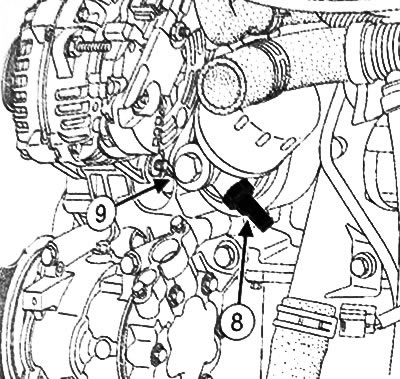
5. Disconnect the oil pressure sensor connector (8).
6. Place a drain pan under the engine on the oil filter side.
7. Loosen the bolt (9) and remove the oil filter support.
8. Remove the gasket (10) from the oil filter support.
9. Unscrew the bolt (11) from the oil radiator.
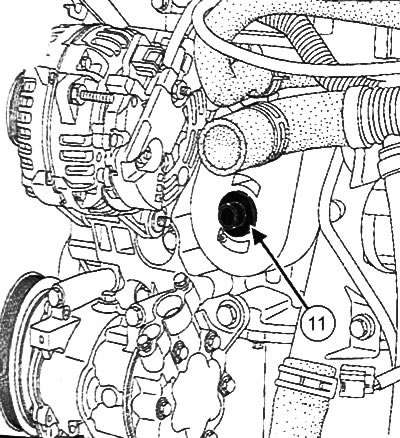
10. Remove the oil cooler from the engine
11. Use a clean cloth to remove oil and coolant leaking from the cylinder block and oil filter support.
Installing an oil radiator
Note:
Be sure to replace the gasket between the oil cooler and the cylinder block with a new one, as well as the oil filter seals.
1. Remove the oil cooler seals (12).
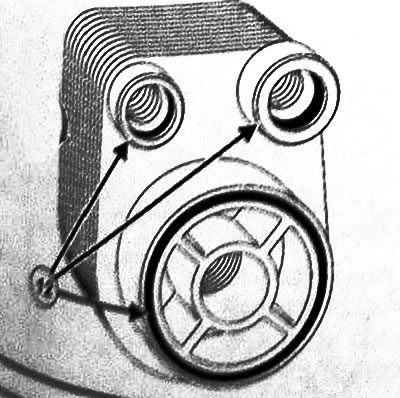
2. Use a cleaning agent to clean and degrease the seal seats in the oil radiator (if it is reused), as well as all contact surfaces.
3. Install new seals (13) and (14) into the oil cooler.
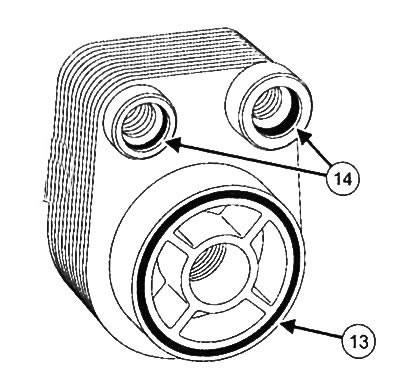
4. Apply soapy water to the seals (14) where they come into contact with the water pump inlet pipe.
5. Install the oil radiator.
6. Tighten the oil cooler bolt to 39 Nm.
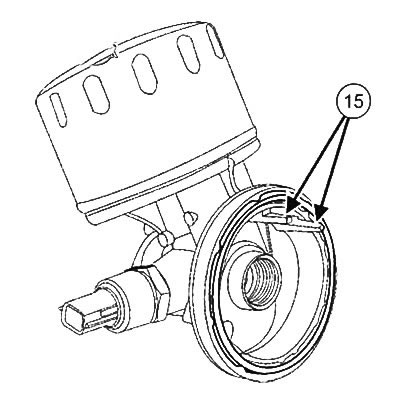
7. Install a new gasket into the oil filter support housing.
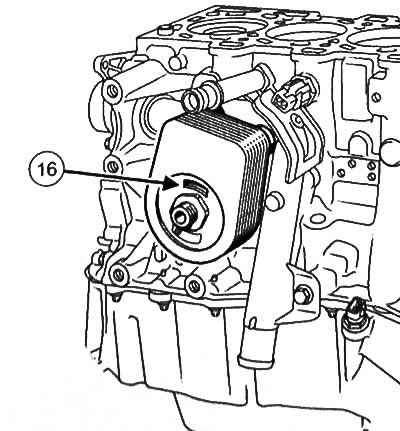
8. Install the oil filter support by placing the protrusions (15) into the holes (16) of the oil cooler.
9. Install the oil filter holder bolt and tighten to 28 N·m.
10. Connect the oil pressure sensor connector.
11. Install the air-to-air cooler outlet pipe and air inlet duct.
12. Install the engine protective pan.
13. Fill and bleed the cooling system.
14. Check and adjust the engine oil level.
View the original on the specified resource: RENAULTBOOK