



Main components of the heater:
- a heater heat exchanger (radiator) designed to heat the air entering the passenger compartment with the heat of the engine cooling liquid;
- electric fan (supercharger), providing a controlled supply of outside air to the heater and air conditioner flaps;
- the damper that regulates the temperature of the air coming from the heater into the passenger compartment; the amount of air passing through the heater heat exchanger and the outside air passing bypassing the heat exchanger depends on the change in its position;
- flaps for distributing air coming from the heater through air ducts into the passenger compartment or for blowing air onto the windshield.
The purpose and operation of the air conditioner controls are described in Section 1 "Vehicle structure", see. "Heating (conditioning) and interior ventilation".
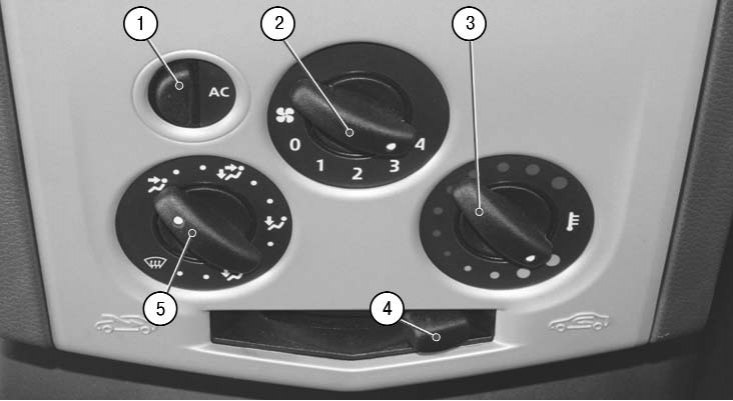
1.9. Heating system control unit (air conditioning) and ventilation of the cabin
Switch 2 (see figure 1.9) the fan operating modes operate independently of the position of the air distribution regulator 5 and the temperature regulator 3 and control the fan speed by changing the voltage in the electric motor power supply circuit.
The air conditioning system includes the following elements.
The compressor is belt-driven from the engine crankshaft pulley. The compressor pulley has a built-in friction electromagnetic clutch that disconnects the compressor shaft from the pulley or connects them when the air conditioner is running, based on a signal from the engine's electronic control unit. When running, the compressor compresses the refrigerant vapors coming from the evaporator heat exchanger to high pressure. The temperature of the refrigerant vapors at the compressor outlet is significantly higher than at the inlet.
The pressure reducing valve is built into the compressor and performs a protective function, triggering when the pressure increases above the permissible value at the compressor outlet. The reason for the pressure reducing valve triggering may be the failure of the high-pressure valve, electric fan, etc.
A heat exchanger (radiator) of the condenser, located behind the radiator of the engine cooling system and having a coil with developed fins for rapid cooling and condensation of refrigerant vapors compressed by the compressor to high pressure.
A throttle pipe (reducer) with mesh filters at the inlet and outlet is installed in the pipeline supplying liquid refrigerant to the evaporator heat exchanger. The throttle opening in the pipe limits the flow of liquid refrigerant and reduces the pressure in the evaporator. After the engine stops, the liquid refrigerant continues to flow through the throttle pipe from the high-pressure zone to the low-pressure zone for some time. The flow of liquid through the throttle opening is accompanied by a characteristic hissing sound, which can be heard for 30–60 seconds after the engine stops and does not indicate a malfunction.
Evaporator heat exchanger (radiator). The liquid coolant of the condenser heat exchanger enters the evaporator heat exchanger, located in the heater unit, through the throttle pipe. In the heat exchanger, the liquid passes into a gaseous state, absorbing heat. The moisture contained in the air entering the heat exchanger condenses on it, flows down from the evaporator and is removed from the heater unit. From the evaporator heat exchanger, the gaseous coolant with an admixture of a small amount of the liquid fraction of the coolant and drops of refrigeration oil enters the receiver, which is connected to the outlet pipeline of the evaporator.
Receiver-dryer. In the lower part of the receiver body there is a container with an absorber of water vapor from refrigerant vapors, which, freed from moisture through a special hole in the intake tube, mix with refrigeration oil. In the upper part of the receiver body there are fittings for connecting pipelines. The receiver is not repairable, it must be replaced only as an assembly.
In addition to the listed elements, the system includes high and low pressure valves and pressure sensors.
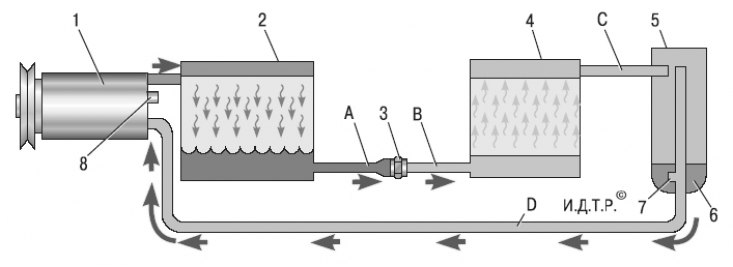
11.2. Schematic diagram of the movement of refrigerant in the air conditioning system: 1 – air conditioning compressor; 2 – condenser heat exchanger; 3 – throttle pipe (reducer); 4 – evaporator heat exchanger; 5 – receiver-dryer; 6 – moisture absorber in the receiver; 7 – hole for mixing refrigerant vapors with refrigeration oil; 8 – pressure reducing valve in the compressor; A – liquid refrigerant under high pressure; B – liquid refrigerant under low pressure; C – high pressure gaseous refrigerant; D – low pressure gaseous refrigerant
The basic diagram of the movement of refrigerant in the air conditioning system is shown in Figure 11.2.
Attention! All repair work on the air conditioning system should be carried out only when the system is completely discharged. Since refrigerant vapors are toxic, repair the system using special equipment available at specialized air conditioning service centers.
Note: Due to the specific features of air conditioning system repair (see warning above) this subsection describes only the repair work of the heater: removal and installation of the heater radiator and the control unit of the air conditioning and heating system.