
English Русский
Български
Беларускі
Український
Српски
Hrvatski
Română
Polski
Slovenský
Magyar
Bookmark Contacts Articles Sitemap
Company vehicles Peugeot Company vehicles Opel Company vehicles Skoda Company vehicles Land Rover Company vehicles Mitsubishi Company vehicles Volkswagen Company vehicles Honda
RenaultBook.ru


Duster   Fluence   Kangoo   Laguna   Logan   Megane   Sandero   Scenic   Symbol   Clio   Other
Logan 1 (2004-2012, petrol) Logan 2 (2012-2020)

Removal and installation the heater radiator (Renault Logan 1)

  • Main
  • Logan
  • Logan 1 (2004-2012, petrol)
  • Body and interior
  • Interior (internal elements)
  • Removal and installation the heater radiator
0
You will need: TORX T20 and 13 keys.

1. Drain the cooling system (see "Replacing the coolant").
1. Drain the cooling system (see «Replacing the coolant»).


2. Remove the lower instrument panel trim (see "Removing and installing the instrument panel").

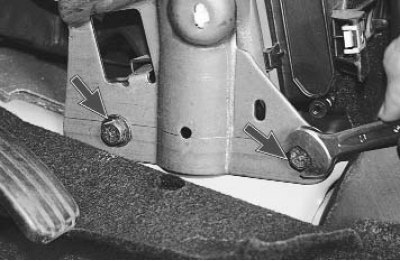
3. Bend back the edge of the floor mat under the instrument panel and remove the two bolts securing the panel cross member reinforcement to the body base.

4. Remove the instrument cluster (see "Removing and installing the instrument cluster").
4. Remove the instrument cluster (see «Removing and installing the instrument cluster»).


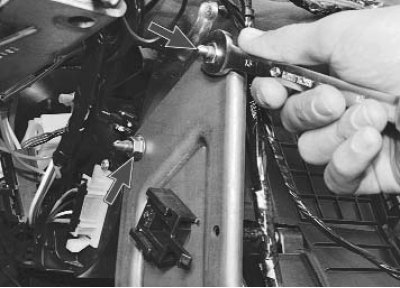
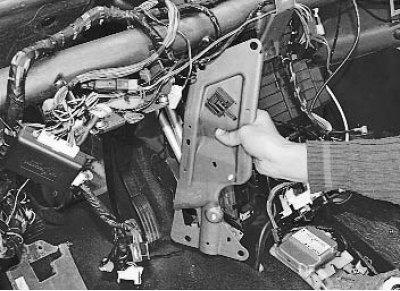
5. Through the window in the instrument panel that opened after removing the instrument cluster, unscrew the two nuts of the upper fastening of the instrument panel cross member reinforcement...

Note: For clarity, the work is shown with the instrument panel removed.

Note: For clarity, the work is shown with the instrument panel removed.


6. ...and remove the amplifier.


6. ...and remove the amplifier.


(This article is taken from the website: «www.renaultbook.ru»)

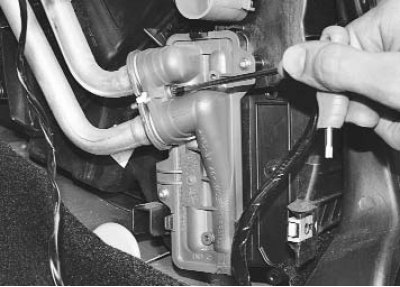
7. Unscrew the screw securing the pressure plate of the pipes supplying liquid to the heater radiator and draining it...
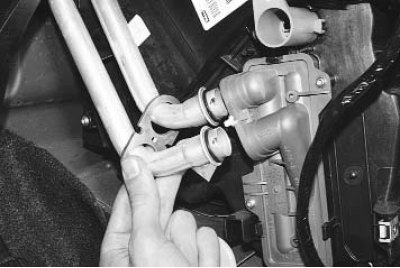
7. Unscrew the screw securing the pressure plate of the pipes supplying liquid to the heater…


8. ...and disconnect the pipes from the radiator.

Note: Coolant residue may leak from the hoses and radiator. Take precautions to prevent it from contaminating the floor mat.
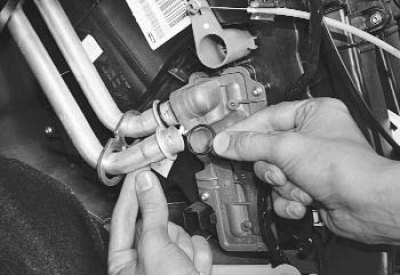

Note: Coolant residue may leak from the hoses and radiator. Take precautions to prevent it from…


Please note that the pipes are sealed with rubber rings. Replace rings that are too tight, hardened or torn.
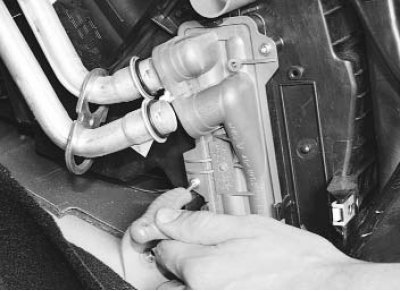


Please note that the pipes are sealed with rubber rings. Replace rings that are too tight, hardened…


9. Unscrew the screw securing the radiator to the heater body, press one plastic radiator retainer on top and two on the sides below...
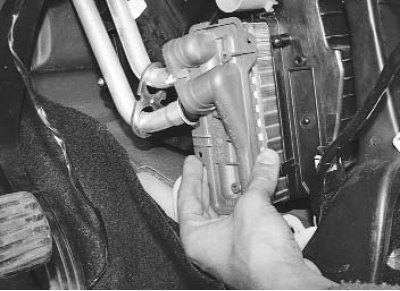
9. Unscrew the screw securing the radiator to the heater body, press one plastic radiator retainer…


10. ...then remove the radiator from the housing.

11. Install the heater radiator and all removed parts in the reverse order of removal.

12. Fill with coolant.
This article is available on: russian, bulgarian, belarusian, ukrainian, serbian, croatian, romanian, polish, slovak, hungarian
Article has been reviewed by editor: Podkrepilov Maxim
Share with friends:
Previous
Logan 1: Interior (internal elements)
Next

Features of the heater and air conditioner
Removal and installation the instrument panel
Removal and installation the interior rearview mirror
Removal and installation of the electronic control unit of the…
Replacing the rear seat belt
Removal and installation the heating and air conditioning control unit
Replacing handrails
Replacing sun visors
Removal and installation of interior trim
Removal and installation trunk trim
Other articles on other Renault models

➽ Heater radiator — removal and installation Renault Duster 1 (2009-2017)
➽ Heater radiator Renault Fluence 1 (2009-2020, petrol)
➽ Heater radiator Renault Kangoo 1 (1997-2007)
➽ Removal and installation the heater radiator Renault Megan 2 (2002-2009, petrol)
➽ Removal and installation the heater radiator Renault Sandero 1 (2007-2012, petrol)
Link to this article in different formats
Reviews and comments of visitors
No comments yet


Add two numbers 11 + 31


Logan 2 (2012-2020) 
  • General information
  • Faults en route
  • Daily checks
  • Governing bodies
  • Maintenance
  • Power unit
  • Petrol engines 1.2 l
  • Petrol engines 1.6 l
  • Diesel engines 1.5 l
  • Cooling system
  • Lubrication system
  • Power and control system
  • Intake and exhaust system
  • Engine electrical equipment
  • Transmission
  • Clutch
  • Car gearbox
  • Drive shafts
  • Chassis, running gear
  • Suspension and wheels
  • Brake system
  • Steering
  • Body and interior
  • Exterior (external elements)
  • Interior (internal elements)
  • Safety system
  • Heating and air conditioning
  • Electrical equipment
  • Equipment and devices
  • Wiring diagrams (sedan)
  • Wiring diagrams (wagon)
Logan 1 (2004-2012, petrol) 
  • General information
  • Vehicle device
  • User manual
  • Faults en route
  • Daily maintenance
  • First maintenance
  • Second maintenance
  • Driver tips
  • Power unit
  • Engine repair
  • Lubrication system
  • Cooling system
  • Power and exhaust system
  • Transmission
  • Clutch
  • Car gearbox
  • Drive shafts
  • Chassis, running gear
  • Front suspension
  • Rear suspension
  • Steering
  • Brake system
  • Wheels and tires
  • Body and interior
  • Exterior (external elements)
  • Interior (internal elements)
  • Doors, locks and windows
  • Body Care
  • Electrical equipment
  • Equipment and devices
  • Headlights and lighting
  • Power devices
  • Electrical circuits
RenaultBook.ru © 2018–2026 | Mobile version | News and articles | Sitemap: EN BG BY UA RS HR RO PL SK HU | Administration | Site search | Bookmark
Duster 1 (2009-2017) | Fluence 1 (2009-2020, petrol) | Kangoo 1 (1997-2007) | Laguna 2 (2001-2007) | Logan 1 (2004-2012, petrol) | Logan 2 (2012-2020) | Megane 1 (1995-2002) | Megan 2 (2002-2009, petrol) | Sandero 1 (2007-2012, petrol) | Scenic 1 (1996-2003) | Symbol 1 (1999-2008, petrol) | Symbol 2 (2008-2013, petrol) | Renault 19 (1988-1996) | Espace I and II (1984-1996) | Espace III (1996-2002) | Clio 1 (1990-1998) |
We want your visit to be comfortable 😌 and use cookies 🍪 to do so.