
English Русский
Български
Беларускі
Український
Српски
Hrvatski
Română
Polski
Slovenský
Magyar
Bookmark Contacts Articles Sitemap
Company vehicles Peugeot Company vehicles Opel Company vehicles Skoda Company vehicles Land Rover Company vehicles Mitsubishi Company vehicles Volkswagen Company vehicles Honda
RenaultBook.ru


Duster   Fluence   Kangoo   Laguna   Logan   Megane   Sandero   Scenic   Symbol   Clio   Other
Megane 1 (1995-2002) Megan 2 (2002-2009, petrol)

Removal and installation the heater radiator (Renault Megane 2)

  • Main
  • Megane
  • Megan 2 (2002-2009, petrol)
  • Body and interior
  • Heating and air conditioning
  • Removal and installation the heater radiator
0
Contents: Removal 🠛 Installation 🠛

Removal


Disconnect the wires from the battery terminals, starting with the negative terminal.

Clamp the heater hoses at the outlet from the front shield into the engine compartment.

Remove the lower casing access cover.

Remove the instrument panel side panel by pressing the spring clips.

Remove the wiring harness from the headlight range control panel.

Note: On vehicles with manual heating or climate control, set the air temperature switch to the position corresponding to the minimum temperature of the air supplied to the passenger compartment (turn the switch to the far left position). This will allow you to raise the control lever located above the heater radiator as high as possible.


Remove the cover.

Disconnect the air duct.

Bend the air duct downwards.

Remove the front air distribution duct.

Move aside the wiring harness secured to the instrument panel beam reinforcement panel.

Remove the lower part of the casing covering the instrument panel beam reinforcement shield and partially the carpet.
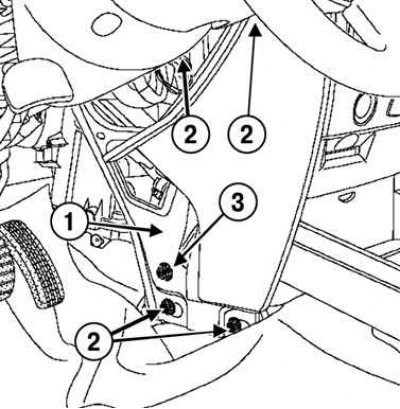
Fig. 8.141. Removing the instrument panel beam reinforcement shield: 1 – beam reinforcement shield;…

Fig. 8.141. Removing the instrument panel beam reinforcement shield: 1 – beam reinforcement shield; 2 – bolt for fastening the elastic connecting insert between the block and the instrument panel beam reinforcement shield; 3 – bolts for fastening the instrument panel beam reinforcement shield


Loosen the tightening of the bolt securing the elastic connecting insert between the block and the instrument panel beam reinforcement shield (fig. 8.141).

Remove the four instrument panel beam reinforcement panel mounting bolts.

Remove the beam reinforcement shield by sliding it towards the front of the vehicle.
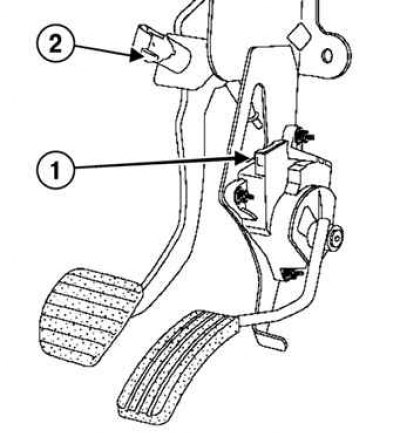
Fig. 8.142. Removing the wiring block and brake light switch from the accelerator pedal: 1 – wiring…

Fig. 8.142. Removing the wiring block and brake light switch from the accelerator pedal: 1 – wiring block; 2 – brake light switch


Remove the wiring harness from the accelerator pedal assembly and the brake light switch (fig. 8.142).
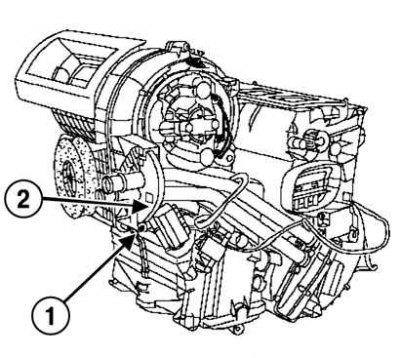
Fig. 8.143. Removing the flange of the interior heater radiator pipes: 1 – flange bolt; 2 –…

Fig. 8.143. Removing the flange of the interior heater radiator pipes: 1 – flange bolt; 2 – pipeline flange


Remove the interior heater radiator pipe flange bolt and remove the interior heater radiator pipe flange (fig. 8.143).


Note: Unlock the flange, then lift it up to remove it from the air distribution unit.
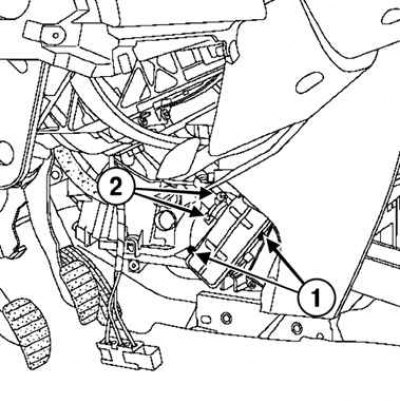

Fig. 8.144. Removing the heater radiator fasteners: 1 – heater radiator mounting bolt; 2 – bolts…

Fig. 8.144. Removing the heater radiator fasteners: 1 – heater radiator mounting bolt; 2 – bolts for fastening the clamps of the heater radiator connections


Unscrew the two bolts securing the heater radiator and the two bolts securing the heater radiator connection clamps (fig. 8.144).

Place a container underneath to collect any spilled coolant.

Move the heater radiator with pipes aside.

Move the heater radiator pipe clamps.

Remove the heater core lines by pulling them toward the front of the vehicle and the heater core.

Installation


When replacing the radiator, be sure to replace the sealing gaskets.

Installation is carried out in the reverse order of removal.

Restore the original shape of the duct by working through the outlet holes and straightening out bends by pressing perpendicular to the bend.

Tighten to the specified torque:
  • beam reinforcement mounting bolts (210 Nm);
  • elastic connecting insert fastening bolt (2 Nm).

Fill the cooling system with fluid.

Bleed the engine cooling system.

Check the cooling system for leaks using a device (Ms. 554-07).
This article is available on: russian, bulgarian, belarusian, ukrainian, serbian, croatian, romanian, polish, slovak, hungarian
Article has been reviewed by editor: Kupriyanov Sergey
Share with friends:
Previous
Megan 2: Heating and air conditioning
Next

Heating system — design description
General information about heating and air conditioning systems
Removal and installation of the heating system ECU
Removal and installation the cabin ventilation filter
Removal and installation the condenser
Removal and installation the receiver-dryer
Reducer with tubular adjustable valve
Other articles on other Renault models

➽ Heater radiator — removal and installation Renault Duster 1 (2009-2017)
➽ Heater radiator Renault Fluence 1 (2009-2020, petrol)
➽ Heater radiator Renault Kangoo 1 (1997-2007)
➽ Removal and installation the heater radiator Renault Logan 1 (2004-2012, petrol)
➽ Removal and installation the heater radiator Renault Sandero 1 (2007-2012, petrol)
Link to this article in different formats
Reviews and comments of visitors
No comments yet


Add two numbers 27 + 38


Megan 2 (2002-2009, petrol) 
  • User manual
  • Introduction to manual
  • Controls and instruments
  • Salon equipment
  • Operation and driving
  • Maintenance and care
  • Power unit
  • Engine repair
  • Fuel system
  • Injection system
  • Intake and exhaust system
  • Starting and charging system
  • Cooling system
  • Decreased toxicity
  • Transmission
  • Clutch
  • Mechanical gearbox
  • Automatic gearbox
  • Wheel drive mechanism
  • Chassis, running gear
  • Suspension and wheels
  • Steering
  • Brake system
  • Body and interior
  • Exterior (external elements)
  • Interior (internal elements)
  • Doors, locks and windows
  • Heating and air conditioning
  • Electrical equipment
  • Equipment and devices
  • Headlights and lighting
  • Electrical circuits
Megane 1 (1995-2002) 
  • General information
  • User manual
  • Maintenance
  • Power unit
  • Petrol engines 1.4/1.6 l
  • Petrol engines 2.0 l
  • Diesel engines 1.9 l
  • Overhaul of engines
  • Cooling system
  • Fuel system (petrol)
  • Fuel system (diesel)
  • Decreased toxicity
  • Charge and launch systems
  • Ignition system (petrol)
  • Preheat system (diesel)
  • Transmission
  • Clutch
  • Mechanical gearbox
  • Automatic gearbox
  • Drive shafts
  • Chassis, running gear
  • Brake system
  • Car suspension
  • Steering
  • Body and interior
  • Exterior (external elements)
  • Interior (internal elements)
  • Doors, locks and windows
  • Electrical equipment
  • Equipment and devices
  • Electrical circuits
RenaultBook.ru © 2018–2026 | Mobile version | News and articles | Sitemap: EN BG BY UA RS HR RO PL SK HU | Administration | Site search | Bookmark
Duster 1 (2009-2017) | Fluence 1 (2009-2020, petrol) | Kangoo 1 (1997-2007) | Laguna 2 (2001-2007) | Logan 1 (2004-2012, petrol) | Logan 2 (2012-2020) | Megane 1 (1995-2002) | Megan 2 (2002-2009, petrol) | Sandero 1 (2007-2012, petrol) | Scenic 1 (1996-2003) | Symbol 1 (1999-2008, petrol) | Symbol 2 (2008-2013, petrol) | Renault 19 (1988-1996) | Espace I and II (1984-1996) | Espace III (1996-2002) | Clio 1 (1990-1998) |
We want your visit to be comfortable 😌 and use cookies 🍪 to do so.