



Caution: Use leak-resistant nitrile gloves for handling.
Note: The engine oil pan is sealed with silicone sealant at the factory. When removing the oil pan in the workshop, it is necessary to use a sealant, which can be ordered from the spare parts catalog.
Engine D4F (1.2 l)
Removal the oil pan
1. Place the vehicle on a two-post lift.
2. Loosen the mounting bolts and remove the engine protective pan.
3. Drain the engine oil.
4. Loosen the bolt (1) and remove the flywheel protective cover (2).
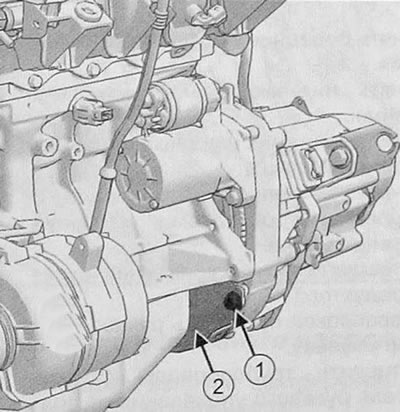
5. Loosen the engine sump bolts.
6. Using a special cutter (Mot. 1716), cut the silicone sealant and gradually separate the oil pan from the engine.
7. Remove the engine oil pan.
Installing the oil pan
1. Apply the cleaning agent to the contact surfaces of the cylinder block and oil pan.
2. Wait about 10 minutes.
3. Remove any remaining sealant from the surfaces with a wooden spatula.
4. Clean the contact surfaces with fine sandpaper.
5. Degrease the contact surfaces of the cylinder block and oil pan with a cleaning agent.
Caution: Contact surfaces must be clean, dry and free of grease (keep fingerprints away).
6. Install the engine sump with a new seal and tighten the mounting bolts in the sequence shown in the figure to a torque of 10 Nm.
7. Remove any traces of oil from the engine sump.
8. Fill the engine with engine oil.
9. Check the tightness of the oil pan.
10. Further installation is carried out in the reverse order of removal.
Removal the oil pan
1. Place the vehicle on a two-post lift.
2. Loosen the mounting bolts and remove the engine protective pan.
3. Unscrew the bumper mounting bolts under the subframe.
4. Drain the engine oil.
5. Remove the front wheels from the vehicle.
6. Remove the front mudguards from the vehicle.
7. Remove the lower engine thrust rod.
8. Remove the lower ball joints from the steering knuckles.
9. Remove the exhaust pipe with flange gaskets by unscrewing the mounting bolts.
10. Loosen the steering gear mounting bolts.
11. Use wire to tie the steering gear to the body.
12. Disconnect the power steering lines from the subframe.
13. Loosen the upper bolts (2) of the front subframe struts.
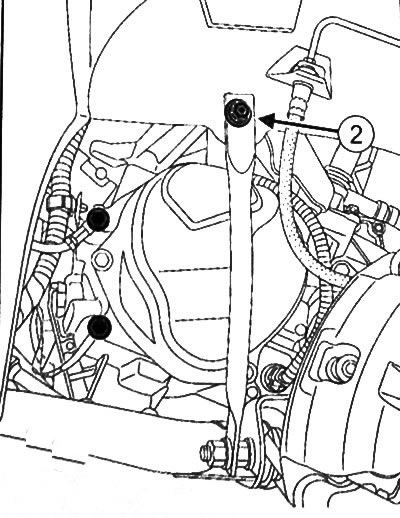
Original publication on the website: RenaultBook.ru
14. Unscrew the front subframe bolts (6) one by one, replacing them with threaded studs (Tav. 1747).
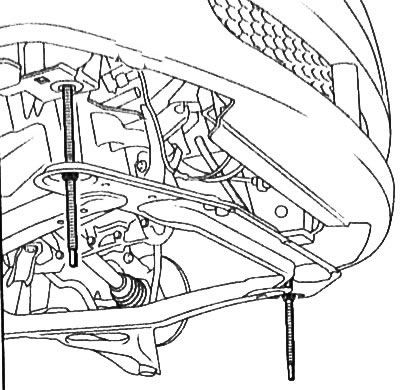
Caution: Make sure that the grub screws (Tav. 1747) are properly screwed into the threaded holes and that their nuts rest against the subframe.
15. Lower the subframe by approximately 120 mm, gradually unscrewing the nuts of the threaded pins (Tav. 1747).
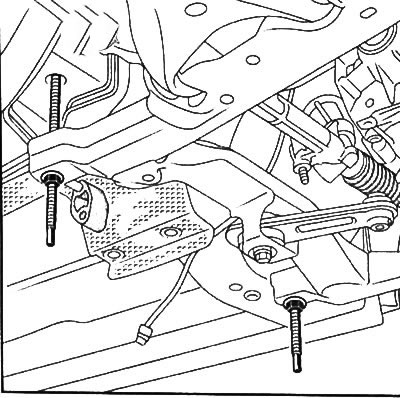
16. Loosen the connecting bolts (7) of the gearbox/engine.
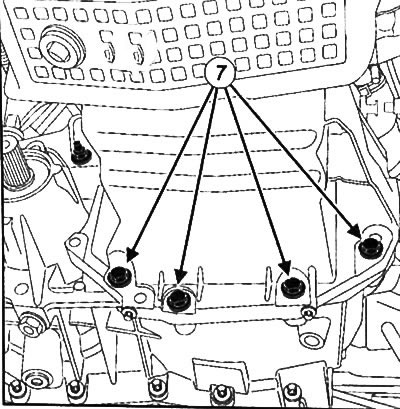
17. Loosen the bolts securing the oil pan to the engine cylinder block.
18. Remove the engine oil pan.
Installing the oil pan
Caution: Be sure to replace the front subframe bolts with new ones.
1. Clean and degrease the contact surfaces of the oil pan with a cleaning agent (if it is reused) and the engine cylinder block.
Attention:
- Do not scratch the connecting aluminum surfaces, any damage to the contact surfaces may result in leaks.
- Contact surfaces must be clean, dry and free of grease (keep fingerprints away).
2. Apply four 5 mm diameter beads (8) and two 7 mm diameter drops (9) of silicone sealant to the joint between the cylinder block and the crankshaft thrust plate.
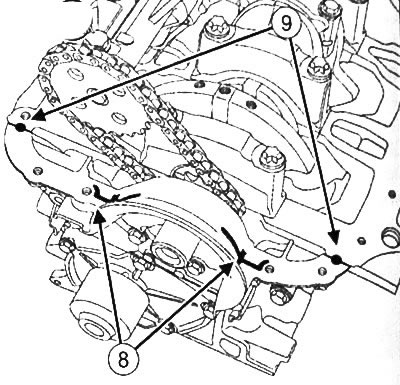
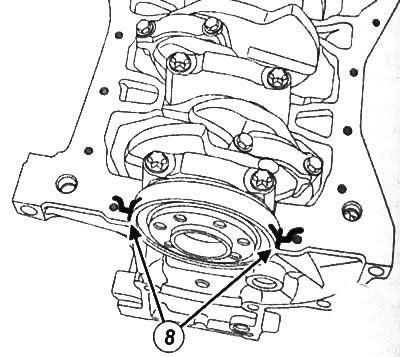
Caution: Excess sealant may be squeezed out when tightening threaded connections. Sealant in contact with coolant may cause damage to some components (engine, radiator, etc.).
3. Install the engine oil pan with a new gasket.
4. Tighten the oil pan mounting bolts without tightening.
5. Loosen the gearbox/engine connecting bolts without tightening.
6. Tighten the mounting bolts in the sequence shown in the figure to the specified tightening torques:
- engine oil pan mounting bolts: 44 Nm
- engine gearbox connecting bolts: 44 Nm.
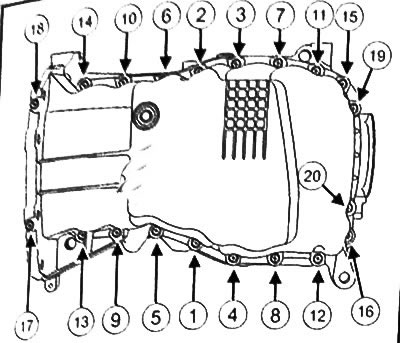
7. Further installation is carried out in the reverse order of removal.
8. Fill the engine with engine oil.