English Русский
Български
Беларускі
Український
Српски
Hrvatski
Română
Polski
Slovenský
Magyar
Bookmark Contacts Articles Sitemap
Company vehicles Peugeot Company vehicles Opel Company vehicles Skoda Company vehicles Land Rover Company vehicles Mitsubishi Company vehicles Volkswagen Company vehicles Honda
RenaultBook.ru


Duster   Fluence   Kangoo   Laguna   Logan   Megane   Sandero   Scenic   Symbol   Clio   Other
Logan 1 (2004-2012, petrol) Logan 2 (2012-2020)

Checking engine oil pressure (Renault Logan 2)

  • Main
  • Logan
  • Logan 2 (2012-2020)
  • Power unit
  • Lubrication system
  • Checking engine oil pressure
0

Engine Oil Pressure Checking Procedure


1. Place the vehicle on a two-post lift.

2. Disconnect the negative battery terminal.

3. Loosen the mounting bolts and remove the engine protective pan.

4. D4F engine: loosen the bolts (1) and remove the heat shield (2).
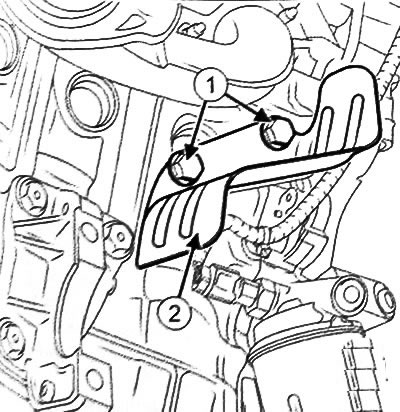
4. D4F engine: loosen the bolts (1) and remove the heat shield (2).


5. Remove the oil pressure sensor (see the relevant section below).

6. Check the functionality of the oil pressure sensor using a 2 mm punch and a multimeter.

7. Place the oil pressure gauge (Mot. 836-05) with a suitable tip using a 22 mm socket for removing and installing oxygen sensors (Mot. 1495-01) or end cap length (with 12.7mm square section).
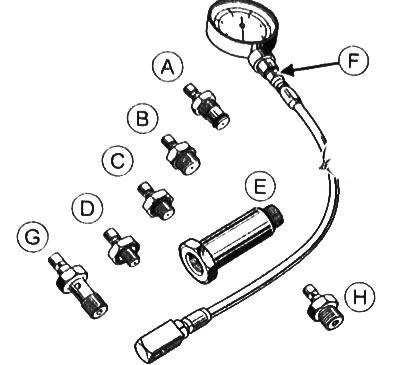
D4F engine: C+F tips K4M, K7M and K9K engines: E+C+F tips

D4F engine: C+F tips K4M, K7M and K9K engines: E+C+F tips


8. Start the engine.

9. Monitor the engine oil pressure with the engine idling at operating temperature (80°C or when the radiator fan first operates).


10. If the oil pressure is below normal, make sure that the oil filter is not clogged and that there is no dirt or small sawdust in the engine oil. Check the condition of the oil pump.

11. Check oil pressure at 3000 rpm.

Note:

D4F Engine:
  • at idle: 1.5 bar
  • at 3000 rpm: not less than 3.9 bar
  • maximum oil pressure: 5.3 bar

Engine K7M:
  • at idle: 1.3 bar
  • at 3000 rpm: more than 3.7 bar
  • maximum oil pressure: 5.0 bar

Engine K4M:
  • at idle: 0.5 bar
  • at 4000 rpm: more than 3.1 bar
  • maximum oil pressure: 4.4 bar

Engine K9K:
  • at idle: 0.8 bar
  • at 3000 rpm: more than 3.4 bar
  • maximum oil pressure: 5.2 bar


12. Turn off the engine.

13. Remove the oil pressure gauge (Mot. 836-05) with adapters.

14. Further installation is carried out in the reverse order of removal.

15. Remove any spilled oil with a cloth.

16. Wait at least 10 minutes.

17. Check the oil level using the dipstick.

Material taken from an online portal [www.RenaultBook.ru]

18. If necessary, add oil to the engine.

19. Start the engine and check for leaks through the engine oil pressure sensor.
This article is available on: russian, bulgarian, belarusian, ukrainian, serbian, croatian, romanian, polish, slovak, hungarian
Article has been reviewed by editor: Petrovsky Roman
Share with friends:
Previous
Logan 2: Lubrication system
Next

Engine K9K (1.5 l)
Engine K4M (1.6 l, 16 valves)
Engine K7M (1.6 l, 8 valves)
Draining and filling engine oil
General information about the lubrication system
Engine oil pan
Engine oil pump
Engine oil pressure sensor
Turbocharger oil line (K9K diesel engine only)
Special tools and accessories for the cooling system
Other articles on other Renault models

➽ Checking fuel pressure (K4M engine) Renault Duster 1 (2009-2017)
➽ Checking the fuel pressure regulator (F4R engine) Renault Laguna 2 (2001-2007)
➽ Checking the pressure in the engine fuel system Renault Sandero 1 (2007-2012, petrol)
➽ Checking engine oil pressure Renault Espace I and II (1984-1996)
➽ Checking the mating surface of the cylinder head of the K4M… Renault Fluence 1 (2009-2020, petrol)
Link to this article in different formats
Reviews and comments of visitors
No comments yet


Add two numbers 43 + 43


Logan 2 (2012-2020) 
  • General information
  • Faults en route
  • Daily checks
  • Governing bodies
  • Maintenance
  • Power unit
  • Petrol engines 1.2 l
  • Petrol engines 1.6 l
  • Diesel engines 1.5 l
  • Cooling system
  • Lubrication system
  • Power and control system
  • Intake and exhaust system
  • Engine electrical equipment
  • Transmission
  • Clutch
  • Car gearbox
  • Drive shafts
  • Chassis, running gear
  • Suspension and wheels
  • Brake system
  • Steering
  • Body and interior
  • Exterior (external elements)
  • Interior (internal elements)
  • Safety system
  • Heating and air conditioning
  • Electrical equipment
  • Equipment and devices
  • Wiring diagrams (sedan)
  • Wiring diagrams (wagon)
Logan 1 (2004-2012, petrol) 
  • General information
  • Vehicle device
  • User manual
  • Faults en route
  • Daily maintenance
  • First maintenance
  • Second maintenance
  • Driver tips
  • Power unit
  • Engine repair
  • Lubrication system
  • Cooling system
  • Power and exhaust system
  • Transmission
  • Clutch
  • Car gearbox
  • Drive shafts
  • Chassis, running gear
  • Front suspension
  • Rear suspension
  • Steering
  • Brake system
  • Wheels and tires
  • Body and interior
  • Exterior (external elements)
  • Interior (internal elements)
  • Doors, locks and windows
  • Body Care
  • Electrical equipment
  • Equipment and devices
  • Headlights and lighting
  • Power devices
  • Electrical circuits
RenaultBook.ru © 2018–2026 | Mobile version | News and articles | Sitemap: EN BG BY UA RS HR RO PL SK HU | Administration | Site search | Bookmark
Duster 1 (2009-2017) | Fluence 1 (2009-2020, petrol) | Kangoo 1 (1997-2007) | Laguna 2 (2001-2007) | Logan 1 (2004-2012, petrol) | Logan 2 (2012-2020) | Megane 1 (1995-2002) | Megan 2 (2002-2009, petrol) | Sandero 1 (2007-2012, petrol) | Scenic 1 (1996-2003) | Symbol 1 (1999-2008, petrol) | Symbol 2 (2008-2013, petrol) | Renault 19 (1988-1996) | Espace I and II (1984-1996) | Espace III (1996-2002) | Clio 1 (1990-1998) |
We want your visit to be comfortable 😌 and use cookies 🍪 to do so.