English Русский
Български
Беларускі
Український
Српски
Hrvatski
Română
Polski
Slovenský
Magyar
Bookmark Contacts Articles Sitemap
Company vehicles Peugeot Company vehicles Opel Company vehicles Skoda Company vehicles Land Rover Company vehicles Mitsubishi Company vehicles Volkswagen Company vehicles Honda
RenaultBook.ru


Duster   Fluence   Kangoo   Laguna   Logan   Megane   Sandero   Scenic   Symbol   Clio   Other
Logan 1 (2004-2012, petrol) Logan 2 (2012-2020)

Checking the air conditioning system (Renault Logan 2)

  • Main
  • Logan
  • Logan 2 (2012-2020)
  • Body and interior
  • Heating and air conditioning
  • Checking the air conditioning system
0
Note: To test the air conditioning system, you will need a dual temperature sensor meter.


Note: To test the air conditioning system, you will need a dual temperature sensor meter.


1. Check the functionality of the measuring device (see the operating instructions supplied with the device).

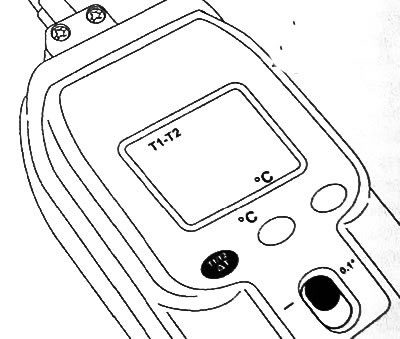
2. Set the device to°C mode.

3. Set the device sensitivity to 0.1°C.

4. Set the reading mode to (ΔT) = (T1 - T2).

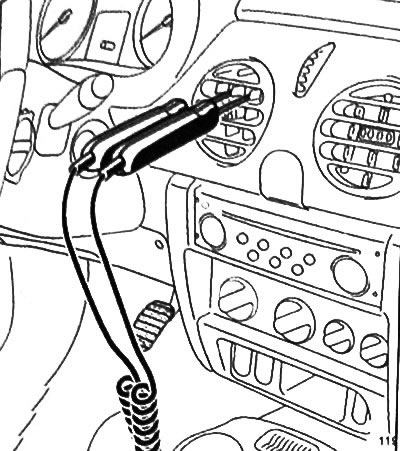
5. Check the two sensors T1 and T2 to correct the error value when determining (Δ) by subtracting (T1-T2). Under the same conditions, both sensors should display the same value. To check, bring the ends of the two sensors together until they touch, then place the sensors in the air deflector on the dashboard. Set the maximum ventilation speed of the cabin and wait until the displayed value stabilizes. Record the error value (Δ).

5. Check the two sensors T1 and T2 to correct the error value when determining (Δ) by subtracting…


Note: There is no need to start the engine.


Note: Note the error value only after the temperature readings have stabilized. Calculate the error value (Δ) = - (T1 - T2), which will need to be added to the value (ΔT).

Examples:

If (T1 - T2) = - 0.3°C, the corrected value (ΔT) by (Δ) = +0.3°C

If (T1 - T2) = + 0.3 C, the corrected value (ΔT) by (Δ) = -0.3°C


6. Place the car in a shaded area so that the air temperature is approximately 15°C.

7. Close the hood.

8. Open the front windows of the car.

9. Start the engine at idle speed.

10. Set the air conditioning system controls to the following positions:
  • air intake switch to outside air intake position;
  • air flow distribution switch to "in-your-face" mode;
  • temperature switch to maximum cooling position;
  • cabin fan speed switch to maximum speed mode (turn off if rear control panel is present);
  • set the front side and central deflectors to neutral position;
  • the air conditioner must be turned on (the indicator light should be on).

Note: Wait 5 minutes with the engine idling before starting measurements.


11. Measure the air temperature at the air intake grille (T3):
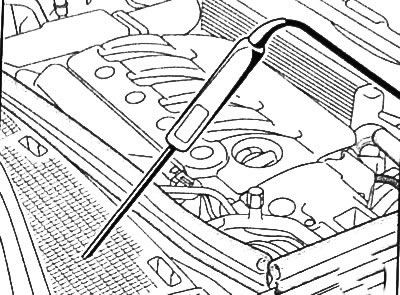
11. Measure the air temperature at the air intake grille (T3):

  • Open the hood to gain access to the air intake grille.
  • Insert the sensor into the air intake grille opening.
  • Wait until the displayed value stabilizes.
  • Record the temperature value (T3).
  • Close the hood.

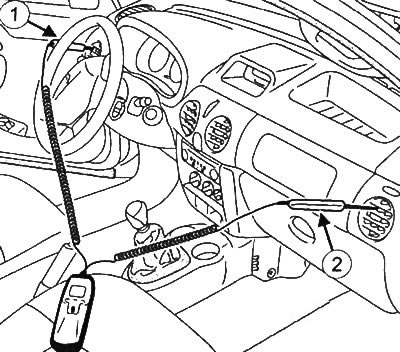
12. Measure the air temperature on the left (T1) and right (T2) air deflectors by inserting sensor T1 into the left (1) and sensor T2 into the right (2) air deflectors.


12. Measure the air temperature on the left (T1) and right (T2) air deflectors by inserting sensor…


13. After the temperature values have stabilized, determine the value (ΔT) between T3 and the larger of the values T1 or T2, (TZ - maximum value). Write down the obtained value.

14. Determine the value (ΔT) between T1 and T2 (read the value (ΔT) from the display in the (T1-T2) mode). Record the obtained value (ΔT) taking into account the correction by the error value (Δ) obtained earlier.

15. If the measurement (ΔT)=(T1-T2) is unstable, do the following:

Note: Depending on the programming version of the air conditioning system of a particular vehicle, this method of checking may not be suitable, since the engine cooling system fan may be activated, as a result of which the calculation of the value (ΔT) may be unstable. To eliminate this error, it is necessary to activate the radiator fan for the entire period during which T1 and T2 measurements will be made.

  • stabilize the engine crankshaft speed at 2000 rpm for the time of measuring temperatures T1 and T2;
  • make sure that the cooling fan is activated;
  • measure temperature values T1 and T2.

16. Ensure that the following conditions are met:
  • the difference between T3 and the larger of the two values T1 or T2 must be greater than or equal to 5°C;
  • the difference between T1 and T2 must be less than or equal to 2°C.

Note: If any of these conditions are not met, the air conditioning system is not working properly. The cause of the malfunction must be identified and corrected.
This article is available on: russian, bulgarian, belarusian, ukrainian, serbian, croatian, romanian, polish, slovak, hungarian
Article has been reviewed by editor: Petrovsky Roman
Share with friends:
Previous
Logan 2: Heating and air conditioning
Next

Air conditioning system
Heater core
Fan assembly
Cabin filter
Middle air ducts of the leg area
Car capacitor
Expansion valve
Cleaning the evaporator
Evaporator sensor
Refrigerant pressure sensor
Other articles on other Renault models

➽ Checking the air conditioning system with a tester Renault Fluence 1 (2009-2020, petrol)
➽ Air conditioning system — checking operation and maintenance Renault Clio 1 (1990-1998)
➽ Checking the cooling system using the Mot. 1700 tool Renault Duster 1 (2009-2017)
➽ Checking the tightness of the cooling system Renault Kangoo 1 (1997-2007)
➽ Automatic air conditioning system Renault Laguna 2 (2001-2007)
Link to this article in different formats
Reviews and comments of visitors
No comments yet


Add two numbers 50 + 43


Logan 2 (2012-2020) 
  • General information
  • Faults en route
  • Daily checks
  • Governing bodies
  • Maintenance
  • Power unit
  • Petrol engines 1.2 l
  • Petrol engines 1.6 l
  • Diesel engines 1.5 l
  • Cooling system
  • Lubrication system
  • Power and control system
  • Intake and exhaust system
  • Engine electrical equipment
  • Transmission
  • Clutch
  • Car gearbox
  • Drive shafts
  • Chassis, running gear
  • Suspension and wheels
  • Brake system
  • Steering
  • Body and interior
  • Exterior (external elements)
  • Interior (internal elements)
  • Safety system
  • Heating and air conditioning
  • Electrical equipment
  • Equipment and devices
  • Wiring diagrams (sedan)
  • Wiring diagrams (wagon)
Logan 1 (2004-2012, petrol) 
  • General information
  • Vehicle device
  • User manual
  • Faults en route
  • Daily maintenance
  • First maintenance
  • Second maintenance
  • Driver tips
  • Power unit
  • Engine repair
  • Lubrication system
  • Cooling system
  • Power and exhaust system
  • Transmission
  • Clutch
  • Car gearbox
  • Drive shafts
  • Chassis, running gear
  • Front suspension
  • Rear suspension
  • Steering
  • Brake system
  • Wheels and tires
  • Body and interior
  • Exterior (external elements)
  • Interior (internal elements)
  • Doors, locks and windows
  • Body Care
  • Electrical equipment
  • Equipment and devices
  • Headlights and lighting
  • Power devices
  • Electrical circuits
RenaultBook.ru © 2018–2026 | Mobile version | News and articles | Sitemap: EN BG BY UA RS HR RO PL SK HU | Administration | Site search | Bookmark
Duster 1 (2009-2017) | Fluence 1 (2009-2020, petrol) | Kangoo 1 (1997-2007) | Laguna 2 (2001-2007) | Logan 1 (2004-2012, petrol) | Logan 2 (2012-2020) | Megane 1 (1995-2002) | Megan 2 (2002-2009, petrol) | Sandero 1 (2007-2012, petrol) | Scenic 1 (1996-2003) | Symbol 1 (1999-2008, petrol) | Symbol 2 (2008-2013, petrol) | Renault 19 (1988-1996) | Espace I and II (1984-1996) | Espace III (1996-2002) | Clio 1 (1990-1998) |
We want your visit to be comfortable 😌 and use cookies 🍪 to do so.