



Contents: Cars without power steering and…🠛 Cars equipped with air conditioning 🠛 On vehicles where the generator and…🠛 Cars equipped with air conditioning…🠛
According to the manufacturer's recommendation, the auxiliary drive belt should be replaced after 4 years of operation or after 60 thousand km of mileage (whichever comes first).
Cars without power steering and without air conditioning
Perform the following operations.
1. Check the belt tension by pressing your finger on it between the generator and crankshaft pulleys. When pressing with a force of 100 N (10 kgf), the belt deflection should be 8–12 mm.
Note: To check the tension, you can use a spring balance scale by pulling the belt branch with a hook.
2. To adjust the belt tension, loosen the generator mounting bolt to the tension bar.
3. Loosen the bolt securing the generator to the bracket.
4. Adjust the belt tension and tighten the generator mounting bolt to the tension bar to a torque of 21 N·m.
5. Tighten the generator mounting bolt to the bracket to 44 N·m.
This note was copied from the resource renaultbook.ru
6. To replace the belt, loosen its tension (see above) and remove the belt from the drive pulleys.
7. Install the new belt and adjust its tension.
Cars equipped with air conditioning
On Renault Logan cars equipped with an air conditioning system, there are two possible layout options for auxiliary units: the air conditioning compressor and generator can be installed on different sides of the engine or on one side. In the first case, the car uses two drive belts: one to drive the generator, the second to drive the air conditioning compressor. In the second case, one drive belt is used, the tension of which is adjusted by a tension roller.
On vehicles where the alternator and air conditioning compressor are located on different sides of the engine, replace the drive belts in the following order.
1. Remove the air conditioner compressor drive belt by cutting it.
2. Replace the alternator drive belt (see above).
3. Install the belt holder (included in the air conditioning compressor drive belt kit) at the bottom of the crankshaft pulley.
4. Place the belt on the air conditioning compressor pulley and place it behind the holder that you installed on the crankshaft pulley.
5. Slide the belt holder with the belt secured to it along the crankshaft pulley clockwise as far as your hand force allows.
6. Install the special hook (included in the air conditioning compressor drive belt kit): one side it clings to the compressor mounting bracket, and the other (more curved) - by the belt. The hook is installed to prevent the upper branch of the belt from slipping off the air conditioner compressor pulley.
7. Turn the crankshaft so that the belt fits onto its pulley.
8. Remove the belt holder and hook. These devices are disposable and can be thrown away after use.
9. Turn the crankshaft two revolutions to ensure that the air conditioning compressor drive belt is correctly positioned on the pulleys.
On vehicles where the generator and air conditioning compressor are located on the same side of the engine
On vehicles where the alternator and air conditioning compressor are located on the same side of the engine, replace the drive belts in the following order.
1. Open the hood and slightly unscrew the belt tensioner adjusting bolt.
2. Remove the right front wheel and engine mudguards on the right side (see "Removal and installation of mudguards and engine crankcase protection").
3. Unscrew the two bolts securing the tension roller and remove it.
Note: Replace the tensioner roller every time the belt is changed.
4. Install the new tension roller without fully tightening the mounting bolts.
5. Install the new drive belt.
Caution! Place the belt on the pulleys in such a way that the outer groove of the pulleys remains free.
6. Adjust the drive belt tension using the adjusting bolt.
Note. The manufacturer recommends checking the belt tension and controlling it during adjustment using a special strain gauge tester. In this regard, there is no data on the magnitude of the force when deflecting a belt branch by a certain size in the technical documentation. In practice, you can initially roughly estimate the correctness of the belt tension using the "rule of thumb": pressing on the belt branch with your thumb and determining the deflection with a ruler. According to this universal rule, if the distance between the pulley centers is from 180 to 280 mm, the deflection should be approximately 6 mm. This method can only diagnose excessive loosening of the belt, so for an accurate check and adjustment of the tension, contact the service.
7. Tighten the tension roller mounting bolts to 21 Nm.
8. Rotate the crankshaft three full revolutions to ensure that the belt is correctly positioned on the pulleys.
9. Recheck the belt tension and readjust if necessary.
10. Install the parts in the reverse order of removal.
Cars equipped with air conditioning and power steering
You will need a 13 mm wrench.
1. Remove the right front wheel.
2. Remove the engine splash guards on the right side (see "Removal and installation of mudguards and engine crankcase protection").
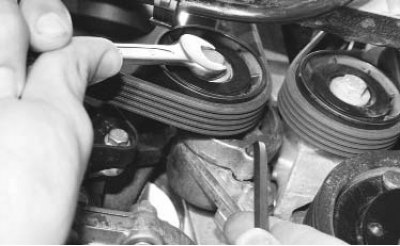
3. Turn the tensioner roller clockwise with the key and fix the tensioner in this position with a 6 mm diameter pin (for example, with a hex key).
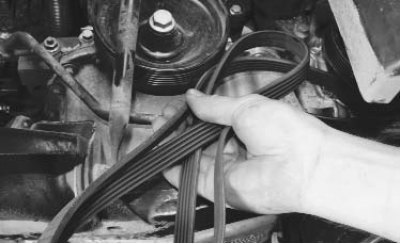
4. Remove the accessory drive belt.
5. Install the new drive belt.
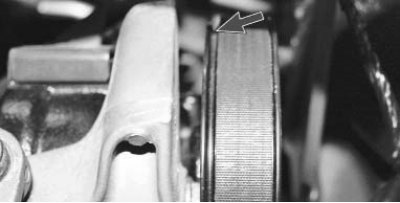
Caution! Place the belt on the pulleys in such a way that the inner groove of the pulleys remains free.
6. Remove the pin that secures the tensioner.
7. Rotate the crankshaft three full revolutions to ensure that the accessory drive belt is correctly positioned on the pulleys.
8. Install the parts in the reverse order of removal.