



4-cylinder petrol engines
2. Check the tension of the water pump belt at the point shown in the illustration. The power steering and air conditioning compressor drive belts are also shown there. Renault workshops use a special device to check the belt tension, but the tension can be checked without it. To do this, take the belt with your index finger and thumb and press it down and up at point "1". The amplitude of the deviation should not exceed 3.5 -4.5 mm, i.e. the belt should be sufficiently tight. This value is specified for a new belt, when installed on a cold engine. With a warm engine, the deviation is 5.5 - 6.5 mm.
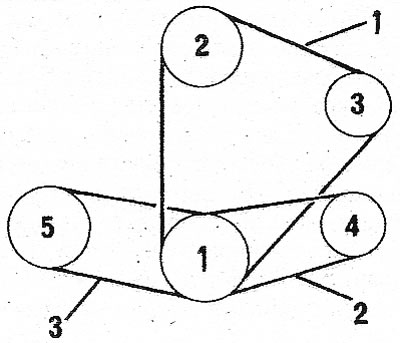
9.2 Location of drive belts on a gasoline engine. The following components are circled 1. Crankshaft; 2. Water pump; 3. Generator; 4. Power steering pump; 5. Compressor
3. The remaining belts must be checked based on the following data, taking into account the difference between cold and warm engines:
At point "2" (steering):
- Cold engine - 3.5 mm.
- Warm engine - 4.0-4.5 mm.
At point "3" (compressor):
- Cold engine 3.0-4.0 mm.
- Warm engine 3.5-4.5 mm.
4. The installation method of the water pump and generator belt is different for each engine group.
5. To install the belt on earlier models, loosen the guide nut and bolt and use a special puller or screwdriver to push the generator outward until tension is established.
6. Check the tension and tighten the bolt and nut. Also tighten both screws on the bottom of the generator.
7. Modern engines are equipped with a tensioning device (see illustration). Bolt 1 is used to tension the belt of the two components. If power steering is installed, check the tension at the points indicated in Illustration 9.2 (between the power steering pump pulley and the crankshaft pulley).
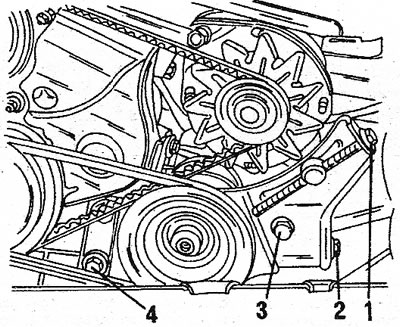
9.7 Generator and power steering pump with tensioner installed. Bolt 1 is used to tension the generator belt, bolt 2 is used to tension the power steering pump belt. The power steering pump is secured with bolts 3 and 4
Diesel engine
8. The accompanying illustration shows all the belts that can be installed on a diesel engine, as well as the toothed drive belt of the fuel pump.
Original article is on the portal RenaultBook
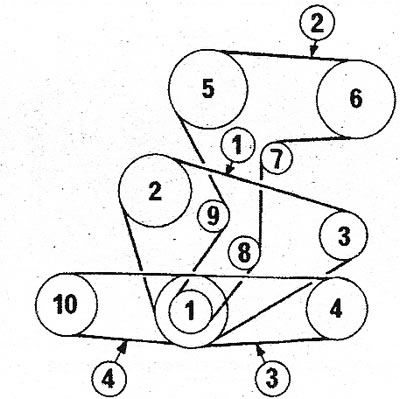
9.8 Location of drive belts on a turbocharged diesel engine. Check the water pump belt tension at point 1. The remaining points are indicated in the text 1. Crankshaft; 2. Water pump; 3. Generator; 4. Power steering pump; 5. Camshaft; 6. Fuel pump; 7. Timing belt tensioner; 8. Support roller; 9. Support roller; 10. Compressor
9. The tension value of the water pump and generator belt is checked at point 1 and must correspond to the value specified in the Specifications for a gasoline engine both cold and warm.
10. To tension the belt, see Illustration 9.2, on earlier models the belt movement is adjusted using guides, as on early petrol engines. Bolt 1 is used to adjust the alternator. The V-belt is used to drive the alternator and water pump. On early models, after removing the guides, the belt tension is adjusted by pressing the alternator outward. 11 The process of tensioning the power steering pump belt is described in the Section "Steering". This belt is located between pulleys 1 and 4 and its tension is measured at point 3. The following values are considered standard for individual components:
At point 3 (steering):
- Cold engine 4.0 - 4.5 mm.
- Warm engine 5.0 mm.
At point 4 (compressor):
- Cold engine 3.0 - 4.0 mm.
- Warm engine 3.5 - 4.5 mm.
12 To replace the water pump and alternator belt, you must first remove the power steering pump belt.
V6 Engine
13. The attached illustration shows the drive belt installed on a V6 engine. A so-called V-belt is used to drive the water pump and alternator.
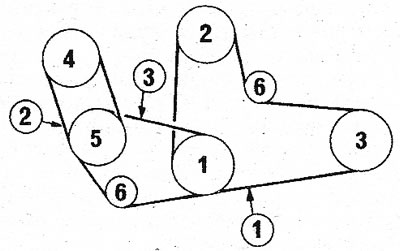
9.13 Location of drive belts on a V6 engine. All possible options are shown 1. Crankshaft; 2. Water pump; 3. Generator; 4. Power steering pump; 5. Compressor; 6. Belt tensioner
14. The amplitude of the deflection of this belt must be checked at point 1. The magnitude of the belt deflection should be approximately 3 mm on a cold engine and, accordingly, 3.0 - 3.5 mm on a warm engine.
15. If the belt deflection is no more than 4.5 mm, no adjustment is required. Otherwise, loosen the tensioner to adjust and press on the inside, then tighten the tensioner again. Check the tension after adjustment.
16. The tension of the remaining belts should be as follows:
At point 2 (steering):
- Cold engine 2.5 - 3.0 mm.
- Warm engine 3.0 - 3.5 mm.
At point 3 (compressor):
- Cold engine 3.0 - 4.0 mm.
- Warm engine 3.5 - 4.5 mm.
17. The procedure for replacing drive belts is quite labor-intensive in most cases. To get to the fastening, it is necessary to remove the radiator grille, the upper cross member of the frame and the radiator.
18. To replace the alternator belt on a diesel engine, first remove the power steering pump belt.
19. To replace the compressor drive belt on a 4-cylinder engine, remove the drive belt.
20. To replace the alternator belt on a V6 engine, first remove the power steering pump belt. Also remove the compressor belt if the model has air conditioning.
21. When replacing the power steering pump belt, also remove the compressor belt first.
22. Note that certain drive belts may have nicks on the inside. If the belt is worn, torn, oily, or leaves particles on the pulleys, it should be replaced. When replacing a V-belt, be sure to thoroughly clean the nicks on the inside of the pulleys.