



Contents: Removal 🠛 Installation 🠛
The vehicles use brake hoses without copper sealing rings. Sealing is provided by a conical shoulder (U, Fig. 12.26) hose tip. Brake hoses provide movable connections between the moving and fixed parts of the vehicle.
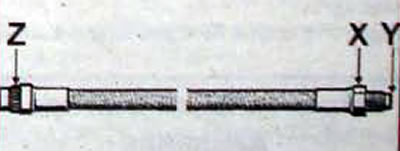
Fig. 12.26. Brake hose: X - nut, 17 Nm; Y - conical shoulder; Z - slotted nut, 17 Nm
- The connection of the tubes to the brake cylinders and distributors is made by conical couplings. The ends of the tubes are compressed and have a conical shape for the corresponding size of the conical threaded holes in the brake cylinders or distributors. Before the ends of the tubes are compressed, a lock nut is put on them, which, after screwing the conical surface into the conical base of the threaded hole, presses and seals the tube.
Removal
- Use a pipe wrench to loosen the union nut (1, Fig. 12.27) brake pipe from the brake hose end until the spring (3) is unloaded enough that the hose can be removed from the splined hole (4).
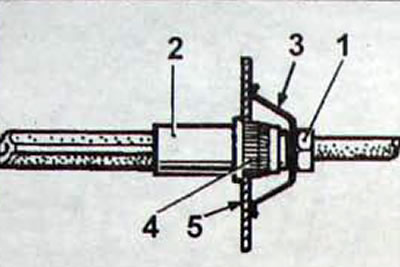
Fig. 12.27. Brake hose connection elements: 1 - union nut; 2 - brake hose; 3 - spring; 4 - spline hole; 5 - bracket
- Unscrew the hose from the brake caliper bracket and, if necessary, remove the brake caliper bracket.
Installation
- Install the caliper bracket onto the pad guide and screw the brake hose tip into the bracket, then tighten it to a torque of 14 Nm.
- The brake hoses are installed with the suspension in the following position:
- the wheels are hanging (suspension in place);
- the wheels are set to move in a straight line.
- Insert the splined end of the hose into the bracket (5), making sure the hose is not twisted.
- Make sure that the tip (4) of the hose fits freely into the hole in the bracket, then install the spring (3) and connect the brake pipe to the hose, preventing the hose from rotating when screwing on the union nut of the pipe
- Tighten the union nut to the specified torque.
- Bleed the brake system.