



Contents: Removal 🠛 Installation 🠛
The control unit and hydraulic unit form a non-separable unit, therefore if any of them fails, the entire unit must be replaced.
Removal
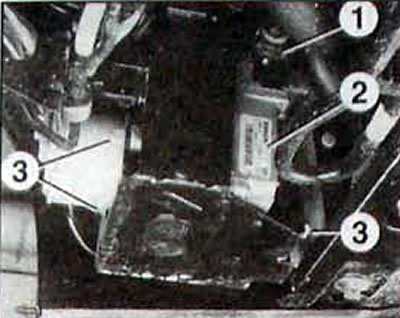
Fig. 12.33. Removing the hydraulic unit: 1 - ABS control unit electrical connector; 2 - ABS control unit; 3 - hydraulic unit bracket mounting bolt
- To reduce brake fluid loss, lock the brake pedal in the depressed position.
- Disconnect the cable from the negative battery terminal.
- Remove the plastic protective covers.
- Unscrew the bolt and remove the rubber cushion.
- Remove the three bolts securing the ABS hydraulic unit bracket.
- Remove the bracket and tie the unit to the body so that it does not hang on the pipes
- Disconnect the 40-pin connector from the unit.
- Using a ratchet wrench, disconnect the brake lines.
- To reduce the loss of brake fluid, install plugs in the fittings.
- Remove the ABS hydraulic unit assembly with the control unit.
Installation
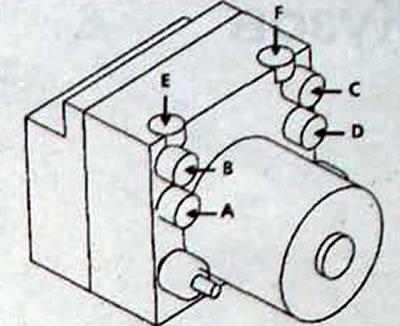
Fig. 12.34. Location of pipelines on the ABS hydraulic unit: A - outlet for the pipe to the front left brake; B - outlet for the line to the rear right brake; C - outlet for the line to the rear left brake; D - outlet for the line to the front right brake, E - inlet for the line of the circuit "front left - rear right brakes" from the master brake cylinder; F - inlet for the "front right - rear left brake" circuit line from the master brake cylinder
- Installation is carried out in the reverse order of removal.
- Install the ABS hydraulic unit complete with control unit, ensuring correct piping arrangement (fig. 12.34).
- Remove air from the hydraulic circuit of the brake system following the required sequence of operations.
- Check the system using the G function on the XR25 handheld diagnostic tool.
- After the road test (with anti-lock braking system regulation) check the ABS operation on the XR25 device.
- Confirm test completion: G13*.
Source link is located on [www.RenaultBook.ru]