



Contents: Description 🠛 Operating principle 🠛 Pressure increase phase 🠛 Pressure support phase 🠛 Pressure reduction phase 🠛 The phase of pressure increase after…🠛 Examination 🠛
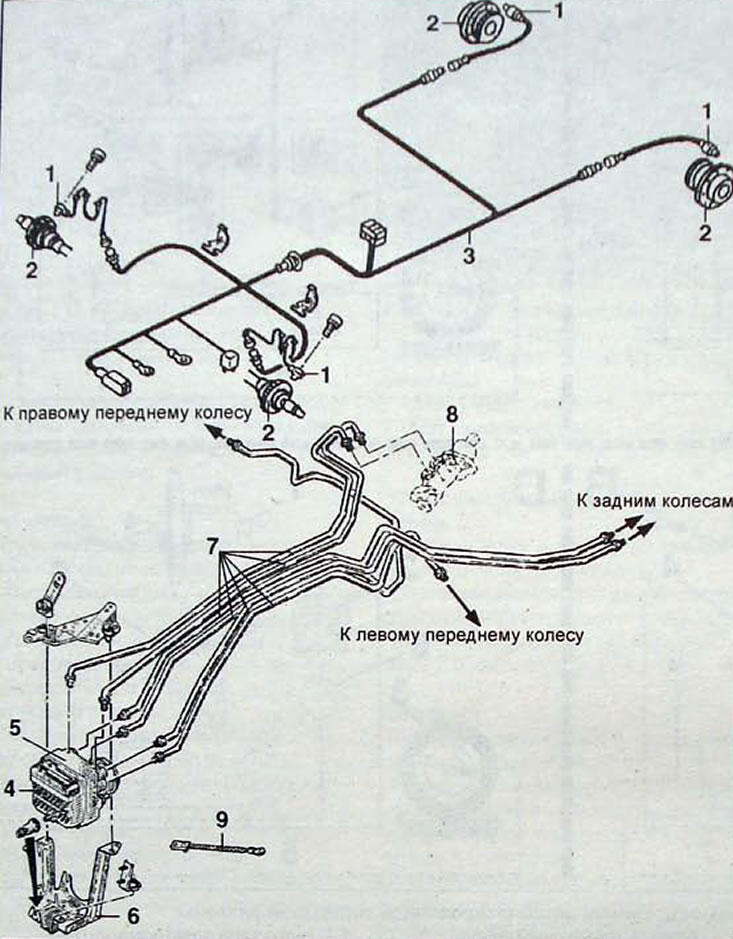
Fig. 12.29. Elements of the braking system with ABS: 1 - wheel speed sensor; 2 - toothed rotor; 3 - wiring harness; 4 - control unit; 5 - bracket; 6 - hydraulic tubes; 7 - master brake cylinder; 8 - "ground" connection bus
The anti-lock braking system prevents the wheels from locking during sudden braking. Thanks to this, the car remains controllable during maximum braking. ABS is ready for operation when the ignition is turned on and the indicator lamp goes out.
Braking is most effective when the tire has maximum grip on the road surface. When braking, the tire slides on the surface and the circumferential speed of the wheel becomes less than the speed of the car.
Slip is minimal when the wheel rolls freely and maximal when the wheel is locked. The greatest braking efficiency is achieved when the peripheral speed of the wheel is almost equal to the speed of the vehicle.
Description
The ABS system "BOSCH 5.0" includes the following elements:
- vacuum booster with dual master cylinder and reservoir;
- hydraulic control unit, including a two-way electric pump and a block of inlet and outlet electromagnetic valves;
- four toothed ring gear and wheel speed sensor assemblies;
- control unit, combined into one unit with a hydraulic unit;
- indicator light in the instrument cluster.
ABS "BOSCH 5.0" is an additional type system.
The ABS hydraulic unit is installed as an addition to the classic brake system, which includes the main brake cylinder and the brake booster
Operating principle
As soon as the vehicle speed reaches 5-6 km/h, ABS performs a self-test and is ready for operation. The wheel speed is recorded by sensors installed opposite the toothed rims. The information about the wheel speed is processed by the control unit and its analysis allows the system to immediately determine the beginning of the locking of any wheel. This leads to the immediate operation of the corresponding electromagnetic valves and a change in the brake fluid pressure in the brake master cylinder of this wheel. The operation of the system consists of several different phases:
- pressure increase phases;
- pressure support phases;
- pressure reduction phases.
- phases of pressure increase after its decrease.
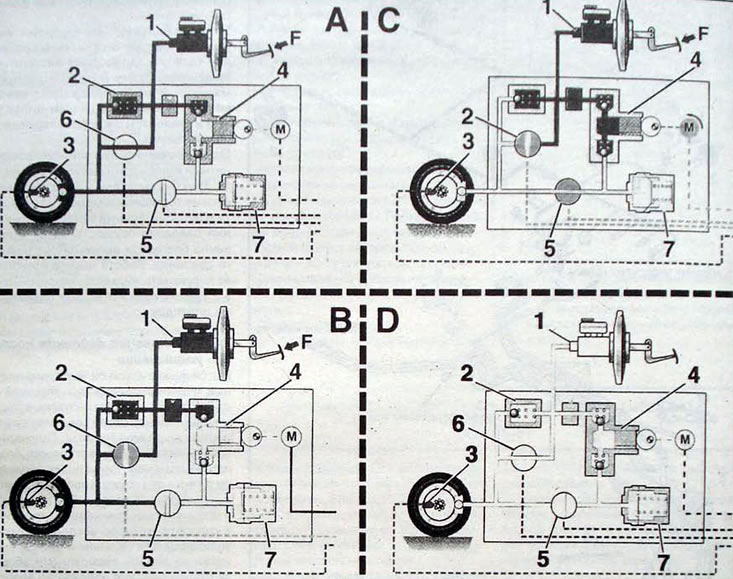
Fig. 12.30. Phases of operation of the anti-lock braking system: A - pressure increase phase; B - pressure support phase; C - pressure reduction phase; D - the phase of pressure increase after its decrease;1 - master brake cylinder; 2 - brake valve; 3 - wheel speed sensor; 4 - pump; 5 - exhaust solenoid valve; 6 - inlet solenoid valve; 7 - brake fluid pressure accumulator
This note was copied from the resource [Renaultbook.ru]
Regulation is carried out for the brakes of all wheels. The brake pressure of the front wheels is regulated separately in each wheel cylinder. The pressure in both rear brakes is regulated according to the principle of "selecting low": "loss of adhesion" of one of the wheels causes immediate regulation of the brake pressure of the other wheel.
Pressure increase phase
During this phase, no voltage is supplied to the electromagnetic valves and the electric motor of the hydraulic unit. The pressure in the calipers is directly proportional to the pressure created by the force with which the driver presses the brake pedal. The braking force increases and, consequently, the wheel reduces its rotation speed and reduces its own peripheral speed in relation to the speed of the car (increases the slip between the wheel and the road surface). The wheel speed decreases to values at which the traction decreases and the wheel starts to slip. In this case, it is necessary to reduce the braking force so that the wheel increases the speed and restores traction with the road surface.
Pressure support phase
During this phase, the wheel speed and acceleration increase continuously, while the inlet solenoid valve breaks the connection between the master cylinder and the disc brake caliper, and the pressure in the caliper is maintained constant at the level previously reached, regardless of the degree of pressure on the brake pedal.
Pressure reduction phase
This phase only occurs if the pressure in the pressure support phase exceeds that required at that moment.
The ABS control unit receives information from the wheel speed sensor and activates the anti-lock system. The inlet solenoid valve breaks the connection between the master cylinder and the disc brake caliper
At the same time, the exhaust solenoid valve opens, the electric motor is turned on and the brake fluid is pumped out of the caliper into the refill tank. The pressure is reduced instantly thanks to the low-pressure accumulator. The pump operation allows the fluid accumulated in the accumulators to be pumped to the main brake cylinder.
The phase of pressure increase after its decrease
In this phase, the outlet solenoid valve closes and the inlet solenoid valve opens, with the master cylinder again connected to the disc brake caliper. Hydraulic supply is provided by the master cylinder and also by a continuously operating pump. This results in an intermittent change in pressure in the caliper, which is felt by the driver when the brake pedal is pressed hard and sharply. This is a completely normal phenomenon during the operation of the anti-lock system and informs the driver about the adjustment process.
Examination
"EBV" system (electronic Brakeforce Distribution), which is integrated into the control program, made it possible to eliminate the brake force regulator.
This system allows:
- increase the distribution of braking force to the rear wheels, which leads to a reduction in the thermal load on the front brake mechanisms;
- increase stability when braking in corners,
- ensure consistency of braking force distribution throughout the entire service life of the system.
If the control system fails, the ABS indicator lamp lights up in the instrument cluster. In this case, the vehicle brakes without distributing the braking force between the front and rear wheels, i.e. if ABS is disabled, a road test is not required.