



Disassembly
Caution: When disassembling the cylinder head, make sure that all parts can be installed in their original places later.
- Remove the glow plugs.
- Remove the exhaust manifold and turbocharger.
- Using the Renault Mot 799 tool, block the camshaft from turning, unscrew the bolt and remove the pulley from the camshaft.
- Remove the vacuum pump.
- Remove the coolant housing located at the end of the cylinder head.
- Loosen the bolts and remove the camshaft bearing caps.
- Remove the oil seal and camshaft.
- Remove the valve rocker arms and take the hydraulic valve clearance compensators out of their sockets.
- Using a valve spring compressor, compress the first valve spring and remove the keepers.
- Gently loosen the spring compressor and remove it.
- Remove the upper spring retainer, spring, lower spring retainer and valve from the cylinder head
- Using suitable pliers, remove the valve stem seal from the valve guide.
- Remove the remaining valves in the same manner.
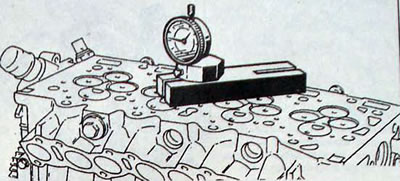
Fig. 3.53. Using a dial indicator with bracket Renault Mot. 251-01 to measure the protrusion of the pre-combustion chambers
- Remove the pre-combustion chambers. If necessary, squeeze them out using a jet of suitable liquid or Renault B.Vi. 31-01, supplied through the injector installation hole.
Caution: The pre-combustion chambers may be loosely installed, so be careful not to drop them when removing the cylinder head.
Checking the cylinder head
- Check that the mating surface of the cylinder head is not scratched or shows any signs of burnout.
- Using a steel ruler and feeler gauge or dial indicator, check the flatness of the underside of the cylinder head. If the head is warped, replace it, as regrinding of the head is not provided.
- Using a dial indicator with bracket Renault Mot. 251-01 or Mot 252-01, check the protrusion of the pre-combustion chambers.
- Measure the distances from the upper ends of the guide bushings to the lower plane of the cylinder head.
Note: To avoid changes in the volume of combustion chambers, only minor treatment of the valve seats is necessary.
- The valve seats are pressed into the cylinder head. After replacing the valve seats, they must be machined on a milling machine. Working chamfer (1, Fig. 3.55) is machined with a No.230 cutter with an angle of 45°. Reduce the width of this chamfer to obtain width (X) by machining chamfer (2) with a No.211 cutter with an angle of 65° for intake valves and with a No.605 cutter with an angle of 65° for exhaust valves.
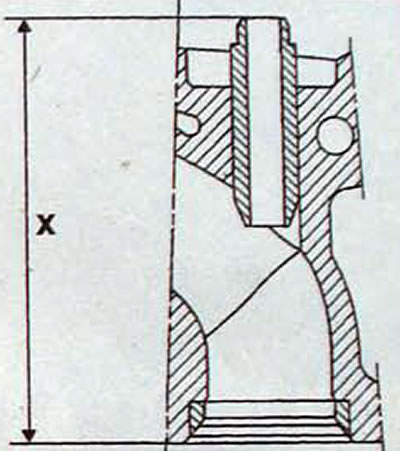
Fig. 3.54. Location for measuring the distance from the upper end of the guide sleeve to the lower plane of the cylinder head
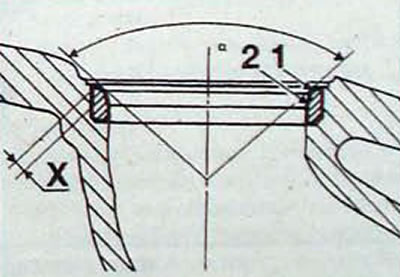
Fig. 3.55. Processing of valve seats: X - width of the working chamfer; 1 and 2 - processed chamfers
Note: After machining the valve seats, be sure to grind the valves.
- Check the smooth movement of the valve stems in the valve guides. %
- Check the calibration of the springs and replace them if necessary.
Cylinder head assembly
- Clean the cylinder head and all parts installed in the cylinder head
- Replace worn parts.
- Check the cleanliness of the lubrication holes to the camshaft bearings.
- Check for the presence of a drain valve on the camshaft bearing support on the vacuum pump side.
- Lubricate the first valve stem with engine oil and insert it into the guide.
- Install the oil deflector cap using a tubular mandrel.
- Install the lower spring seat, spring and upper spring seat.
- Compress the valve spring with a spring compressor and insert the crackers into the top of the valve stem.
- Slowly remove the spring compressor and check that the crackers are in place.
- Install the remaining valves into the cylinder head in the same manner.
- After all the valves are in place, lightly tap the top of the valve springs with a plastic-faced hammer to ensure that the keepers are seated properly.
- Using a dial indicator with bracket Renault Mot. 251-01 or Mot 252-01, check the valve recess in relation to the mating surface of the cylinder head.
- Install the pre-combustion chambers and use a dial indicator to measure their protrusion from the cylinder head.
- Install hydraulic valve clearance compensators and rocker arms.
- Install the camshaft.
Note: If new hydraulic valve lash adjusters are installed, tighten the camshaft bearing caps gradually on all five bearings.
- If hydraulic valve clearance compensators that have already been installed are in operation, all valves will be open after tightening the camshaft bearing cap bolts. In this case, it is prohibited to turn the camshaft for 16-20 minutes. After installing the cylinder head, it is necessary to run the engine for 5-10 minutes at a crankshaft speed of 2500 min⁻¹.
- Tighten the camshaft bearing cap bolts to the specified torque and measure the camshaft end play using a dial indicator and the appropriate bracket.
- Replace the camshaft seal using the Renault Mot. 1315 tool.
- Install the camshaft pulley, use the Renault Mot. 799 tool to lock the pulley from turning, screw in and tighten the pulley mounting bolt to the required torque.
- Further assembly of the cylinder head is carried out in the reverse order of disassembly, while it is necessary to observe the tightening torques of the threaded connections.
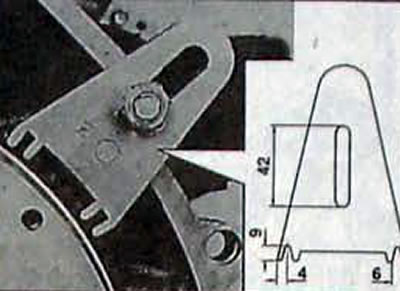
Fig. 3.56. Using the Renault Mot. 1316 device to lock the flywheel from turning