



Contents: Sensors 🠛 Executive devices 🠛
Sensors
The engine management system uses two types of sensors, called "active" or "passive" which differ in their internal functioning caused by their design. Active sensors operate autonomously and do not require external power supply. In contrast, passive sensors require external power supply to generate a signal. The electronic control unit receives information from the following sensors:
- intake manifold air pressure;
- throttle angle position;
- an inductive crankshaft speed and position sensor located near the flywheel ring gear and generating a sinusoidal voltage proportional to the engine operating mode. In order for the sensor to generate a specific crankshaft position signal, two teeth are missing on the ring gear. - camshaft position, the cylinder recognition sensor at the beginning of the intake stroke, located on the left side of the cylinder head, sends a signal which, in accordance with the signal sent by the crankshaft mode/position sensor, allows the control unit to calculate the cylinder located at the beginning of the intake stroke and determine the valve timing and ignition timing in the corresponding cylinder;
- concentration of oxygen in the exhaust gases, located in the exhaust pipe and generating a characteristic galvanic charge, which is an indicator of the oxygen content in the exhaust gases;
- a piezoelectric knock sensor mounted on the cylinder head that responds to high-frequency vibrations of the cylinder block that occur during detonation and transforms them into electrical signals, on the basis of which the control unit shifts the ignition timing towards delay;
- coolant temperatures with negative temperature coefficient (CTN);
- engine inlet air temperature with negative temperature coefficient (CTN);
- speed of the vehicle installed in the gearbox;
- switching on/off the air conditioning system: based on its signal, the control unit, depending on the engine operating mode, allows or prohibits the engagement of the air conditioning compressor clutch;
- oil pressure in the hydraulic drive of the power steering transmitting a signal to the engine control unit, if the pressure exceeds a certain value, the engine crankshaft speed increases;
- battery voltage, based on the signal from which the control unit adjusts the crankshaft speed at idle and compensates for the voltage drop when a large number of consumers are turned on, when the battery is only slightly charged.
Executive devices
The electronic unit controls the following devices
(View the original on the specified resource: www.renaultbook.ru)
- the fuel pump relay supplies voltage to terminal 52 of the engine control unit connector and powers the fuel pump, the activated carbon canister solenoid valve, the idle speed control valve, the cylinder recognition sensor at the beginning of the intake stroke, the lambda sensor and the injectors;
- an idle speed controller that changes the cross-section of the air supply channel bypassing the throttle valve, as a result of which the required crankshaft speed is maintained at idle speed;
- injectors, the opening time of which affects the amount of fuel injected;
- ignition coils, to which the ignition signal is transmitted by the control unit via the switch. Spark formation occurs simultaneously on two spark plugs of those cylinders whose pistons are in the TDC area, by interrupting the "ground" circuit of the corresponding ignition coil. Two ignition coils have two power contacts each and are controlled separately by the injection system control unit. The injection system control unit, depending on the signals from the crankshaft position sensor, pressure sensor and other sensors. but mainly, based on the data on the engine load and crankshaft speed, determines the optimal ignition timing in accordance with the program.
- electromagnetic valve of the activated carbon canister mounted on the right side in the rear part of the engine compartment and under certain conditions
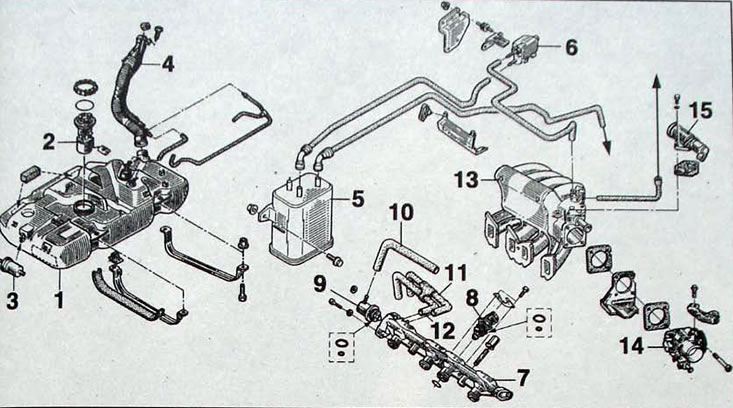
Fig. 1.12. Fuel system: 1 - fuel tank; 2 - fuel pump; 3 - fuel filter; 4 - fuel tank filler neck; 5 - adsorber; 6 - electromagnetic valve of the adsorber; 7 - fuel line; 8 - nozzle; 9 - pressure regulator; 10 - vacuum hose; 11 - fuel supply hose; 12 - fuel return hose; 13 - intake manifold; 14 - throttle assembly;15 - idle speed controller
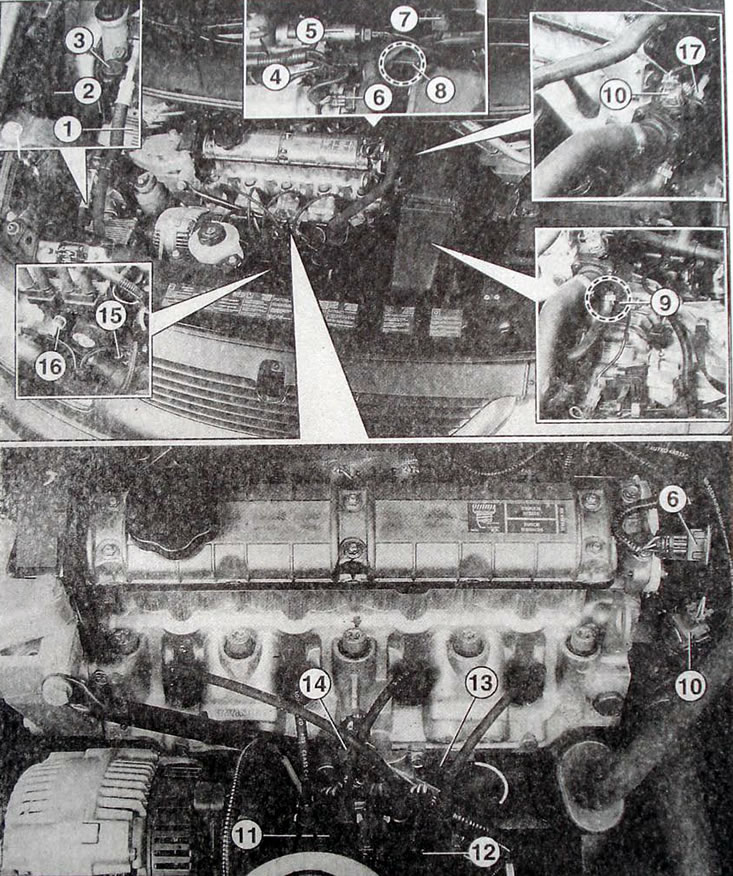
Fig. 1.13. Location of elements of the SIEMENS FENIX 5 engine control system in the engine compartment:1 - electronic control unit; 2 - canister with activated carbon adsorber); 3 - inertial shock sensor; 4 - throttle position sensor; 5 - idle speed controller; 6 - cylinder recognition sensor at the beginning of the intake stroke; 7 - air pressure sensor; 8 - air temperature sensor; 9 - TDC mode/position sensor; 10 - coolant temperature sensor; 11 - ignition coils of cylinders 2 and 3; 12 - ignition coils of cylinders 1 and 4; 13 - Noise suppression capacitor; 14 - knock sensor; 15 - oil level/temperature sensor; 16 - oil pressure sensor; 17 - coolant temperature sensor of the indicator in the instrument cluster
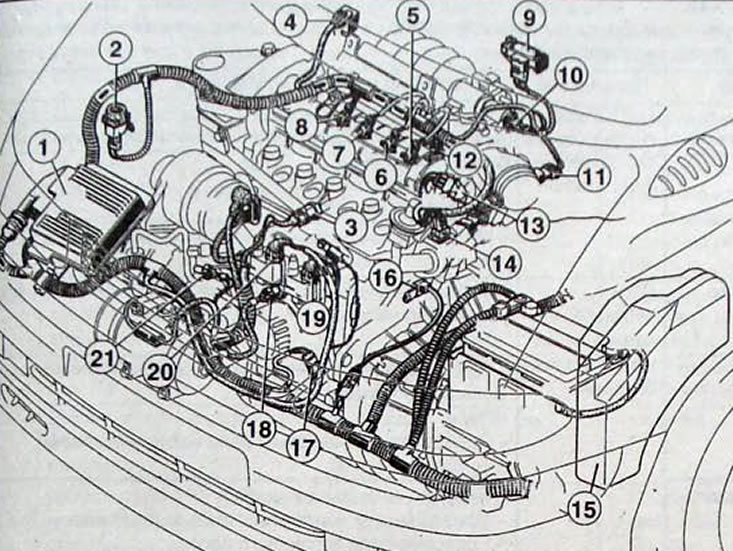
Fig. 1.14. Location of the SIEMENS FENIX 5 engine control system elements in the engine compartment: 1 - electronic control unit; 2 - inertial shock sensor; 3 - knock sensor; 4 - electromagnetic valve of the activated carbon canister; 5 - nozzle #1; 6 - nozzle #2; 7 - nozzle #3; 8 - nozzle #4; 9 - air pressure sensor; 10 - idle speed controller; 11 - air temperature sensor; 12 - throttle position sensor; 13 - cylinder recognition sensor at the beginning of the intake stroke; 14 - coolant temperature sensor; 15 - relay and fuse box; 16 - Crankshaft position/mode sensor; 17 - Oil level/temperature sensor; 18 - oil pressure sensor; 19 - ignition coils of cylinders 1 and 4; 20 - ignition coils of cylinders 2 and 3; 21 - Power steering hydraulic oil pressure sensor