English Русский
Български
Беларускі
Український
Српски
Hrvatski
Română
Polski
Slovenský
Magyar
Bookmark Contacts Articles Sitemap
Company vehicles Peugeot Company vehicles Opel Company vehicles Skoda Company vehicles Land Rover Company vehicles Mitsubishi Company vehicles Volkswagen Company vehicles Honda
RenaultBook.ru


Duster   Fluence   Kangoo   Laguna   Logan   Megane   Sandero   Scenic   Symbol   Clio   Other
Renault 19 (1988-1996) Espace I and II (1984-1996) Espace III (1996-2002)

Gas distribution mechanism drive belt (Renault Espace III)

  • Main
  • Renault
  • Espace III (1996-2002)
  • Power unit
  • Petrol engines F3R
  • Gas distribution mechanism drive belt
0
Contents: Removal 🠛 Installation 🠛
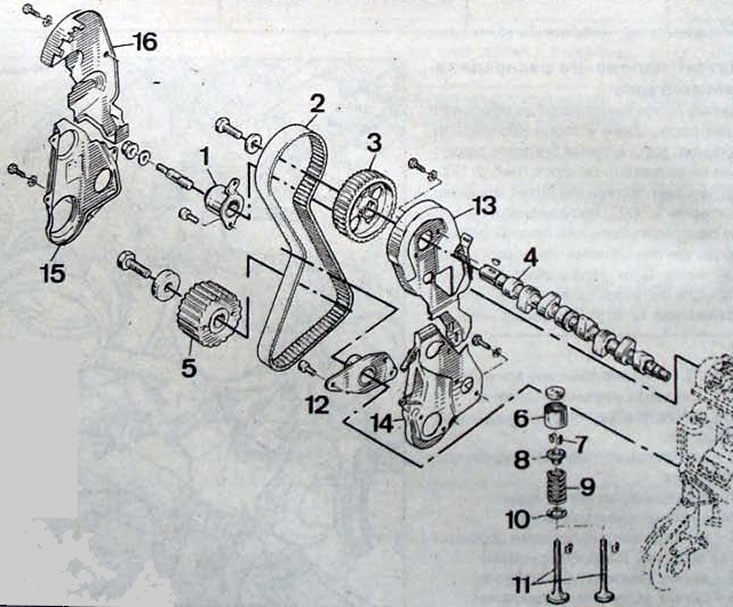
Fig. 1.18. Timing belt of the gas distribution / mechanism: 1 - tension roller; 2 - toothed timing…

Fig. 1.18. Timing belt of the gas distribution / mechanism: 1 - tension roller; 2 - toothed timing belt for gas distribution mechanism drive; 3 - camshaft pulley; 4 - camshaft; 5 - intermediate shaft pulley (f3R 728 engine) or idle pulley (engine /F3R 768); 6 - pusher; 7 - crackers; 8 - upper spring plate; 9 - valve spring; 10 - oil deflector cap; 11 - valves; 12 - tension roller; 13 - inner upper casing; 14 - inner lower casing; 15 - lower toothed belt casing; 16 - Upper toothed belt casing


Note. To check the timing belt tension, use the Tronic 105.6 instrument.


Removal


Place the vehicle on a two-post lift and raise the front wheels off the ground.

Disconnect the cable from the negative battery terminal.

Remove:
  • right front wheel;
  • right lower engine compartment shield:
  • protective liner of the front right wheel arch;
  • the intake pipe of the exhaust gas system.

Set the piston of the first cylinder to TDC. Turn the engine crankshaft with a key for the central bolt of the pulley fastening to the crankshaft in the direction of its normal rotation. You can also turn the crankshaft with the front wheel raised and 4th or 5th gear engaged. Use Locking Tool Mot. 1054 to fix the piston of the 1st cylinder at TDC.
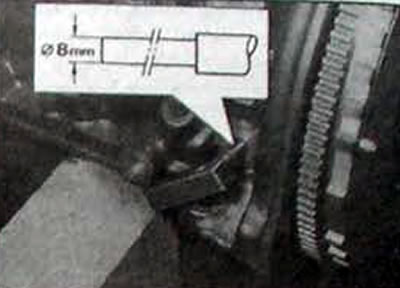


Fig. 1.19. Installation location and dimensions of the Renault MoL 1054 retainer for fixing the…

Fig. 1.19. Installation location and dimensions of the Renault MoL 1054 retainer for fixing the piston of the 1st cylinder at TDC


Use a wooden support to support the engine from below on the right side.

Remove:
  • pendulum suspension bracket and travel limiter;
  • cover of the timing belt of the gas distribution mechanism.
  • crankshaft pulley;
  • lower cover of the timing belt;
  • accessory drive belt.

Loosen the nut and bolt securing the tension roller and loosen the tension of the timing belt.

Disconnect the pendulum suspension bracket (3, Fig. 1.20) from the cylinder head.
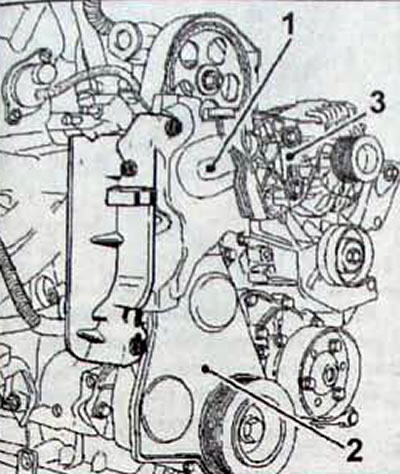
Fig. 1.20. Location of the upper (1) and lower (2) timing belt covers and pendulum suspension…

Fig. 1.20. Location of the upper (1) and lower (2) timing belt covers and pendulum suspension bracket (3)


Remove the bolts and timing belt covers.


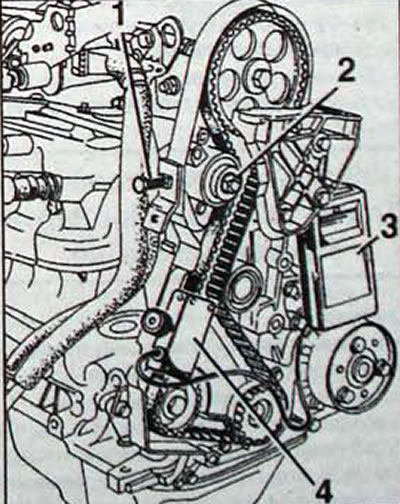
Release the tension roller (T, Fig. 1.21) timing belt. If the tension roller mounting nut is loosened more than one turn, the tension roller may come off the axle.
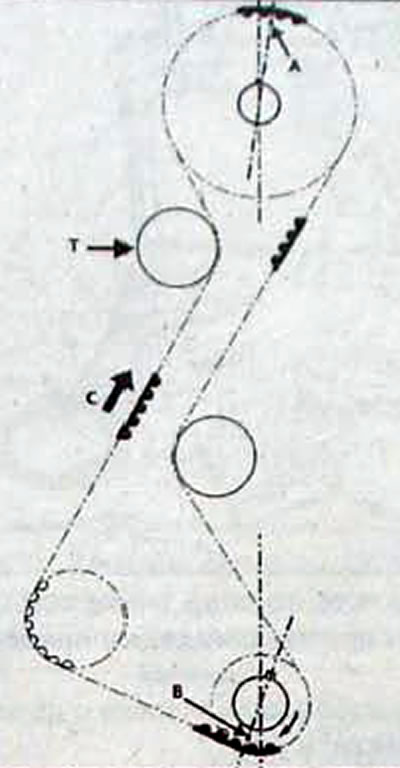
Fig. 1.21. Timing belt of the gas distribution mechanism: T - tension roller; C - direction of belt…

Fig. 1.21. Timing belt of the gas distribution mechanism: T - tension roller; C - direction of belt installation; A and B are the points between which there should be 61 tops of the belt teeth


Remove the timing belt. When removing the timing belt without replacing it, make sure that the belt has marks indicating its direction of rotation. If the marks are worn off, make marks before the camshaft and crankshaft pulley marks.

Note: The timing belt cannot be removed without first removing the pendulum suspension bracket.


Installation
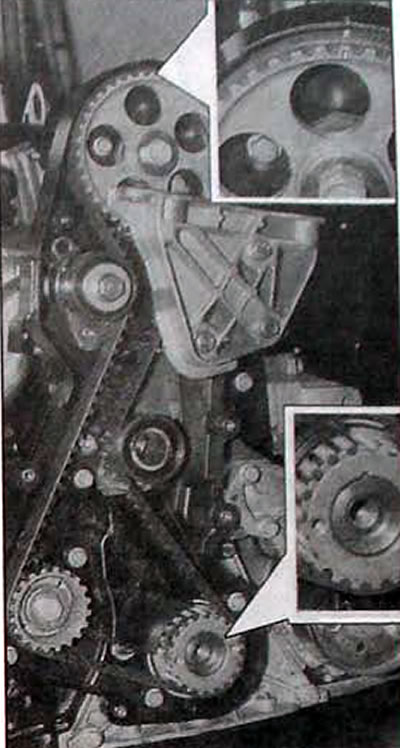


Fig. 1.22. Installing the timing belt

Fig. 1.22. Installing the timing belt


Attention: When replacing the timing belt, it is advisable to replace the tension roller.

  • Do not turn the engine crankshaft in the direction opposite to the operating direction.
  • Make sure that the TDC locking pin Mot. 1054 is in place.
  • Install the timing belt and the pendulum suspension bracket on the cylinder head, aligning the marks on the belt and pulleys. Pre-tighten the timing belt by turning the M6x45 bolt on the rear cover of the timing belt drive.
  • Install tool Mot. 1505.
  • Tighten the timing belt.
  • Using special tool Mot. 1543-02 with intermediate shaft and Mot. 1543-03 without intermediate shaft and a torque wrench set to a tightening torque of 11 Nm, apply a preliminary force to the section of the belt whose tension is adjustable.
  • Bring the Tronic 105.6 reading head close and take a measurement, then adjust the tension by turning the tensioner bolt until the pre-tension value T1 is reached.
  • Tighten the tensioner.
  • Turn the crankshaft four revolutions and set the timing belt back to the top dead center position.
  • Using a special tool and a torque wrench set to a tightening torque of 11 Nm, apply a preliminary force to the section of the belt whose tension is adjustable
  • Bring the Tronic 105.6 reading head close and take a measurement, then adjust the tension by turning the tensioner bolt until the pre-tension value T2 is reached.
  • Remove the tension sensor.
  • Belt tension setting, units SEEM 29
  • Minimum allowable operating tension, SEEM 27 units

Setting belt tension Hz:
  • T1 83±3
  • T2 77±5


Fig. 1.23. Timing belt tension: 1 - bolt M6x45; 2 - tension roller fastening nut; 3 - Tronic 105.6…

Fig. 1.23. Timing belt tension: 1 - bolt M6x45; 2 - tension roller fastening nut; 3 - Tronic 105.6 belt tension tester; 4 - tension check sensor
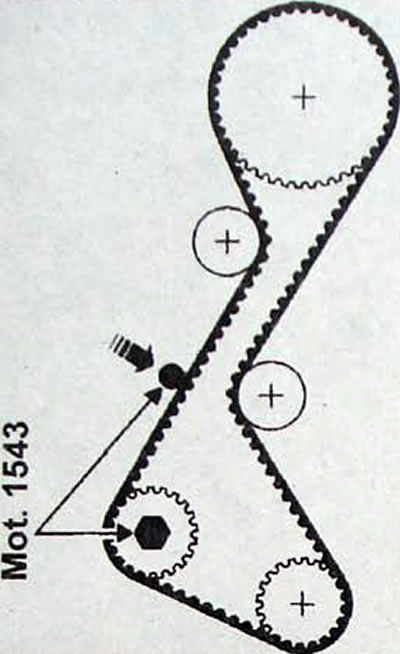

Fig. 1.24. Location of the check point and the point of application of the preliminary force. Using…

Fig. 1.24. Location of the check point and the point of application of the preliminary force. Using a special device, tighten the bolt lock nut to a torque of 50 N·m.


Note: Be sure to replace the crankshaft pulley mounting bolt with a new one, tighten it to a torque of 20 N·m, then turn it further by an angle of 115±15°.

  • Finally install the pendulum suspension bracket.
  • Using the centering fork Mot. 1289-02, center the pendulum suspension travel limiter.
  • Further installation is carried out in the reverse order of removal.
This article is available on: russian, bulgarian, belarusian, ukrainian, serbian, croatian, romanian, polish, slovak, hungarian
Article has been reviewed by editor: Trofimova Anastasia
Share with friends:
Previous
Espace III: Petrol engines F3R
Next

Diagnostic tests
Engine management
Idle speed correction
Siemens Fenix 5 Multi-Point Fuel Injection System
Engine repair
Using the Tronic 105.6 to check belt tension
Throttle assembly
Intake and exhaust manifolds
Fuel injectors
Fuel distribution line
Other articles on other Renault models

➽ Gas distribution mechanism drive belt Renault Kangoo 1 (1997-2007)
➽ Removal the timing belt of the gas distribution mechanism drive Renault Logan 2 (2012-2020)
➽ Removal, inspection and installation of the drive belt toothed… Renault Megane 1 (1995-2002)
➽ Timing belt of the gas distribution mechanism Renault Scenic 1 (1996-2003)
➽ Drive Belt Sprockets and Tensioner Mechanism — removal and… Renault Clio 1 (1990-1998)
Link to this article in different formats
Reviews and comments of visitors
No comments yet


Add two numbers 24 + 36


Renault 19 (1988-1996) 
  • General information
  • Maintenance
  • Power unit
  • Engine repair
  • Exhaust system
  • Cooling system
  • Supply system
  • Single-point injection
  • Multi-point injection
  • Diesel injection system
  • Transmission
  • Clutch
  • Car gearbox
  • Chassis, running gear
  • Car suspension
  • Steering
  • Brake system
  • Wheels and tires
  • Body and interior
  • Exterior (external elements)
  • Interior (internal elements)
  • Heating and ventilation
  • Electrical equipment
  • Equipment and devices
  • Headlights and lighting
  • Ignition system
  • Power devices
  • Electrical circuits
Espace I and II (1984-1996) 
  • General information
  • Introduction to the guide
  • Troubleshooting
  • Power unit
  • Engine repair
  • Cooling system
  • Carburetor fuel system
  • Injection fuel system
  • Diesel fuel system
  • Ignition system
  • Transmission
  • Clutch
  • Car gearbox
  • Drive shafts
  • Chassis, running gear
  • Brake system
  • Steering
  • Front suspension
  • Rear suspension
  • Body and interior
  • Exterior (external elements)
  • Interior (internal elements)
  • Doors, locks and windows
  • Electrical equipment
  • Equipment and devices
  • Electrical circuits
Espace III (1996-2002) 
  • General information
  • Introduction to the manual
  • User manual
  • Power unit
  • Petrol engines F3R
  • Petrol engines Z7X
  • Diesel engines G8T
  • Diesel engines G9T
  • Transmission
  • Clutch
  • Mechanical gearbox
  • Automatic gearbox
  • Drive shafts
  • Chassis, running gear
  • Steering
  • Front suspension
  • Rear suspension
  • Brake system
  • Body and interior
  • Exterior (external elements)
  • Interior (internal elements)
  • Doors, locks and windows
  • Heating and ventilation
  • Electrical equipment
  • Equipment and instruments
  • Power devices
  • Electrical circuits
RenaultBook.ru © 2018–2026 | Mobile version | News and articles | Sitemap: EN BG BY UA RS HR RO PL SK HU | Administration | Site search | Bookmark
Duster 1 (2009-2017) | Fluence 1 (2009-2020, petrol) | Kangoo 1 (1997-2007) | Laguna 2 (2001-2007) | Logan 1 (2004-2012, petrol) | Logan 2 (2012-2020) | Megane 1 (1995-2002) | Megan 2 (2002-2009, petrol) | Sandero 1 (2007-2012, petrol) | Scenic 1 (1996-2003) | Symbol 1 (1999-2008, petrol) | Symbol 2 (2008-2013, petrol) | Renault 19 (1988-1996) | Espace I and II (1984-1996) | Espace III (1996-2002) | Clio 1 (1990-1998) |
We want your visit to be comfortable 😌 and use cookies 🍪 to do so.