



Contents: Electrical power supply 🠛 Fuel system operation 🠛 Air supply system 🠛 Ignition system 🠛 Operating principle 🠛 Removal the cylinder detection sensor 🠛 Installing the cylinder detection…🠛 Adjusting the camshaft position…🠛 Anti-theft engine start blocking 🠛 Replacing the fuel injection system…🠛 Checking the operation of the…🠛
The multi-point fuel injection system ensures that each injector opens with the opening of the corresponding intake valve and is controlled by a programmed digital engine control unit, which also controls the ignition timing.
Electrical power supply
The engine control unit is supplied with a constant voltage of 12 V via contact 32 of the connector. The power supply circuit via contact 32 maintains the power supply of the control unit memory and is protected by fuse F10 3A, located in the passenger compartment of the car.
When the ignition is turned on, battery voltage is supplied to contact 24 of the engine control unit connector via the F38 30 A fuse located in the passenger compartment. In response, the engine control unit connects contact 48 of the connector to ground, which closes the fuel pump power supply circuit. The fuel pump power supply relay supplies voltage to contact 52 of the engine control unit connector and supplies the fuel pump, the activated carbon canister solenoid valve, the idle speed controller, the cylinder recognition sensor at the beginning of the intake stroke, the Lambda sensor and the injectors. At the same time, if no attempt is made to start the engine after 1 second (no signal from engine crankshaft position sensor), the engine control unit breaks the electrical circuit connecting pin 48 of the connector to ground, thus cutting off power to some components of the fuel system. This power will only be restored if the engine control unit receives a signal from the crankshaft speed sensor.
Inertial sensor (switch) the impact switch is designed to turn off the electrically driven fuel pump if the vehicle has been subjected to a significant impact, eliminating the risk of vehicle fire. If the vehicle's engine does not start after a collision, the impact sensor may have been activated, so you must turn on the switch by pressing the button protected by an elastic casing.
Fuel system operation
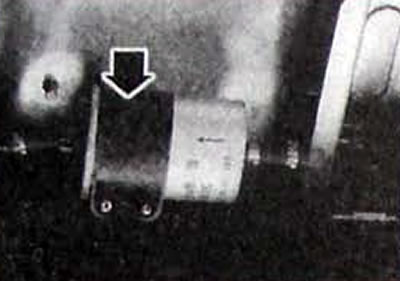
Fig. 1.5. Installing the fuel filter, the arrow on the filter must match the direction of the fuel flow or the "OUT" mark must be directed towards the right side of the vehicle
An electric fuel pump located in the fuel tank supplies fuel under pressure to the fuel line via a fuel filter. The pressure regulator maintains the pressure at 2.5-3 bar regardless of fuel consumption by the fuel injectors, returning excess fuel to the fuel tank.
The fuel vapor recovery system prevents fuel vapors from evaporating into the atmosphere from the fuel tank, thereby preventing the formation of photochemical smog. The fuel tank cap is completely hermetic, and there is a tube connected to a canister with activated carbon to remove fuel vapors
Fuel vapors are accumulated in a canister with activated carbon. When the engine is running, the electronic control unit opens the valve and fuel vapors enter the engine, where they are burned.
Air supply system
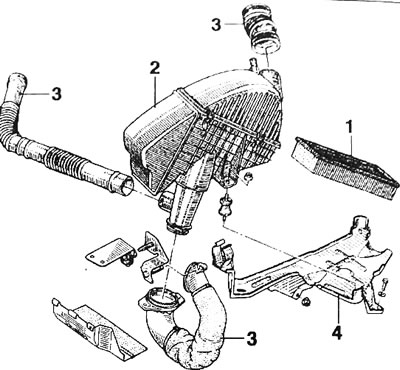
Fig. 1.6. Air supply system: 1 - air filter; 2 - air filter housing; 3 - air ducts; 4 - bracket
Fresh air is taken in at the top left of the engine compartment and cleaned by a filter. One electromagnetic valve, acting as an idle speed regulator, passes a certain small amount of air bypassing the throttle valve and controls the crankshaft speed at idle depending on the engine operating conditions.
Ignition system
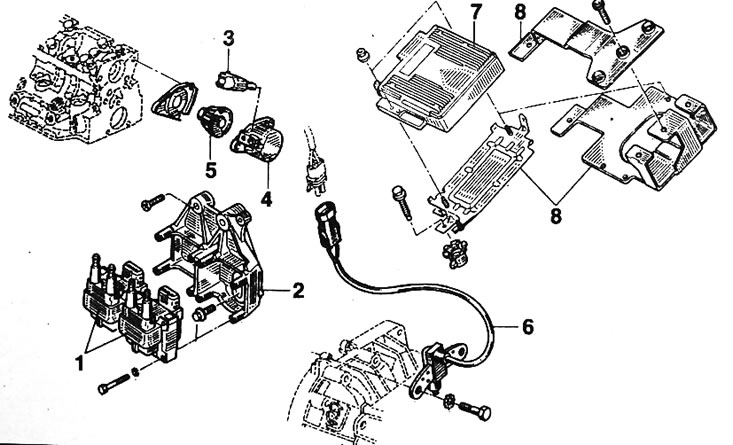
Fig. 1.7. Elements of the ignition system:1 - ignition coils; 2 - ignition coil mounting bracket; 3 - cylinder recognition sensor at the beginning of the intake stroke;4 - cap; 5 - cylinder detection sensor; 6 - TDC mode/position sensor; 7 - fuel injection and ignition system control unit; 8 - bracket
The ignition system is designed to ignite the fuel-air mixture in each cylinder at a precisely set time. In gasoline engines, this is achieved by an electric spark (electrical discharge), created between the spark plug electrodes.
The static ignition system differs from the classic ignition system by the absence of an ignition distributor and the presence of two ignition coils with two power contacts.
The system consists of:
- injection system control unit with an ignition power module integrated into it;
- two ignition coils with double power contact;
- four spark plugs;
- noise suppression capacitor.
The injection system control unit, depending on the signals from the crankshaft position sensor, pressure sensor and other sensors, but mainly on the basis of data on the engine load and crankshaft speed, determines the optimal ignition timing in accordance with the program.
The ignition signal is transmitted by the control unit to the switch, which controls two ignition coils. Spark formation occurs simultaneously on two spark plugs of those cylinders whose pistons are in the TDC area, by interrupting the "ground" circuit of the corresponding ignition coils. The two ignition coils have two power contacts each and are controlled separately by the injection system control unit.
The ignition coils are equipped with three-pin electrical connectors of different colors.
One ignition coil has a black electrical connector and generates simultaneous high-voltage pulses for spark plugs of cylinders 1 and 4 and is controlled via channel 28 of the injection unit.
The second ignition coil has a grey electrical connector and generates simultaneous high-voltage pulses for spark plugs of cylinders 2 and 3 and is controlled via channel 29 of the injection unit.
Both ignition coils are connected to the same interference suppression capacitor.
The flywheel ring gear has 60 identical teeth of a given size, spaced at a given interval. Two teeth are missing, thus forming an absolute position mark located at an azimuth of 84° (or 14 teeth around the circumference) to the TDC position of the pistons of the 1st and 4th cylinders. That is, the crown actually has 58 teeth.
Operating principle
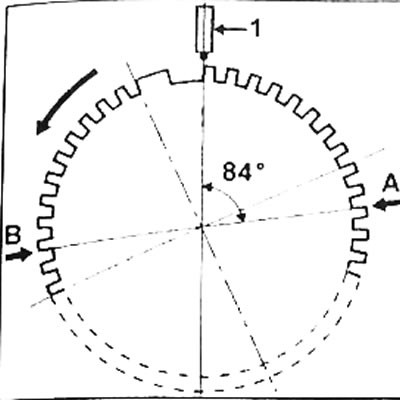
Fig. 1.8. Location of teeth on the flywheel: A - TDC position of pistons of the 1st and 4th cylinders; B - TDC position of pistons of the 2nd and 3rd cylinders; 1 - mode sensor
Cylinders 1 and 4 are at top dead center when the location marked by the arrow (A, Fig. 1.8). passes in front of the mode sensor 1.
Cylinders 2 and 3 are at top dead center when the location marked by arrow B passes in front of the mode sensor (1, Fig. 1.8).
The injection system control unit recognizes the TDC position of the pistons of the 1st and 4th cylinders by the passage of the 15th tooth in front of the crankshaft sensor (after an elongated tooth). As a result, the injection control unit, by counting the number of teeth, determines the angle to the TDC of the pistons, when ignition should be carried out, depending on the calculated ignition advance angle required at the moment. The TDC of the pistons of the 2nd and 3rd cylinders is determined by the passage of the 45th tooth in front of the crankshaft sensor (after an elongated tooth).
Note: Correction of the ignition timing angle is also performed based on the signal from the knock sensor.
Removal the cylinder detection sensor
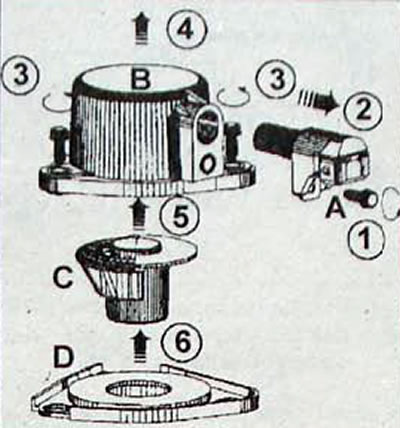
Fig. 1.9. Sequence of removing the cylinder detection sensor: A - cylinder detection sensor; B - cap; C - target; D - protective plate
Article reprinted from the website RenaultBook
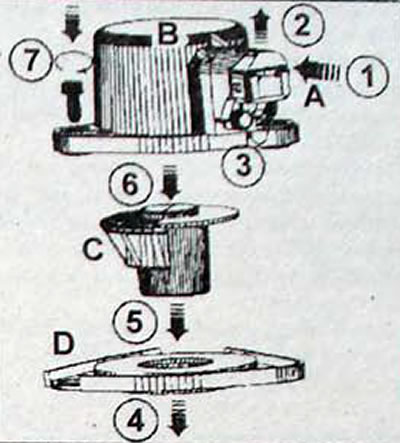
Fig. 1.10. Sequence of installation of the cylinder detection sensor: A - cylinder detection sensor B - cap; C - target; D - protective plate
- Disconnect the electrical connector from the sensor.
- Remove one bolt and remove the cylinder detection sensor (A. Fig. 1.9).
- Remove three bolts and cap (B).
- The target (C) is held on the end of the camshaft by a retaining ring. To remove the target, place the end of a drift on the rear of the target, use a hammer to strike the drift briefly and gently, and remove the target (C) and plastic protective plate (D).
Caution: Be sure to follow the sequence below for installing the cylinder detection sensor, otherwise it may cause the sensor to malfunction and/or fail.
Installing the cylinder detection sensor
- Install the sensor on the cap, press it upwards and tighten it to a torque of 15 Nm
- Install the plastic protective plate.
- Install a target that has a feature that prevents it from being installed incorrectly. Before inserting the target into the camshaft, check that it is positioned correctly.
- Install the cap with the sensor and tighten the three cap mounting bolts to a torque of 10 Nm.
Adjusting the camshaft position sensor clearance
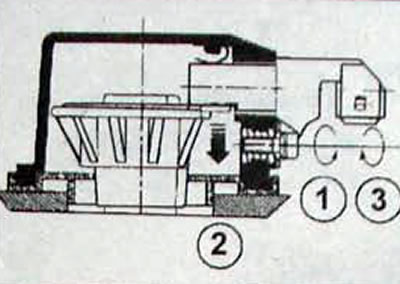
Fig. 1.11. Sequence of adjustment of the camshaft position sensor clearance
- The adjustment consists of releasing the sensor mounting bolt without touching the sensor and tightening the bolt to a torque of 8 Nm.
- When the bolt is released, the sensor is released and a spring built into the cover moves the sensor towards the target.
- When the bolt is tightened, the sensor is fixed.
- The sensor has two plastic grooves that contact the target. These grooves are partially erased during the first revolutions of the target after the engine is started, as a result of which there is no direct contact and the gap is adjusted.
If the grooves are completely worn out, it is impossible to adjust the gap and the sensor must be replaced.
Attention. After installing the sensor, it is necessary to check its adjustment. To do this, use the voltmeter function of the XR25 diagnostic tool. On the connected sensor, slide the rubber protective cap of the connector. Start the engine and check the voltage at contact No.2 of the sensor (contact in the center). The voltage shown by the device should alternate (sometimes 0, sometimes 12 V). Otherwise, readjust the sensor.
Anti-theft engine start blocking
The car is equipped with a 2nd generation engine anti-theft system.
Replacing the fuel injection system control unit
Fuel injection system control units are supplied as spare parts uncoded but ready for coding.
When replacing the unit, you need to enter a code unique to each car. Then check the operation of the anti-theft engine blocking system. To do this, simply turn on the ignition for a few seconds, then turn it off and remove the key from the ignition.
Checking the operation of the anti-theft engine start immobilizer system
Remove the key from the ignition switch, after 10 seconds the red engine immobilizer system indicator light should flash.
Operation of the injection system and air conditioning system When the air conditioning system is switched on, the idle speed of the crankshaft increases to 900 min⁻¹. Under certain operating conditions, the injection system control unit prohibits the compressor from switching on and operating.
The compressor must not be turned on for 10 seconds after the engine has started. The compressor will not turn on if the coolant temperature is over 115°C. The compressor must not be turned on or running if the engine crankshaft speed exceeds 6000 min⁻¹.