



Contents: Angle of longitudinal inclination of…🠛 Camber angle 🠛 Angle of transverse tilt of the axis…🠛 Convergence 🠛 Checking the front wheel alignment…🠛
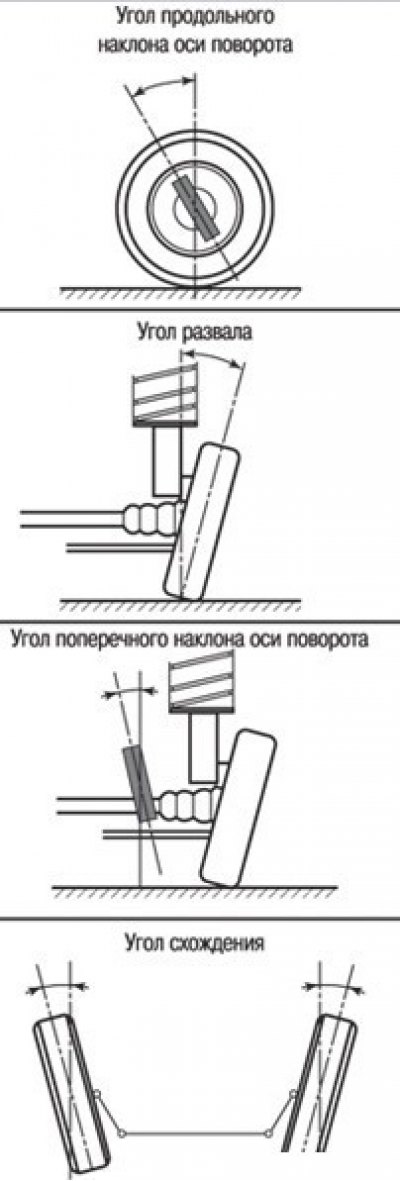
Figure 6.30. Front wheel alignment angles
The front wheel alignment angles are shown in Figure 6.30.
Angle of longitudinal inclination of the axis of rotation
Pivot point is an imaginary line drawn through the axis of the front suspension shock absorber and extended to the point of contact with the road.
The specified angle is measured between the vertical and the pivot axis. The angle is considered positive if the pivot axis is tilted back from the top of the vertical. This angle is not adjusted during operation. Its value can be measured on a special stand and plays a role in the restoration of suspension or body elements after an accident.
Camber angle
This is the angle between the vertical and the plane of rotation of the wheel, when viewed from the front of the car.
Original publication on the portal [RenaultBook]
The angle is considered positive if the plane of rotation of the wheel is tilted outward from the vertical, and negative if the plane of rotation of the wheel is tilted inward from the vertical.
The camber angle is not adjustable; it is provided for reference when restoring the kinematics of the front wheels as a result of an accident.
Angle of transverse tilt of the axis of rotation
This is the angle between the steering axis and the vertical drawn through the wheel axis and the contact patch of the wheel with the road.
The angle is not adjustable and is provided for reference in case of restoration of the front wheel kinematics as a result of an accident.
Convergence
This is the difference in distance between the wheel rims at the front and rear, measured at the height of the hubs. If the distance at the front is smaller, the toe-in is considered positive, and vice versa. Toe-in is measured in millimeters or degrees, taking the central axis of the car as zero. Toe-in is adjusted by loosening or tightening the steering tips, which changes the overall length of the steering rods.
Checking the front wheel alignment angles
Checking the front wheel alignment angles is a precise and complex operation, which is practically impossible for a car owner to perform independently. In car centers, complex optical stands are used for checking and adjusting, which are capable of performing this work with great accuracy.
Wheel alignment angles that differ from those recommended by Renault result in poor handling, vehicle stability and increased wear on the wheel tread.
It is recommended to check and adjust the front wheel alignment angles regularly, and after working on the suspension or steering.
For reference, Table 6.1 shows the control values for the front wheel alignment angles depending on the ground clearance.
Table 6.1. Front wheel alignment angles depending on ground clearance

The permissible difference in angles between the right and left wheels is no more than 1°.
Toe angle (mm) of the front wheels 0°16'±20', or (1.6±2.0) mm.