



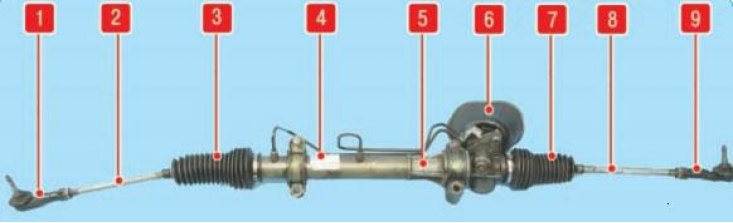
Steering gear: 1 - right steering rod end; 2 - right steering rod; 3, 7 - protective covers; 4 - extension of the steering gear housing; 5 - steering gear housing; b - gear shaft; 8 - left steering rod; 9 - left steering rod end
Special tool:
- Hose Pliers - Mot. 453-01
- Ball joint puller - T.Av. 476
Tightening torques:
- Wheel bolt - 90 Nm
- Ball joint nut - 37 Nm
- Steering gear mounting nut - 50 Nm
- Steering shaft universal joint bolt - 25 Nm
- Torque tie rod bolt - 65 Nm
Removal the steering gear
On models with air bags, disconnect and connect the steering shaft from the steering gear only with the steering wheel in the straight-ahead position and the steering gear in the center position. Otherwise, the air bag unit current collector may be damaged.
- place the car on a lift;
- disconnect the lead from the negative terminal of the battery;
- set the steering wheel to the straight ahead position and lock it;
- remove the front wheels;
- install clamps (or special pliers Mot. 453-01) on all hoses coming from the booster reserve tank with working fluid to reduce fluid loss;
Caution! Never pinch high pressure pipes.
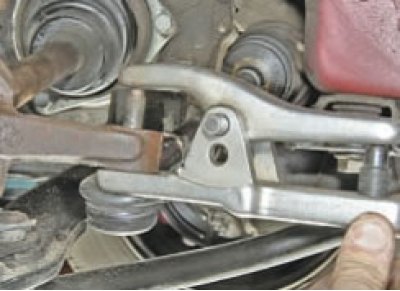
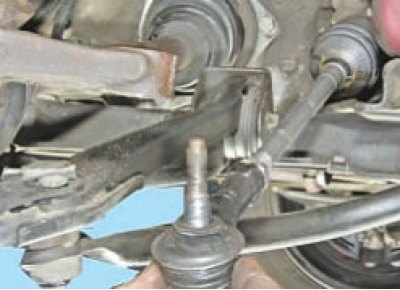
- Loosen the nuts securing the ball joints of the steering rod ends. Disconnect the rods from the steering knuckles using a universal puller by pressing out the pins of the ball joints of the steering rods from the steering knuckles;
 |
 |
You can find the original at this link: renaultbook.ru
Note: If you do not have a special puller, you can knock out the ball joint pin by sharp blows of a hammer on the end of the pivot arm boss, striking along the axis of the arm.
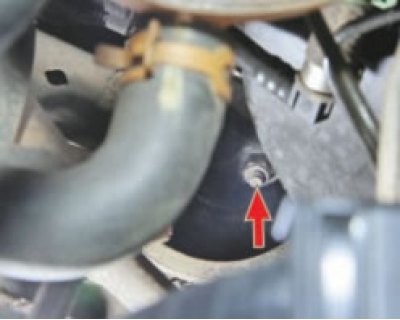
- bend back the boot covering the lower universal joint of the steering shaft under the vehicle and unscrew the eccentric bolt of the universal joint cross clamp;
 |
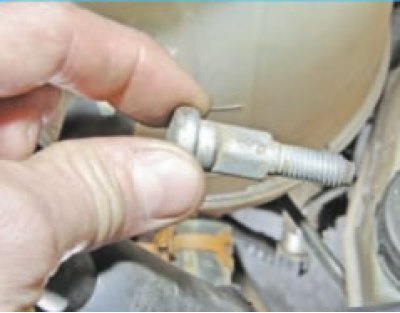 |
- mark the relative position of the clamp and the shaft in an accessible way;
- disconnect the exhaust gas oxygen sensor connector;
- remove the intake pipe of the exhaust system;
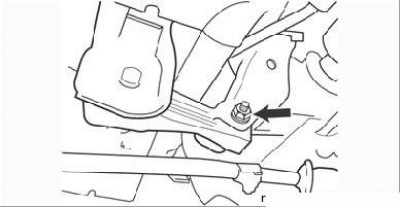
Figure 6.4. Engine thrust mounting bolt
- unscrew the engine support jet rod mounting bolt (Figure 6.4) and tilt the power unit forward by inserting a wooden block between the engine and the engine shield;
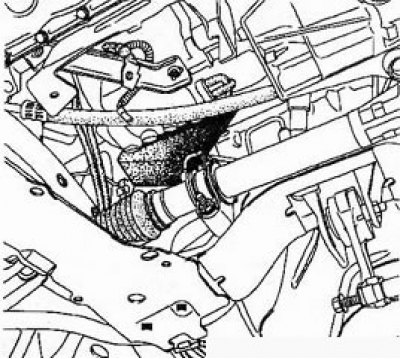
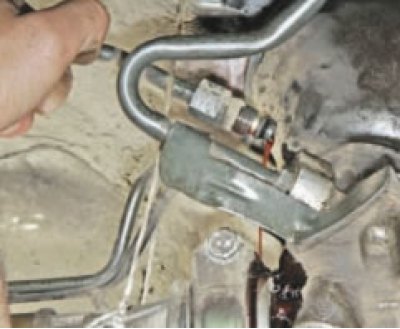
- disconnect the low and high pressure lines from the steering gear housing (taking measures to collect the leaking working fluid) and unscrew the pipe bracket mounting nut. Plug the holes to prevent dirt from entering the system;
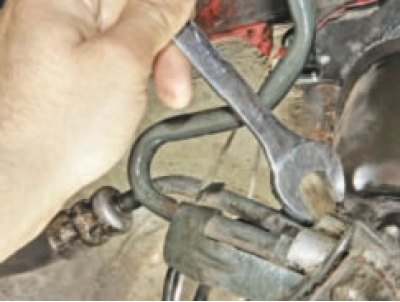 |
 |
Caution! Do not remove the pipes connecting the distributor to the power cylinder.
Note:
- Do not remove the steering tube between the valve and the cylinder.
- Install plugs on open fittings.
- unscrew the two nuts securing the heat shield of the right support of the steering gear housing;
- unscrew the four nuts and remove the bolts securing the steering gear to the rear of the subframe. Remove the clamps and mounting brackets on both sides of the steering gear;
- remove the steering gear from under the car;
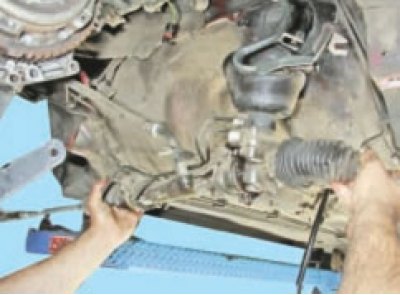
- check the condition of the steering gear by visual inspection. Replace damaged and worn out mechanism supports if necessary. The rack should move freely in the housing throughout its entire travel without jamming; if such damage is present, replace the entire mechanism. The covers must not have cracks or tears, and leaks of working fluid are not allowed.
Installation is carried out in the reverse order of removal, while observing the specified tightening torques.
Fill the power steering system with working fluid. Turn the wheels right and left (with the engine not running), to distribute the working fluid throughout the system. Repeat the operation with the engine running, then top up the reservoir with fluid to the normal level. When installing a new steering gear, the ball joints of the tie rod ends are set to the position marked during removal. To do this, unscrew the bolt of the wheel alignment adjusting sleeve and the tie rod end, holding the inner ball joint of the tie rod with a flat wrench. Mark the position of the ball joint of the tie rod end or count the number of threads in engagement to pre-adjust the wheel alignment. Check and adjust the wheel alignment if necessary.