



Fan thermal switch
Checking the serviceability
1. Checking the serviceability of the switch is described in Section Checking the serviceability, removal and installation of the electric fan.
Removal
1. The switch is screwed into the left side of the radiator. Allow the engine to cool before attempting to remove it.
2. Disconnect the ground cable from the battery (on Scenic models, refer to Chapter Engine electrical equipment).
3. Partially drain the cooling system until the level drops below the switch. Alternatively, find a suitable plug and seal the opening under the switch in the radiator after removing it. If using the second method, work very carefully to avoid damaging the radiator.
4. Disconnect the electrical wiring connector from the switch.
5. Carefully unscrew the switch from the radiator and remove the sealing ring (where is available). If the fluid has not been drained from the system, seal the opening under the switch.
Installation
1. If the switch was installed using an O-ring, replace the seal. Where there was no O-ring, clean the switch threads and coat them with fresh sealant.
2. Install in reverse order. Tighten the switch and bring the coolant level in the cooling system to the normal level.
3. Finally, start the engine and allow it to warm up to normal operating temperature. Make sure the fan runs for a few minutes after warming up.
Coolant Temperature Indicator/Warning Lamp Sensor
Checking the serviceability
1. The coolant temperature gauge/warning light sensor is mounted in the thermostat housing on the left end of the cylinder head. On petrol models, this is the upper of the two sensors located on the front wall of the thermostat housing; on diesel models, the sensor is mounted at the end of the housing.
2. The constant voltage to the temperature gauge is supplied from the power supply wire of the instrument panel (through the ignition switch and fuse). The ground connection circuit of the pointer gauge is closed by the sensor. The sensor contains a thermistor - an electronic component whose electrical resistance decreases as it heats up. Until the engine is warmed up, the resistance of the sensor is high and the current passing through the pointer is low, causing the pointer to remain in the "cold" sector of the scale. As the coolant temperature rises and the resistance of the sensor drops, the pointer moves to the upper edge of the scale. If the sensor is faulty, replace it.
3. Voltage is supplied to the coolant temperature control lamp from the instrument panel. The circuit connecting to the lamp ground is closed by the sensor. The sensor acts as a switch that is triggered at a certain temperature.
4. If the temperature gauge is out of order, first check the operation of other devices. If they do not work, check the power supply to the instrument panel. If the instrument readings are variable, the stabilizer may be faulty and needs to be replaced (the stabilizer is built into the printed circuit board of the instrument panel - contact Chapter 12). If only the temperature gauge is faulty, check it as follows.
5. If after warming up the engine the pointer remains in the "cold" sector of the scale, disconnect the sensor wiring connector and ground the corresponding wire to the cylinder head. If now after turning on the ignition the pointer deflects, the sensor is faulty and should be replaced. If the pointer still does not move, remove the instrument cluster (Chapter On-board electrical equipment) and check the resistance of the wiring between the sensor and the pointer, as well as the power supply part of the circuit. If the circuit is continuous, the pointer itself is faulty and should be replaced.
6. If the pointer remains in the "hot" sector of the scale after the engine has cooled down, disconnect the sensor wiring. If now, when you turn on the ignition, the pointer returns to the "cold" sector, the sensor is faulty and must be replaced. If the pointer still does not move, check the rest of the circuit as described above.
7. The control lamp circuit is checked in a similar manner.
Removal and installation
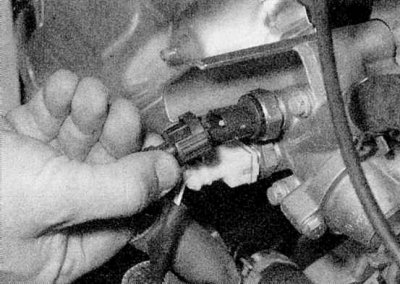
1. On petrol models, the removal and installation of the sensor are carried out similarly to the procedures described in paragraphs Removal and Installation (FAN THERMAL SWITCH).
2. For diesel models, refer to paragraphs Removal and Installation (FAN THERMAL SWITCH), remembering that the sensor is secured in the housing with brackets. Press the sensor into the housing, then use a small flat-head screwdriver to push out the retaining bracket and remove the sensor and sealing ring. When installing, place a new sealing ring on the sensor, then press the sensor into the thermostat housing and secure it in the working position with a bracket.
Fuel injection system coolant temperature sensor - petrol models
Checking the serviceability
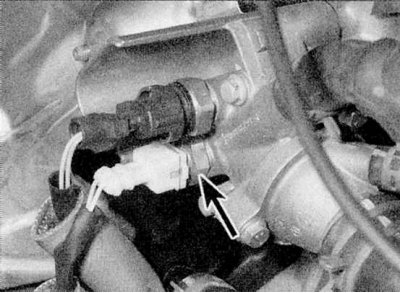
1. The fuel injection system coolant temperature sensor is located in the thermostat housing. It is the lower of the two sensors screwed into the front of the housing (refer to the accompanying illustration).
2. The sensor is a thermistor. The engine/fuel injection system electronic control unit (ECU) supplies a certain voltage to the sensor and then measures the current in the sensor circuit to determine the engine temperature. This information, in combination with other data, is then used to adjust the injection duration. On some models, the idle speed and/or ignition timing also change depending on the temperature.
Removal and installation
1. Remove and install the sensor using the information provided in the Removal and Installation paragraphs (FAN THERMAL SWITCH).