



Contents: Models without air conditioning 🠛 Models with air recirculation mode 🠛 Models with air conditioning 🠛
Models without air conditioning
Heater/Ventilation Control Panel
1. Disconnect the ground cable from the battery.
2. Remove the cigarette lighter as described in Chapter On-board electrical equipment.
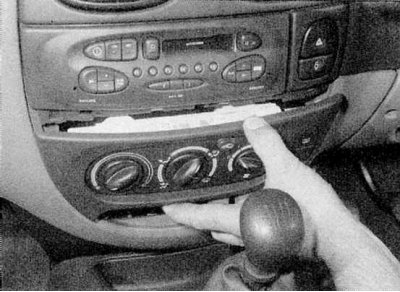
3. Disconnect the control unit and remove it from the panel (refer to the accompanying illustration).
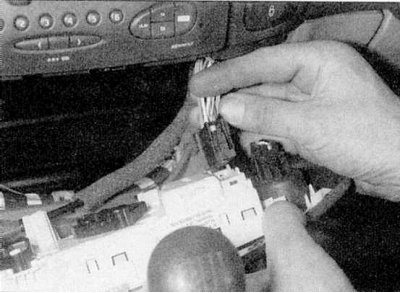
4a. Disconnect the electrical wiring connectors.
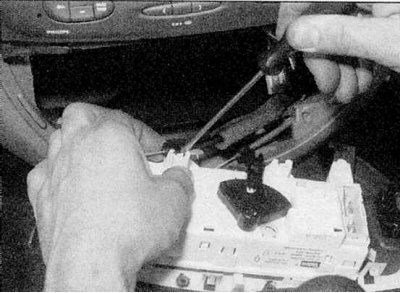
4b. Then disconnect the cable housing brackets from the block.
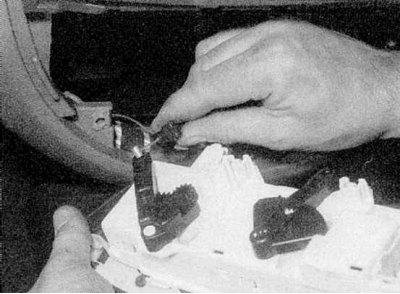
4c. Separate the cables from their levers. Note that the control cables are color-coded to help avoid confusion when installing them (refer to the illustrations). If necessary, disconnect the control unit from the instrument panel.
5. Install in reverse order. Make sure that the control cables are securely attached to the corresponding lever (the air temperature control cable is marked in red, and the air distributor cable is marked in blue). Check the operation of the control handles before installing the cigarette lighter.
Heater control cables
1. Remove the control unit as described in the paragraphs above. Access to the cable fasteners on the right side of the air distributor housing can be obtained both from under the instrument panel and through the control unit opening.
2. Mark the control cables and their mounting brackets on the air distributor housing to avoid confusion of the cables during installation.
3. Unhook the clamps, then separate the cables from the housing and levers and remove them from the panel. Note that the cables are color-coded to avoid confusion during installation.
4. When installing, bring the cable to the working position, using the color marks as a guide. The air temperature control cable has a red mark, the air distributor cable has a blue mark.
5. Attach the cables to the levers and attach their housings to the air distributor housing. Using the marks made before removal, attach both cables with clamps. Install the control unit and check its operation.
Heater blower motor
1. Disconnect the ground cable from the battery. Proceed as described in Chapter On-board electrical equipment, remove both wiper arms.
2. Remove the seal from the top edge of the engine compartment bulkhead.
3. Loosen the mounting screws and remove the ventilation panel on the left side of the windshield.
4. Loosen the two mounting screws and remove the plastic cover from the left side of the blower motor.
5. Disconnect the wiring connectors on the right side of the blower motor assembly and remove the right mounting bolt located below the connectors.
6. Disconnect and remove the water deflector, then loosen the left mounting bolt of the blower motor assembly and remove the motor from the left side.
7. Install in reverse order, after checking the condition of the blower motor seal.
Heater Blower Motor - Non-Air Conditioning Models with Air Recirculation Mode
8. Follow the steps described in the paragraphs above.
9. Disconnect the electrical connectors from the right end of the blower motor housing, then remove the mounting bolt.
10. Loosen the mounting bolts and remove the reinforcing bar installed between the front suspension strut towers.
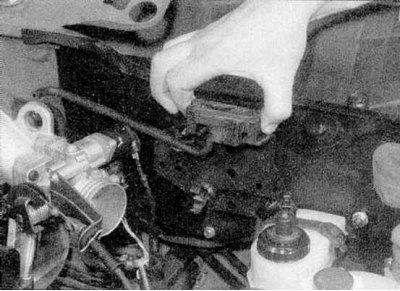
11. On gasoline models, follow these steps to prepare to remove the left side of the engine compartment bulkhead:
- a) On 1.4L models, remove the air cleaner housing and disconnect the MAP sensor and ignition control unit from the bulkhead.
- b) On 1.6L models, remove the intake manifold and separate the IAP sensor from the bulkhead (refer to Chapter Power and exhaust systems) (refer to the accompanying illustration).
- c) On 2.0L models, remove the accelerator pedal cable retainer and associated switches.
22. On diesel models, for the same purpose, do the following:
- a) Release the heating unit from the bulkhead (refer to Chapter Engine electrical equipment).
- b) Separate the solenoid valves from the bulkhead (where are there)
- c) Remove all tubes/hoses and their mounting brackets from the bulkhead.
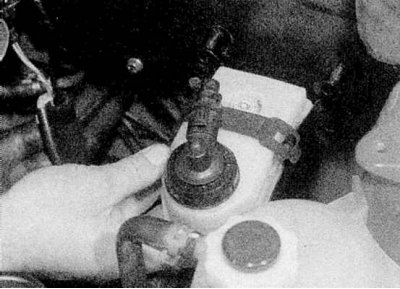
12. On models equipped with a separate brake hydraulic reservoir, loosen the mounting nuts and remove the brake master cylinder reservoir bracket from the bulkhead (refer to the accompanying illustration). Move the reservoir to the side, keeping it upright to avoid spilling liquid.
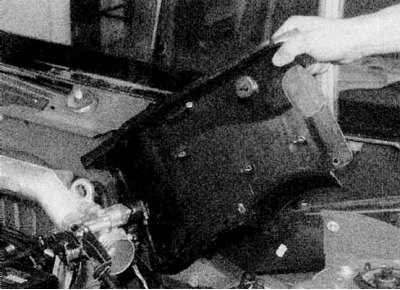
13. On all models, unscrew the mounting bolts and remove the thermal insulation (where is available). Loosen and remove the five mounting bolts and remove the thermal insulation (where is available). Loosen and remove the five mounting bolts and remove the bulkhead panel from the engine compartment (refer to the accompanying illustration).
14. On models with a two-piece blower motor housing, loosen the mounting screws and remove the top cover. Loosen the bolts holding the two halves of the housing together, then separate the halves and remove the right half of the housing. Disconnect the wiring connector from the blower motor, then loosen the two mounting bolts and remove the left half of the blower housing. Loosen the mounting screws and remove the motor assembly.
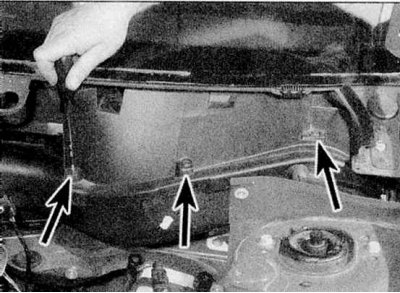
15a. On models with a one-piece supercharger motor housing, remove the mounting screws.
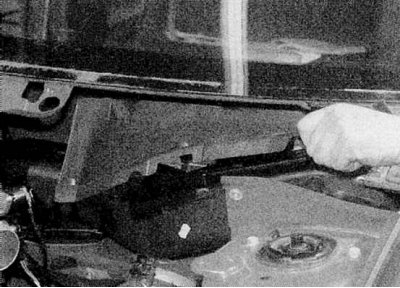
15b. Remove the top cover from the casing.
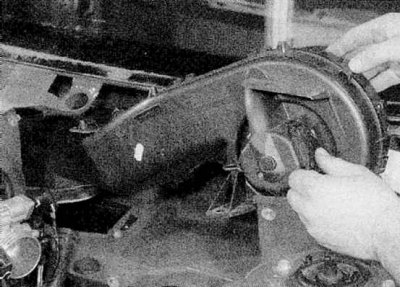
15c. Loosen and remove the mounting bolts and remove the assembly from the operating position (refer to the illustrations).
16. Install in reverse order, after checking the condition of all housing seals. Check the operation of the blower motor before installing the bulkhead.
Supercharger Motor Control Unit
1. Disconnect the ground cable from the battery.
2. Acting in accordance with the description in Chapter On-board electrical equipment, remove both wiper arms.
3. Remove the seal from the top edge of the engine compartment bulkhead.
4. Loosen the mounting screws and remove the air vent deflector panel on the left side of the windshield.
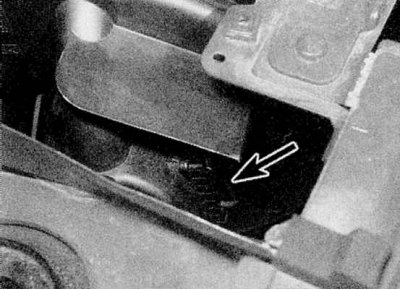
5. On models with recirculated air mode, disconnect the wiring harness connectors from the control unit mounted on the blower motor housing (right side). On some models, you will also need to disconnect the wiring harness connector from the blower motor and release it from its brackets so that it can be removed along with the control unit (refer to the accompanying illustration). Loosen the mounting screws, then release the brackets and remove the control unit.
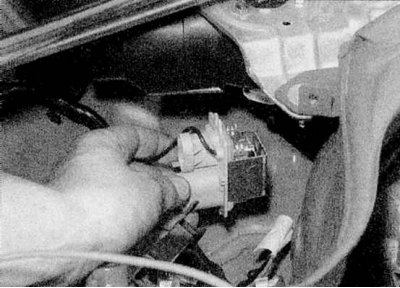
6. On models without recirculation mode, the control unit is mounted on the right side of the blower motor. Disconnect the wiring, then unscrew the mounting screws (where are there) and disconnect the unit from the supercharger motor housing (refer to the accompanying illustration).
7. Perform installation in reverse order.
Air distributor casing
1. Drain the cooling system. Alternatively, clamp the heat exchanger hoses as close to the engine compartment bulkhead as possible.
2. Remove the instrument panel assembly as described in Chapter Body.
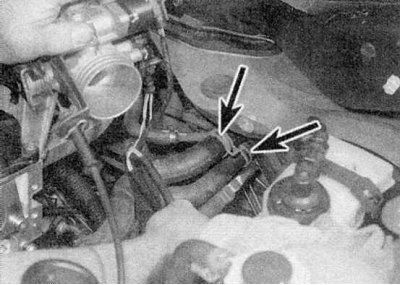
3. Loosen the clamps and remove the cooling system hoses from the heater heat exchanger pipes (refer to the accompanying illustration).
4. Remove the blower motor/housing as described earlier in this Section to gain access to the air distributor housing mounting bolt.
Note: On models with a two-piece casing, it is sufficient to remove only the right half of the casing.
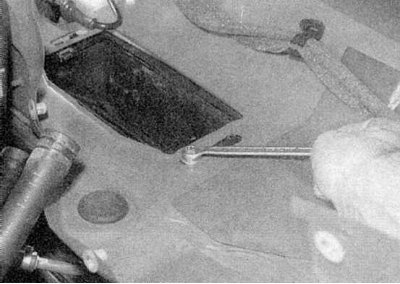
5. Loosen and remove the air distributor housing bolt (refer to the accompanying illustration).
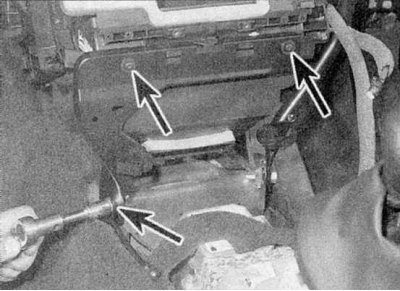
6. Working inside the cabin, loosen and remove the cover mounting screws located at the center console level, then unscrew the bolt securing the lower bracket to the floor and remove the bracket (refer to the illustrations).
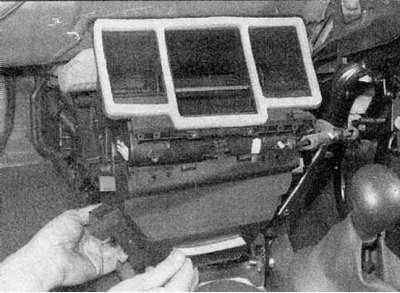
7. Carefully separate the lower duct and housing assembly from the bulkhead and remove it from the vehicle (refer to the accompanying illustration). When removing the casing, try to keep the heater heat exchanger pipes upward to avoid spilling coolant. As a precaution, place a rag around the casing and immediately wipe off any spilled coolant with a damp cloth.
8. Install in reverse order. Note that the lower mounting bracket bolt should be tightened only by hand at first, and finally tightened after the supercharger motor housing is installed. Finally, fill the cooling system.
Heat exchanger heater
Note: Minor leaks from the heater heat exchanger can be repaired using a special sealant without removing the heat exchanger.
1. Remove the air distributor housing as described earlier in this Section.
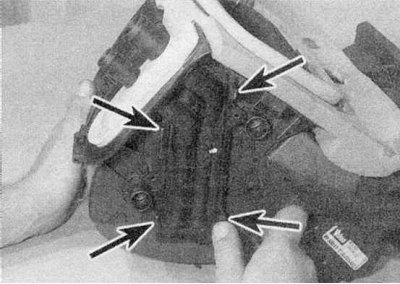
2a. Loosen and remove the mounting screws (where are there), then release the mounting brackets.
Original publication on the portal: www.RenaultBook.ru
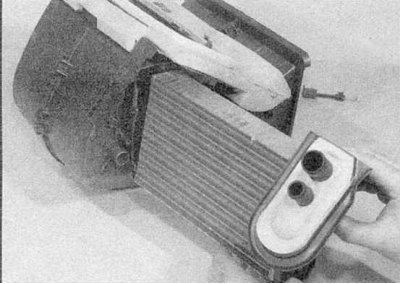
2b. Remove the heater heat exchanger from the casing, being careful not to damage its plates (refer to the illustrations).
3. Install in reverse order. If the fastening brackets were damaged during removal, attach the heat exchanger with screws using the holes on it.
Models with air recirculation mode
EGR valve flap motor
1. Remove the blower motor housing as described earlier in this Section.
2. Follow the wiring from the damper motor back, releasing it from the mounting brackets, and disconnect the connector.
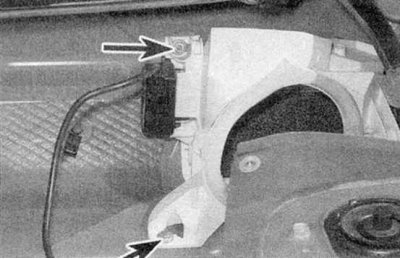
3. Loosen the mounting nuts and remove the damper housing assembly (refer to the illustrations).
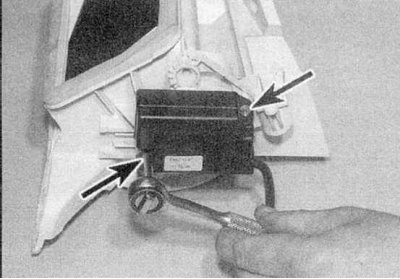
4a. Place the assembly on the workbench, loosen and remove the mounting screws.
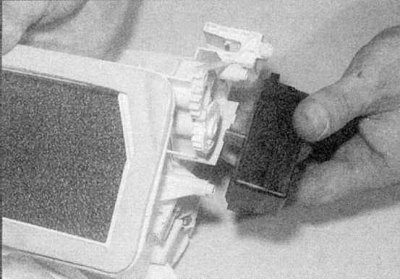
4b. Separate the motor and damper drive gears from the housing (refer to the illustrations).
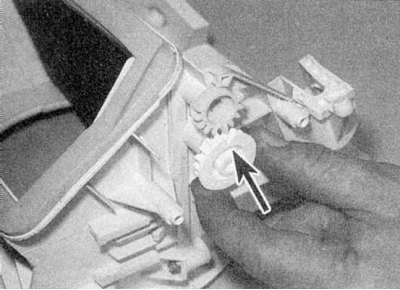
5. Install in reverse order, making sure that the drive gears are correctly engaged - the groove on the motor gear must be aligned with the locking lug on the damper gear (refer to the accompanying illustration). Connect the motor to the gear and tighten the fasteners securely.
Models with air conditioning
1. On models equipped with air conditioning, the car owner can only remove/install the panel and heater control cables, as well as the blower motor control unit. These actions are similar to those described above for models without air conditioning.
2. Removal of the supercharger motor, air distributor housing, heater heat exchanger and recirculation flap motor must be entrusted to a Renault service station, as this requires discharging the air conditioning system (refer to Section Removal and installation of heater components (scenic models)).
Warning! Do not disconnect any air conditioning system components until the air conditioning system is discharged. Refer to the precautions in Section General Description and Precautions - Air Conditioning System.