



Contents: Vacuum brake booster 🠛 Master brake cylinder 🠛 Pressure regulator 🠛 Brake fluid level sensor 🠛 Brake system fittings and pipes 🠛 Brake fluid 🠛 Frequency of brake fluid replacement 🠛
Vacuum brake booster
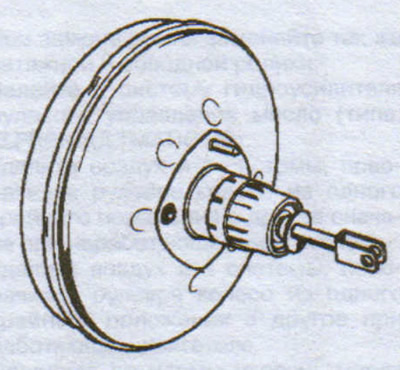
The vacuum brake booster reduces the force on the brake pedal, making it easier to drive. The vacuum amplifier uses a diaphragm, which creates a vacuum on both sides during normal operation. When braking, air is applied from one side of the diaphragm, forming atmospheric pressure. Due to the pressure difference transmitted through the diaphragm, the pusher moves in the direction of vacuum (vacuum), providing an auxiliary force for braking. When the brake pedal is released, air is pumped out of the booster cavity through the control valve, creating a vacuum.
Master brake cylinder
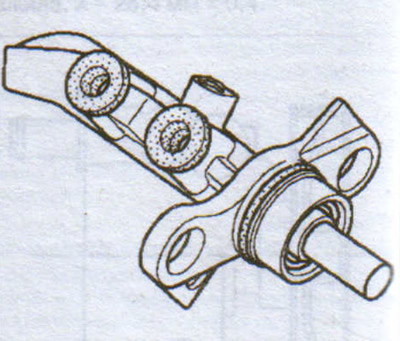
The brake master cylinder is used on dual circuit brake systems. The front right and rear left brakes are actuated by the primary piston, and the front left and rear right brakes are actuated by the secondary piston. The brake master cylinder combines the functions of a standard dual brake master cylinder, as well as a low brake fluid level indicator and brake pressure regulator.
Pressure regulator
The pressure regulator limits the output pressure to the rear brakes after the pressure reaches the maximum value in the master cylinder. The regulator is used when it is necessary to apply less force to the rear brakes to achieve optimal braking.
Brake fluid level sensor
The brake fluid level sensor, located in the brake fluid reservoir, turns on the "BRAKE" indicator lamp when it detects a low brake fluid level. Once the brake fluid level reaches the required level, "BRAKE" goes out.
Brake system fittings and pipes
The connection of the pipes between the master brake cylinder, brake calipers and hydraulic block is carried out by means of threaded fittings with metric threads.
Brake fluid
Brake technology and, in particular, disc brakes (hollow pistons that transfer little heat, a small amount of fluid in the cylinder, floating calipers that eliminate the need to have a relatively large reserve of working fluid in the least cooled part of the wheel), allows to minimize the risk of "vapor locks" even in case of frequent and prolonged use of brakes (in the mountains). However, the characteristics of the brake fluid deteriorate somewhat during the first months of operation due to slight absorption of moisture. This causes the need to replace the brake fluid.
Frequency of brake fluid replacement
As the brake linings wear out, the brake fluid level in the reservoir gradually decreases.
There is no need to compensate for this decrease, the level will be restored at the next replacement of the brake pads. At the same time, the level must not be allowed to fall below the minimum permissible level mark.
Mixing two incompatible brake fluids in a hydraulic system can result in significant fluid leaks, primarily due to seal deformation.
To prevent this, only use brake fluids that have been tested and approved by the technical department and that meet the SAE J 1703-DOT4 standard.
For optimal operating conditions of the brake system of RENAULT vehicles, we recommend using low-viscosity brake fluids at low temperatures (no more than 750 mm / s at 40°C).
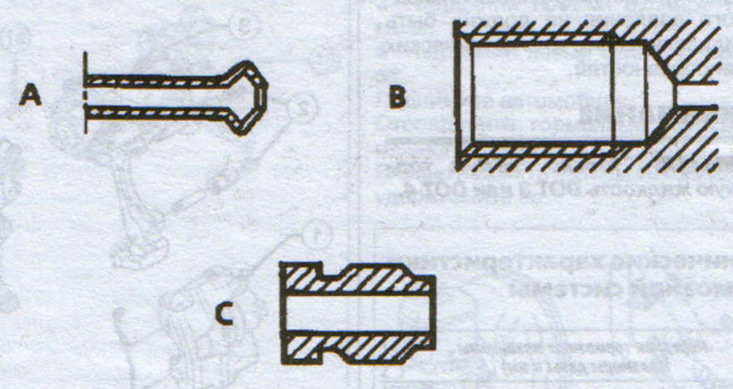
Identification of brake system nipples:
A - shape of steel or copper tube tips;
B — the shape of the threaded recesses in the nodes;
C - fittings with six outer edges of 11 mm.