



Note: Please note that there is minor damage to the radiator (minor leaks) can be eliminated using a special sealant without removing the radiator.
Removal
1. Disconnect the ground cable from the battery (on Scenic models, refer to Chapter Engine electrical equipment).
2. Drain the fluid from the cooling system.
3. Disconnect the electrical wiring connector from the fan and its switch (screwed into the left side of the radiator).
4. Loosen the clamps and separate the cooling system hoses from the radiator (refer to Section Disconnecting and replacing cooling system hoses).
5. Remove the left front turn signal unit as described in Chapter On-board electrical equipment.
6. Unscrew the central screw securing the radiator grille and remove the connecting strip.
7. Loosen the mounting screws, then loosen the lower brackets, move the left and right sections of the radiator grille forward and remove them from the vehicle.
8. Loosen and remove the nuts/bolts securing the upper radiator brackets to the hood crossmember. If the bolt/nut is difficult to access, try to separate the radiator from the bracket.
9. Remove the six crossmember mounting bolts from the hood, then remove the crossmember from the vehicle. Remove the brackets and rubber seals from the top of the radiator.
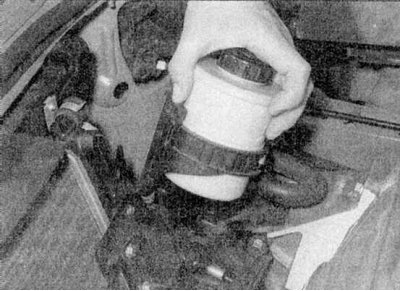
10. Where necessary, disconnect the power steering fluid reservoir and move it away from the radiator (refer to the accompanying illustration).
11. On models with air conditioning, loosen and remove the mounting bolts and nuts and separate the filter drier tank from the rear of the radiator. Remove the bolts securing the condenser to the front of the radiator and separate it as well.
Caution! Do not disconnect any air conditioning system components until the air conditioning system is discharged. Refer to the precautions in Section Removal and installation of heater components (scenic models).
12. Make sure all pipes/wires are disconnected, then lift the radiator and fan assembly out of the engine bay, being careful not to lose the rubber portions of the lower radiator mounts.
Inspection
1. If the radiator was removed because it was suspected of being blocked, back flush it. Clean dirt and debris from the radiator fins using compressed air (protect your eyes with glasses) or a soft brush. Be careful not to cut yourself on the sharp plates or damage them.
2. If necessary, have a specialist perform a special radiator blockage test.
3. Have a leaking radiator repaired by a professional. Do not attempt to weld or solder it, as this may damage adjacent plastic components.
4. Minor radiator leaks can be repaired with a suitable sealant without removing the radiator.
5. If the radiator is to be replaced or repaired, remove all hoses and the fan switch from it (where is available).
6. Check the condition of the radiator rubber mounts and replace them if necessary.
Installation
1. Install in reverse order, placing each rubber cushion in its original place. Finally, fill the cooling system.