



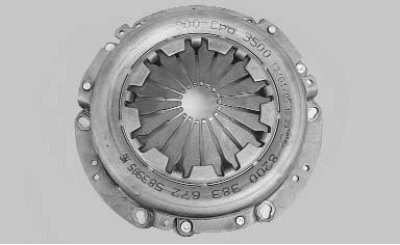
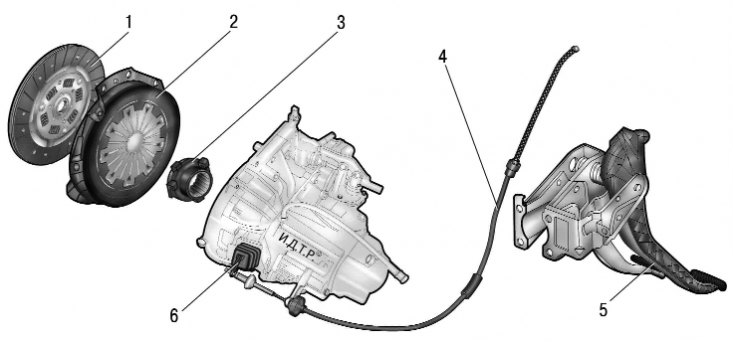
6.1. Clutch and its release drive: 1 – driven disk; 2 – clutch housing with pressure plate; 3 – clutch release bearing; 4 – clutch release cable; 5 – clutch pedal; 6 – clutch release fork
The pressure plate is mounted in a stamped steel casing 2 (figure 6.1), bolted to the engine flywheel.
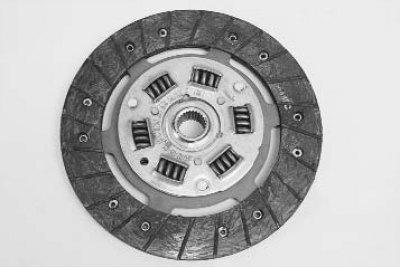
Driven disk 1 is mounted on the splines of the primary shaft of the gearbox and is clamped by a diaphragm spring between the flywheel and the pressure plate.
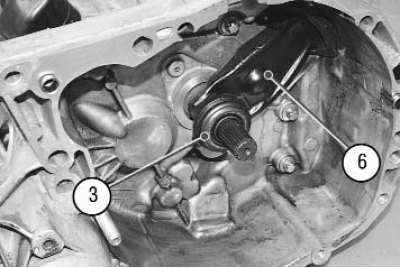
The bearing 3 of the clutch release is of a closed type, which does not require lubrication during operation, and is installed on a guide sleeve pressed into the hole of the clutch housing. The guide sleeve is a non-separable unit, including a seal and a front bearing of the primary shaft. The bearing is moved by a fork 6, installed on a ball joint screwed into the clutch housing. The fork is inserted into the grooves of the bearing coupling without additional fastening.
The free arm of the clutch release fork, sealed in the clutch housing with a rubber boot, is acted upon by the clutch release drive cable 4, the other end of which is secured to the clutch pedal sector 5. The pedal travel during operation is adjusted as the driven disk linings wear out by the adjusting nut installed on the threaded end of the cable (see "Replacing and adjusting the clutch release cable").
The clutches of 1.4 and 1.6 liter engines are identical in design and differ only in the diameters of the driven and pressure plates. For a 1.4 liter engine, the diameter is 180 mm, for a 1.6 liter engine - 200 mm. The working stroke of the outer arm of the clutch release fork also differs slightly, which for a 1.4 liter engine is 28-33 mm, for a 1.6 liter engine - 30-35 mm.
Note. To ensure long and trouble-free service of the clutch, do not keep your foot on the clutch pedal all the time. This bad habit is often acquired during driving lessons at driving schools out of fear of not having time to disengage the clutch when the car stops. In addition to the rapid fatigue of the foot, which is always above the pedal, the clutch is at least slightly pressed, and the driven disk slips and wears out. In addition, although the release bearing is designed to operate in a constant rotation mode, when the pedal is pressed even slightly, it is under load and its service life is reduced.
For the same reason, we do not recommend keeping the clutch in the disengaged position for a long time (for example, in traffic jams). If you don't have to move off right away, it's better to put the gearbox in neutral and release the pedal.
Clutch slippage can be easily detected using a tachometer. If, while driving, when you sharply press the accelerator pedal, the revs increase sharply, and then drop slightly and the car begins to accelerate, the clutch requires repair.