
English Русский
Български
Беларускі
Український
Српски
Hrvatski
Română
Polski
Slovenský
Magyar
Bookmark Contacts Articles Sitemap
Company vehicles Peugeot Company vehicles Opel Company vehicles Skoda Company vehicles Land Rover Company vehicles Mitsubishi Company vehicles Volkswagen Company vehicles Honda
RenaultBook.ru


Duster   Fluence   Kangoo   Laguna   Logan   Megane   Sandero   Scenic   Symbol   Clio   Other
Symbol 1 (1999-2008, petrol) Symbol 2 (2008-2013, petrol)

Description of the clutch design (Renault Symbol 2)

  • Main
  • Symbol
  • Symbol 2 (2008-2013, petrol)
  • Transmission
  • Clutch
  • Description of the clutch design
0
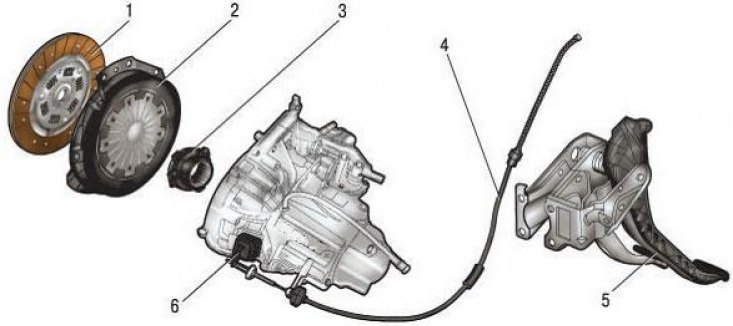
Clutch and its release drive: 1 - slave disk; 2 - clutch housing with pressure plate; 3 - clutch…

Clutch and its release drive: 1 - slave disk; 2 - clutch housing with pressure plate; 3 - clutch release bearing; 4 - clutch release cable; 5 - clutch pedal; 6 - clutch release fork

Clutch and its release drive: 1 - slave disk; 2 - clutch housing with pressure plate; 3 - clutch…


The clutch serves to briefly disconnect the running engine from the gearbox and drive wheels and smoothly connect it when the car starts moving, as well as to change gears in the gearbox while driving. In addition, the clutch serves to protect the engine and gearbox parts from overloads that occur in certain road situations (sudden braking or acceleration). The clutch is installed only on vehicles with a manual transmission.

The clutch drive is cable-operated with automatic adjustment of the gap that occurs when the friction linings wear out.


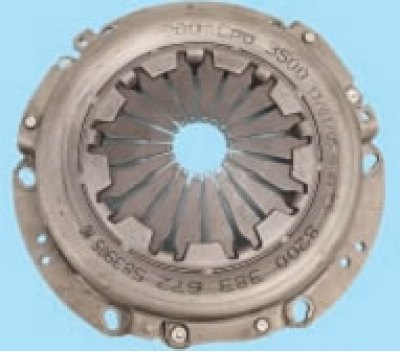
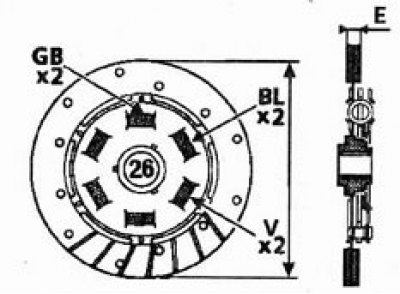
The clutch is a dry single-disk clutch with a central pressure spring of the diaphragm type. Structurally, the clutch consists of a clutch housing with a pressure plate, a driven disk and a clutch release mechanism. The driven disk with a spring damper is put on the splines of the primary shaft of the gearbox. The diameter of the driven disk is 200 mm. The disk includes two friction linings, the thickness of which in a compressed state is 6.8 mm.

When the clutch pedal is pressed, the force is transmitted via the cable drive to the clutch release lever, as a result of which the clutch release bearing located in the clutch moves, which compresses the central part of the diaphragm spring. The outer ends of the spring move the pressure plate away from the linings of the driven disk and the latter moves away from the flywheel. The clutch is disengaged, and the rotation of the crankshaft is not transmitted to the gearbox.

When the pedal is released, the pressure plate again presses the driven disk against the flywheel. Now rotation from the flywheel through the hub of the driven disk is transmitted to the primary shaft of the gearbox.

K4J


26 splines

26 splines
D = 200 mm
E = 6.8 mm
GB = grey-blue
BL = light blue
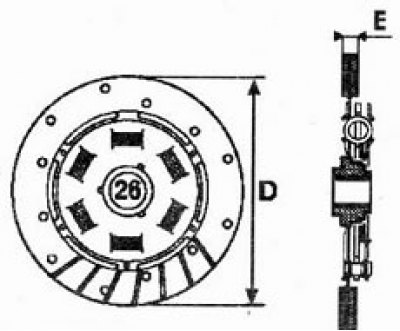
V = green K7J


26 splines

26 splines
D = 181.5 mm
E = 6.8 mm


The clutch is dry, single-disc, cable-controlled and has constant pressure on the release bearing.
This article is available on: russian, bulgarian, belarusian, ukrainian, serbian, croatian, romanian, polish, slovak, hungarian
Article has been reviewed by editor: Kupriyanov Sergey
Share with friends:
 
Symbol 2: Clutch
Next

 
Possible clutch malfunctions
Removal, checking and installation the clutch
Clutch bearing — removal and installation
Clutch cable — removal, inspection and installation
Clutch pedal — removal and installation
Other articles on other Renault models

➽ Description of the clutch design Renault Logan 1 (2004-2012, petrol)
➽ Clutch — design features Renault Sandero 1 (2007-2012, petrol)
➽ Clutch — design description Renault 19 (1988-1996)
➽ Clutch specifications Renault Duster 1 (2009-2017)
➽ Clutch — General Information Renault Fluence 1 (2009-2020, petrol)
Link to this article in different formats
Reviews and comments of visitors
No comments yet


Add two numbers 34 + 42


Symbol 2 (2008-2013, petrol) 
  • General information
  • User manual
  • Maintenance
  • Power unit
  • Engine repair
  • Cooling system
  • Fuel system
  • Exhaust system
  • Ignition system
  • Transmission
  • Clutch
  • Mechanical gearbox
  • Automatic gearbox
  • Drive shafts
  • Chassis, running gear
  • Front suspension
  • Rear suspension
  • Steering
  • Brake system
  • Body and interior
  • Exterior (external elements)
  • Interior (internal elements)
  • Doors, locks and windows
  • Heating and ventilation
  • Electrical equipment
  • Equipment and devices
  • Headlights and lighting
  • Power devices
  • Electrical circuits
Symbol 1 (1999-2008, petrol) 
  • General information
  • User manual
  • Car care
  • Maintenance
  • Power unit
  • Engine repair
  • Cooling and lubrication system
  • Supply system
  • Exhaust system
  • Ignition system
  • Transmission
  • Clutch
  • Mechanical gearbox
  • Automatic gearbox
  • Drive shafts
  • Chassis, running gear
  • Car suspension
  • Steering
  • Brake system
  • Body and interior
  • Exterior (external elements)
  • Interior (internal elements)
  • Doors, locks and windows
  • Restoration and repair
  • Electrical equipment
  • Equipment and devices
  • Headlights and lighting
  • Power devices
  • Heating and ventilation
  • Electrical circuits
RenaultBook.ru © 2018–2026 | Mobile version | News and articles | Sitemap: EN BG BY UA RS HR RO PL SK HU | Administration | Site search | Bookmark
Duster 1 (2009-2017) | Fluence 1 (2009-2020, petrol) | Kangoo 1 (1997-2007) | Laguna 2 (2001-2007) | Logan 1 (2004-2012, petrol) | Logan 2 (2012-2020) | Megane 1 (1995-2002) | Megan 2 (2002-2009, petrol) | Sandero 1 (2007-2012, petrol) | Scenic 1 (1996-2003) | Symbol 1 (1999-2008, petrol) | Symbol 2 (2008-2013, petrol) | Renault 19 (1988-1996) | Espace I and II (1984-1996) | Espace III (1996-2002) | Clio 1 (1990-1998) |
We want your visit to be comfortable 😌 and use cookies 🍪 to do so.