



Note: When replacing the clutch release bearing due to noise, check the condition of the drive disc pressure spring petals. If the ends of the petals are heavily worn where they contact the bearing, replace the drive disc assembly.
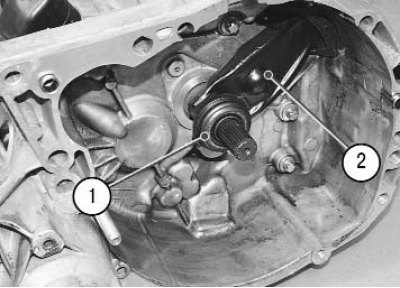
The clutch release bearing 1 assembled with the coupling is mounted on the guide sleeve and connected to the clutch release fork 2. The fork is inserted with its journals to the stop into the blind grooves of the bearing coupling and rests on the ball joint screwed into the clutch housing. The fork is fixed in a certain position by its corrugated rubber cover inserted into the clutch housing window.
1. Remove the gearbox (see "Removal and installation of the gearbox"), unless it was removed for clutch repair.
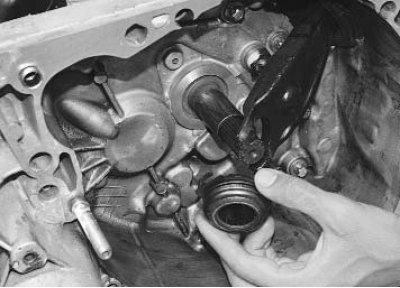
2. By moving the clutch release bearing forward along the guide, remove the fork from the grooves of its coupling and remove the bearing.
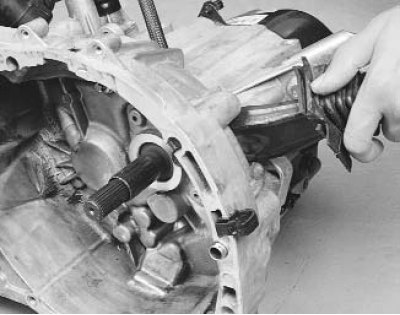
3. If it is necessary to replace the clutch release fork, remove its mudguard from the opening in the clutch housing and remove the clutch release fork from the ball joint.
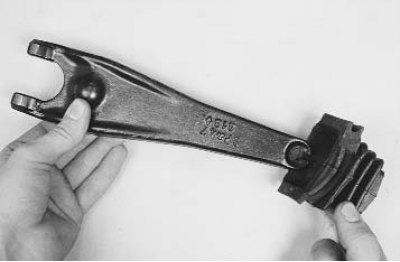
4. If necessary, remove the mudguard from the fork.
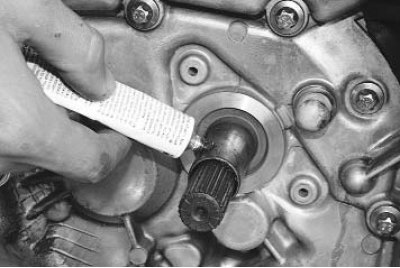
5. Apply a thin layer of high-temperature grease to the outer surface of the guide bushing...
(This note was copied from the resource: Renaultbook.ru)
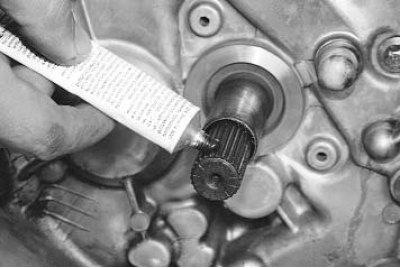
6. ...splines of the primary shaft of the gearbox...
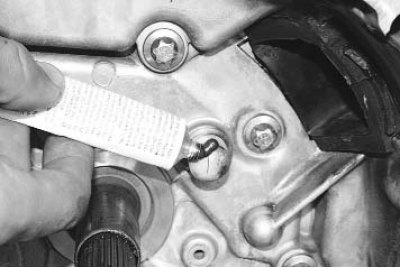
7. ...the ball joint of the clutch release fork...
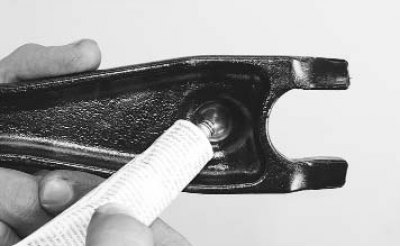
8. ...fork surfaces in contact with the ball joint...
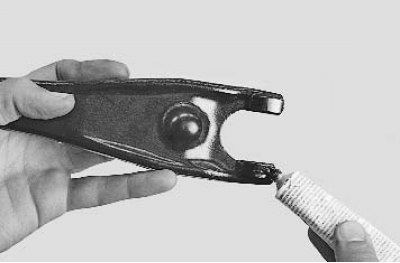
9. ...and with the clutch release bearing sleeve.
10. Install the clutch release fork and new bearing assembly with the clutch (making sure that it rotates smoothly and quietly and that there is no play) in the reverse order of removal.
Attention! Additional fixation of the release fork on the bearing coupling and ball joint is not provided. Therefore, after installing the fork and bearing (and even more so after installing the gearbox) do not rotate the fork in a vertical plane, as this may cause it to disengage from the coupling grooves.