



Note: When purchasing a new wishbone for a second-generation vehicle, make sure the rear bearing shell is missing. The bushings in the wishbone can be replaced, but please note that each bushing must be matched to the same bushing. There are differences depending on the year of manufacture of the model, which must be taken into account when replacing.
1. Press out the first bushing using a tube with a diameter of 31.0 or 39.5 mm, depending on the diameter of the bushing.
2. Press in the new bushing until dimension "A" (see illustration) will not be exactly 181.3 mm for models produced before December 1987, or 112.6 mm for models produced from January 1988 onwards. This value is measured first on the old pressed-in bushing, and then on the new one.
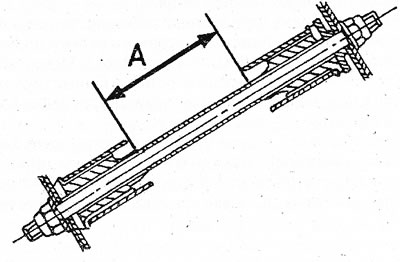
13.2 Installing rubber bushings in the lower wishbone. The value "A" must correspond to the value specified in the text
3. Press out the second bushing and press in a new one according to the given dimensions.
4. Replacing the control arm bushings on second generation vehicles is completely different, as two bushings are pressed in at the front and one bushing is pressed in at the back of the control arm.
5. The process of installing the rear bushing is quite labor-intensive, since it is necessary to maintain a certain angle to create preliminary stress for the rubber support. If you are not sure that you can handle this work yourself, contact a car repair shop. Otherwise, do the following:
6. Cut off the flange (1) (see illustration), be careful not to cut the suspension arm.
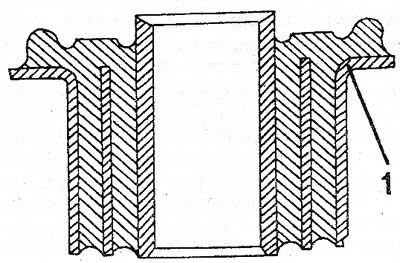
13.6 Before knocking out the front bushings, cut off the flange (1)
7. Press out both bushings with a 34 mm diameter tube. You can use a vice.
8. Press in new bushings. To do this, again use the 38 mm diameter tube until the flange (1) is flush with the suspension arm.
9. Press out the rear bushing using a drift. To remove the old bushing, you need to press out the pin, i.e. secure the bushing from below and press the pin out of the bushing.
10. Install the front hub before replacing the rear hub.
11. Install the new bushing as shown in the illustration. As you can see, the bushing is tilted slightly backwards and is pressed in such a way that the required tilt angle can be set after pressing. In addition, the "X" dimension should be 393 mm. A deviation of 0.5 mm is allowed. Proceed as follows:
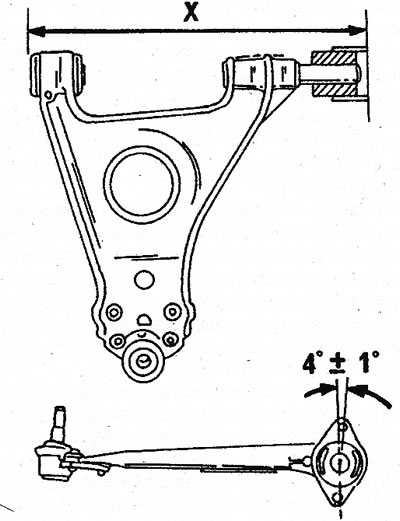
13.11 Pressing in the rear bushing on second generation vehicles
12. Install the bushing in the specified position using the control arm pin, look at the arm from the side and, if necessary, install the bushing at the required angle. It is problematic to measure the angle accurately, i.e. it must be determined by eye.
13. Without turning the bushing, place the pin under the press and press the bushing onto it, while measuring the "X" dimension with a ruler. Use a 24 mm diameter tube to press the bushing. If this dimension is observed, the bushing will be installed accurately, but it is also necessary to set the angle of both screw holes.