English Русский
Български
Беларускі
Український
Српски
Hrvatski
Română
Polski
Slovenský
Magyar
Bookmark Contacts Articles Sitemap
Company vehicles Peugeot Company vehicles Opel Company vehicles Skoda Company vehicles Land Rover Company vehicles Mitsubishi Company vehicles Volkswagen Company vehicles Honda
RenaultBook.ru


Duster   Fluence   Kangoo   Laguna   Logan   Megane   Sandero   Scenic   Symbol   Clio   Other
Symbol 1 (1999-2008, petrol) Symbol 2 (2008-2013, petrol)

Replacing the front brake pads (Renault Symbol 2)

  • Main
  • Symbol
  • Symbol 2 (2008-2013, petrol)
  • Chassis, running gear
  • Brake system
  • Replacing the front brake pads
0
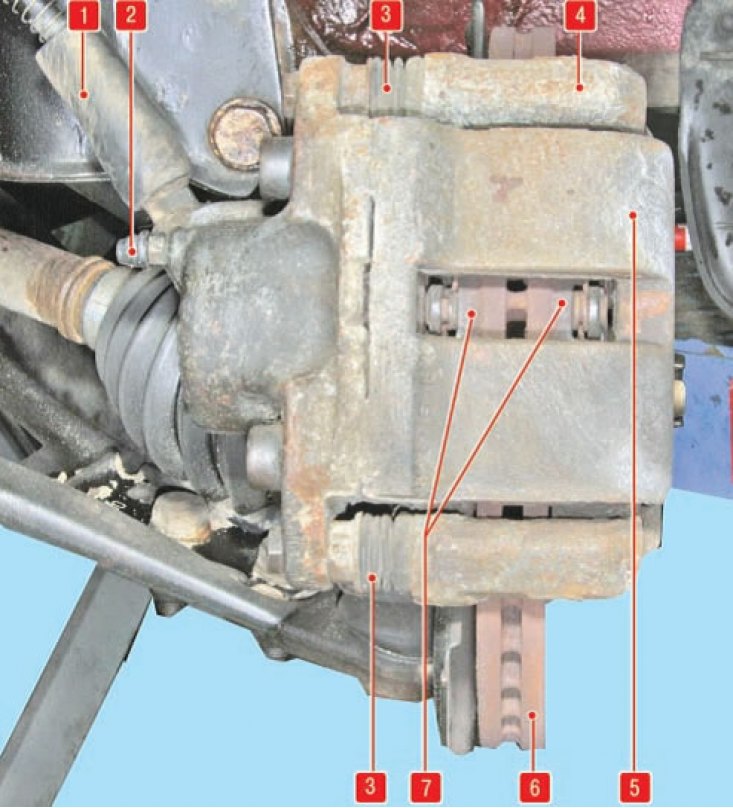
Front wheel brake mechanism: 1 - brake hose; 2 - air release valve; 3 - caliper guide pin (covered…

Front wheel brake mechanism: 1 - brake hose; 2 - air release valve; 3 - caliper guide pin (covered with a protective cover); 4 - shoe guide; 5 - brake caliper; 6 - brake disc; 7 - brake pads


Tightening torques:
  • Wheel bolt - 90 Nm
  • Caliper guide bolt - 40 Nm

Attention! Replace brake pads only in pairs on both wheels at the same time with pads of the specified brands.


New brake pads are run in after 180–230 km, during which time the efficiency of the brakes is somewhat reduced. During the running in process of the pads, sharp and prolonged braking to a complete stop is not recommended.

To speed up the process of running in new pads to the disc, it is recommended to brake the car several times from a speed of 80 to 40 km/h, carefully pressing the brake pedal. Between such braking, maintain a time interval until the brake mechanism has completely cooled down.
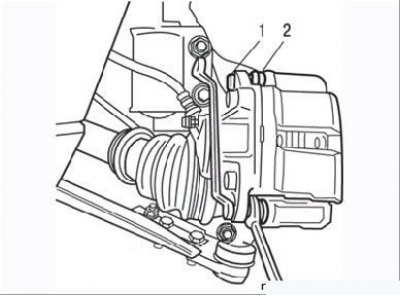
Figure 7.1. Turning out the guide pins on the front wheel brake mechanism: 1 – guide pin; 2 –…

Figure 7.1. Turning out the guide pins on the front wheel brake mechanism: 1 – guide pin; 2 – protective cover


Removal


  • raise the front of the car and place supports under the body;
  • remove the wheel from the desired side;
  • disconnect the brake pad wear sensor connector;
  • pull the caliper towards you, thus moving the piston inside the brake cylinder;
  • unscrew the guide pin bolts with two wrenches, do not clean the guide pins;
  • remove the brake guide bracket and tie it away from the work area without pulling on the brake hose;
  • remove the brake pads;
  • inspect the brake pads: compare the thickness of the pads with the minimum permissible value, the friction lining should wear evenly, without distortion. In case of oiling, the friction lining is subject to unconditional rejection, since it is impossible to remove the oil that has soaked the lining. Eliminate the cause of oil getting into the brake mechanism. In case of replacing one pad, all four on both wheels should be replaced;
  • to decide whether the brake pads are suitable, clean them with a wire brush, paying attention to the cleanliness of the friction lining grooves. Clean the pad seats in the guide bracket and caliper. The guide pins should move easily in the caliper bushings, inspect the protective boots of the guide pins and make sure they are intact;
  • check the integrity of the brake cylinder piston dust boot. Make sure that there is no fluid leakage in the piston-cylinder pair;
  • make sure that the brake disc does not have stepped, uneven wear and that its thickness does not exceed the permissible values;
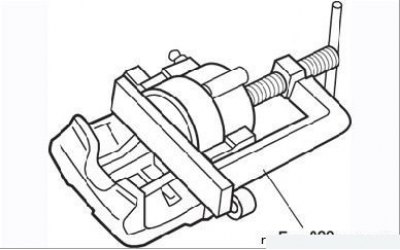

Figure 7.2. Pressing the piston into the caliper using the Fre. 823 device

Figure 7.2. Pressing the piston into the caliper using the Fre. 823 device


Figure 7.5. Installing anti-squeak springs (insert)

Figure 7.5. Installing anti-squeak springs (insert)

  • install brake pads and anti-squeal springs into the caliper (see Figure 7.5). When installing new pads, the piston must be pressed into the caliper flush with its surface. For this purpose, use the Fre. 823 device (Figure 7.2). If you don't have a device, you can use a clamp or suitable wooden blocks as levers. Do not allow the expansion tank to overflow - remove excess fluid in time using a syringe or rubber bulb. The pads are installed with the friction linings facing the brake disc. The pad with the wear sensor is installed on the inside;
  • install the brake guide bracket and lower guide pin in place, after applying Loctite Frenbloc to the threads;
  • press the brake caliper and install the upper guide pin, after applying Loctite Frenbloc to the threads;
  • tighten the guide pins with new bolts to the specified torque, starting with the bottom pin;
  • connect the contact connector to the brake pad wear sensor, correctly laying the wiring;
  • press the brake pedal several times to bring the piston into working position;
  • repeat all the above operations for the brake mechanism of the other wheel;
  • lower the vehicle and check the fluid level in the expansion tank.


[Original article is on the portal: www.renaultbook.ru]
This article is available on: russian, bulgarian, belarusian, ukrainian, serbian, croatian, romanian, polish, slovak, hungarian
Article has been reviewed by editor: Kupriyanov Sergey
Share with friends:
Previous
Symbol 2: Brake system
Next

Brake system — general information
Brake caliper — removal and installation
Brake disc — removal and installation
Brake pressure regulator
Brake drum — removal and installation
Rear brake pads — removal and installation
Other articles on other Renault models

➽ Replacing the front brake pads Renault Fluence 1 (2009-2020, petrol)
➽ Replacing the brake pads of the front wheel brake mechanism Renault Logan 1 (2004-2012, petrol)
➽ Replacing the front brake pads Renault Megane 1 (1995-2002)
➽ Replacing the brake pads of the front wheel brake mechanism Renault Sandero 1 (2007-2012, petrol)
➽ Replacing the front brake pads Renault Espace III (1996-2002)
Link to this article in different formats
Reviews and comments of visitors
No comments yet


Add two numbers 48 + 49


Symbol 2 (2008-2013, petrol) 
  • General information
  • User manual
  • Maintenance
  • Power unit
  • Engine repair
  • Cooling system
  • Fuel system
  • Exhaust system
  • Ignition system
  • Transmission
  • Clutch
  • Mechanical gearbox
  • Automatic gearbox
  • Drive shafts
  • Chassis, running gear
  • Front suspension
  • Rear suspension
  • Steering
  • Brake system
  • Body and interior
  • Exterior (external elements)
  • Interior (internal elements)
  • Doors, locks and windows
  • Heating and ventilation
  • Electrical equipment
  • Equipment and devices
  • Headlights and lighting
  • Power devices
  • Electrical circuits
Symbol 1 (1999-2008, petrol) 
  • General information
  • User manual
  • Car care
  • Maintenance
  • Power unit
  • Engine repair
  • Cooling and lubrication system
  • Supply system
  • Exhaust system
  • Ignition system
  • Transmission
  • Clutch
  • Mechanical gearbox
  • Automatic gearbox
  • Drive shafts
  • Chassis, running gear
  • Car suspension
  • Steering
  • Brake system
  • Body and interior
  • Exterior (external elements)
  • Interior (internal elements)
  • Doors, locks and windows
  • Restoration and repair
  • Electrical equipment
  • Equipment and devices
  • Headlights and lighting
  • Power devices
  • Heating and ventilation
  • Electrical circuits
RenaultBook.ru © 2018–2026 | Mobile version | News and articles | Sitemap: EN BG BY UA RS HR RO PL SK HU | Administration | Site search | Bookmark
Duster 1 (2009-2017) | Fluence 1 (2009-2020, petrol) | Kangoo 1 (1997-2007) | Laguna 2 (2001-2007) | Logan 1 (2004-2012, petrol) | Logan 2 (2012-2020) | Megane 1 (1995-2002) | Megan 2 (2002-2009, petrol) | Sandero 1 (2007-2012, petrol) | Scenic 1 (1996-2003) | Symbol 1 (1999-2008, petrol) | Symbol 2 (2008-2013, petrol) | Renault 19 (1988-1996) | Espace I and II (1984-1996) | Espace III (1996-2002) | Clio 1 (1990-1998) |
We want your visit to be comfortable 😌 and use cookies 🍪 to do so.