
English Русский
Български
Беларускі
Український
Српски
Hrvatski
Română
Polski
Slovenský
Magyar
Bookmark Contacts Articles Sitemap
Company vehicles Peugeot Company vehicles Opel Company vehicles Skoda Company vehicles Land Rover Company vehicles Mitsubishi Company vehicles Volkswagen Company vehicles Honda
RenaultBook.ru


Duster   Fluence   Kangoo   Laguna   Logan   Megane   Sandero   Scenic   Symbol   Clio   Other
Logan 1 (2004-2012, petrol) Logan 2 (2012-2020)

Fuel lines of the fuel system (Renault Logan 2)

  • Main
  • Logan
  • Logan 2 (2012-2020)
  • Power unit
  • Power and control system
  • Fuel lines of the fuel system
0
Partial replacement of plastic fuel lines for gasoline is possible (fuel supply line from tank to fuel rail) and for diesel (fuel supply line from tank to fuel filter). To do this you need:
  • pliers for disconnecting quick-release connectors of fuel lines, diameter 8 mm (Legris and Raymond);
  • pliers for disconnecting quick-release connectors of fuel lines, diameter 10 mm (Legris and Raymond);
  • semi-rigid pipe cutter;
  • double connecting element with a diameter of 8 mm or 10 mm;
  • 1.5 m long pipeline with a diameter of 8 mm or 10 mm (the fuel line will need to be cut to the required length).
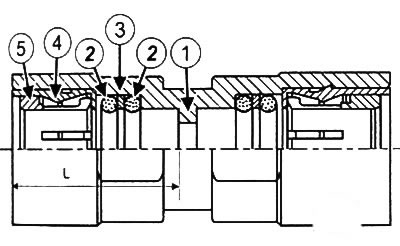
1. Housing. 2. O-rings (2 pcs.). 3. Washer. 4. Key. 5. Clamp. L. Insert length (18.5 mm).

1. Housing. 2. O-rings (2 pcs.). 3. Washer. 4. Key. 5. Clamp. L. Insert length (18.5 mm).


Replacing a part of the fuel line


Cutting off the old fuel line


1. Allow the engine to cool for at least an hour before starting work.

2. Disconnect the negative battery terminal.

3. Measure the diameter of the fuel line to select the appropriate parts and tools.

4. If the fuel line is cut under the bottom of the vehicle, then to prevent fuel from draining from the tank, it is necessary to either disconnect the fuel line or remove the fuel from the tank.


5. The location of the cut will determine the position of the joint. In this regard, the following conditions must be met:
  • the cut must be straight;
  • the fuel line connection must not be located closer than 50 cm to the catalytic converter, above high-heat areas or electrical connectors, on lines between the engine and the body, in the area between the engine and the catalytic converter.

6. When installing connections on parallel pipelines, it is necessary to select the cut locations so that the connecting sleeves are subsequently located relative to each other with some offset.
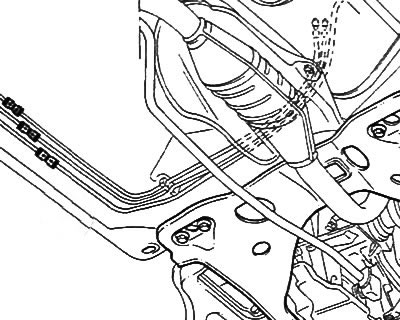
6. When installing connections on parallel pipelines, it is necessary to select the cut locations…


7. To avoid damaging the two sealing rings of the coupling and to ensure a perfect seal of the joint, a special pipe cutter (6) must be used to cut the pipeline.
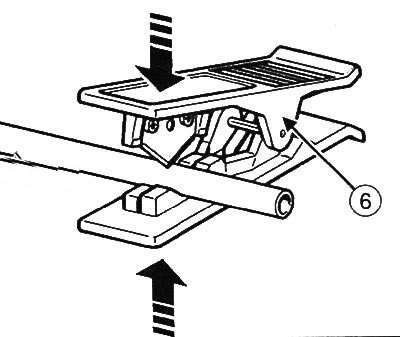
7. To avoid damaging the two sealing rings of the coupling and to ensure a perfect seal of the…


Cutting the new fuel line


If the section of fuel line to be replaced does not have any specific connections and is a straight section, a 1.5 m long line supplied as a spare part can be used.


To ensure proper cutting, place a section of the old fuel line on the new one and mark the cut location.

Cut the pipeline using a special pipe cutter.

Installing the coupling


1. Install the coupling directly onto the pipelines and press firmly.
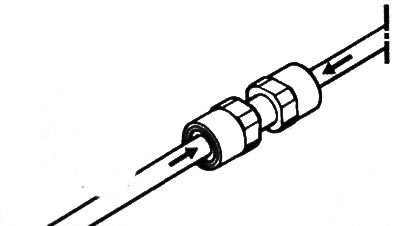
1. Install the coupling directly onto the pipelines and press firmly.


2. Connect the battery.

3. After installing all connecting couplings, it is necessary to check the tightness of the fuel lines:
  • for pressure pipelines (gasoline supply) run the engine for five minutes to ensure there are no leaks around the new connections;
  • for vacuum fuel lines (diesel fuel supply) run the engine for five minutes and make sure there are no air bubbles in the transparent pipe at the outlet of the high-pressure fuel pump.

Removal the coupling sleeve


1. Allow the engine to cool for at least an hour before starting work.

2. Disconnect the negative battery terminal.

3. If the fuel line is disconnected under the bottom of the vehicle, then to prevent fuel from draining from the tank, it is necessary to either disconnect the fuel line or remove the fuel from the tank.

4. Remove the coupling sleeve using special pliers with a diameter of 8 mm or 10 mm (Legris and Raymond) (7), corresponding to the diameter of the fuel line.
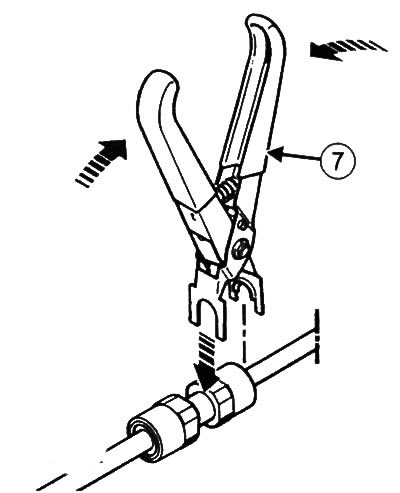
4. Remove the coupling sleeve using special pliers with a diameter of 8 mm or 10 mm (Legris and…
This article is available on: russian, bulgarian, belarusian, ukrainian, serbian, croatian, romanian, polish, slovak, hungarian
Article has been reviewed by editor: Petrovsky Roman
Share with friends:
Previous
Logan 2: Power and control system
Next

Fuel tank and fuel lines
Fuel system of the D4F engine (1.2 l)
Fuel system of K7M and K4M engines (1.6 l)
Removal and installation of fuel rail with injectors, K7M engine (1.6…
Removal and installation of fuel rail with injectors, K4M engine (1.6…
Rules for performing work on components of the fuel system of diesel…
Other articles on other Renault models

➽ Functional diagram of the fuel supply system Renault Duster 1 (2009-2017)
➽ Technical characteristics of engines for diagnostic procedures… Renault Fluence 1 (2009-2020, petrol)
➽ Fuel vapor recovery system Renault Kangoo 1 (1997-2007)
➽ Description of the fuel system design Renault Laguna 2 (2001-2007)
➽ Starting and charging system, cooling fan, diesel fuel heater... Renault Megane 1 (1995-2002)
Link to this article in different formats
Reviews and comments of visitors
No comments yet


Add two numbers 13 + 42


Logan 2 (2012-2020) 
  • General information
  • Faults en route
  • Daily checks
  • Governing bodies
  • Maintenance
  • Power unit
  • Petrol engines 1.2 l
  • Petrol engines 1.6 l
  • Diesel engines 1.5 l
  • Cooling system
  • Lubrication system
  • Power and control system
  • Intake and exhaust system
  • Engine electrical equipment
  • Transmission
  • Clutch
  • Car gearbox
  • Drive shafts
  • Chassis, running gear
  • Suspension and wheels
  • Brake system
  • Steering
  • Body and interior
  • Exterior (external elements)
  • Interior (internal elements)
  • Safety system
  • Heating and air conditioning
  • Electrical equipment
  • Equipment and devices
  • Wiring diagrams (sedan)
  • Wiring diagrams (wagon)
Logan 1 (2004-2012, petrol) 
  • General information
  • Vehicle device
  • User manual
  • Faults en route
  • Daily maintenance
  • First maintenance
  • Second maintenance
  • Driver tips
  • Power unit
  • Engine repair
  • Lubrication system
  • Cooling system
  • Power and exhaust system
  • Transmission
  • Clutch
  • Car gearbox
  • Drive shafts
  • Chassis, running gear
  • Front suspension
  • Rear suspension
  • Steering
  • Brake system
  • Wheels and tires
  • Body and interior
  • Exterior (external elements)
  • Interior (internal elements)
  • Doors, locks and windows
  • Body Care
  • Electrical equipment
  • Equipment and devices
  • Headlights and lighting
  • Power devices
  • Electrical circuits
RenaultBook.ru © 2018–2026 | Mobile version | News and articles | Sitemap: EN BG BY UA RS HR RO PL SK HU | Administration | Site search | Bookmark
Duster 1 (2009-2017) | Fluence 1 (2009-2020, petrol) | Kangoo 1 (1997-2007) | Laguna 2 (2001-2007) | Logan 1 (2004-2012, petrol) | Logan 2 (2012-2020) | Megane 1 (1995-2002) | Megan 2 (2002-2009, petrol) | Sandero 1 (2007-2012, petrol) | Scenic 1 (1996-2003) | Symbol 1 (1999-2008, petrol) | Symbol 2 (2008-2013, petrol) | Renault 19 (1988-1996) | Espace I and II (1984-1996) | Espace III (1996-2002) | Clio 1 (1990-1998) |
We want your visit to be comfortable 😌 and use cookies 🍪 to do so.