



Contents: Removal 🠛 Installation 🠛
The gearbox on the Renault 19 can be removed separately from the engine. Gearbox repairs should only be carried out by specialists in a car repair shop. If you want to do this work yourself, you need to lift the car so that you can work both in the engine compartment and under the bottom of the car. The gearbox is removed upward from the engine compartment. Before you start doing repairs yourself, you should make yourself a device for hanging the engine.
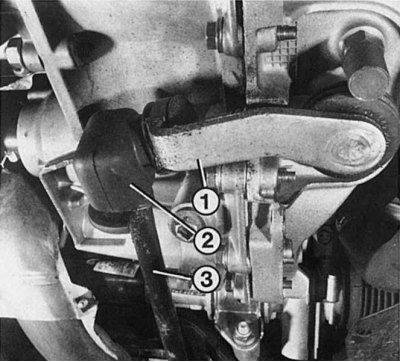
When installing the control rod (3) in the gearbox shift handle (1), it is necessary to check the integrity of the sealing cuff (2). There should be some grease in the sealing cuff so that the screw pin and bushing do not fail prematurely. A worn joint is the cause of inaccurate gear engagement - it cannot be adjusted.
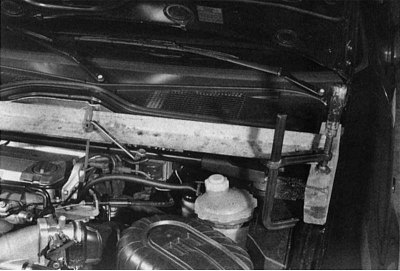
Since the engine rests on the gearbox, it must be suspended to remove the gearbox. In a car repair shop, a special device for hanging with a screw collar is used for this, with which you can center the engine with an accuracy of up to a millimeter - this is especially important during assembly. You can also do it as shown in the picture. It is important that the materials used for hanging are sufficiently strong, and also to protect the engine from sliding. For example, you can strengthen the crossbar with clamps on the body.
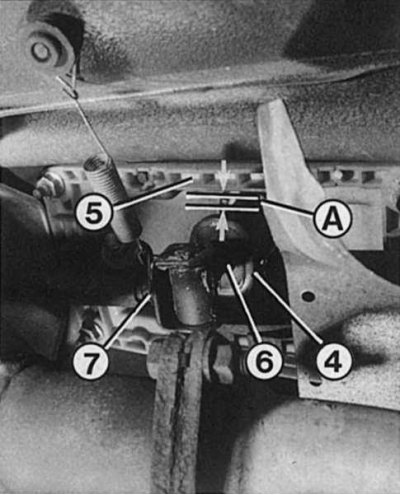
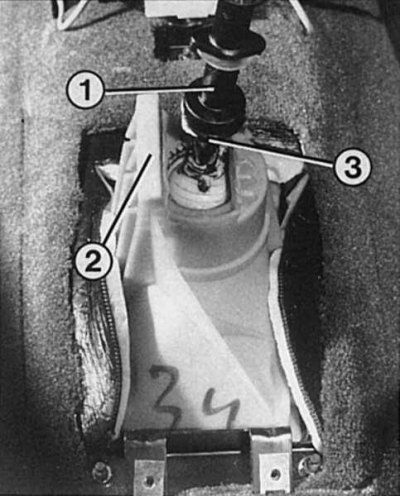
If 1st gear is engaged, the shift lever (1 and 6), if adjusted correctly, should be in contact with the upper reverse lock (3) against the upper limiter (2) of the gearbox. At the same time, there should be a gap "A" between the lower reverse lock (4) and the lower limiter (5) of 2 mm. If this is not the case, the gear shift mechanism must be adjusted. The number "7" indicates the control rod fork, which in the 1st gear position, when tightening the rod, should have a distance of 5 mm from the end of the rod to the start of the knurling.
 |
 |
Removal
1. Disconnect the wires from the battery terminals and remove the battery.
2. If necessary, remove the engine hood to increase the working space.
3. Remove the air filter housing with the mount.
View the original source on this resource: www.RenaultBook.ru
4. Disconnect the clutch cable from the gearbox.
5. Remove the tachometer shaft from the gearbox.
6. Disconnect the plug connection of the reversing light switch.
7. Disconnect the ground wire from the gearbox.
8. Disconnect the wires from the starter, marking the connectors in advance.
9. Drain the transmission oil into a container.
10. Gasoline engine vehicle only: Remove the speed sensor.
11. Disconnect the radiator fan and thermostat connectors.
12. Unscrew the upper radiator mount and carefully move the radiator to the right side. To protect the radiator fins, cover them with cardboard.
13. Diesel only: drain the coolant into a clean container. To do this, remove the lower radiator hose.
14. Remove the radiator together with the fan.
15. All engines: Raise the vehicle at the front, support it and remove the wheels.
16. Left side of the car: completely remove the disc brake calipers and tie them to the fender with wire.
17. Remove the mudguards.
18. Press the steering linkage rod away from the steering pivot support.
19. Remove the drive shaft seal from the gearbox.
20. Remove the lower shock absorber mount from the steering knuckle.
21. Remove the spherical ball pin of the cross balancer from the steering knuckle.
22. Press the cross member down away from the steering knuckle (using a crowbar).
23. Remove the drive shaft completely with the steering knuckle and brake disc so that the inner joint bearing rollers do not fall into the gearbox housing.
24. When disassembling the shaft, avoid excessive stress on the joints due to stretching. The bending angle of the inner and outer joints must not be exceeded.
25. Right side of vehicle: Using a suitable drift, tap the drive shaft expansion pin out of the transmission.
26. Remove the lower shock absorber mount from the steering knuckle (2 bolts with a nut).
27. Pull the steering knuckle out and move it to the side until the drive shaft comes out of the transmission.
28. Unscrew the bracket from the gearbox that connects the gearbox to the engine.
29. Remove both lower connecting bolts between the engine and gearbox.
30. Remove the gearbox splash guard.
31. Pull back the boot from the gearbox control rod and remove it.
32. Tie the control rod to the exhaust pipe with wire.
33. Secure the engine using a lifting mechanism.
34. Remove the gearbox/starter connecting bolts and remove the starter.
35. Secure the gearbox from below with a car jack, without putting too much load on it.
36. Remove the front and rear mounting bolts between the engine and gearbox (from gearbox and bearing) and take them out.
37. Diesel only: remove the balance beam suspension from the gearbox (3 bolts in gearbox, 4 bolts in longitudinal beam).
38. Remove the bottom (torque transfer lever) torque support. When doing this, mark the sequence of mounting the screws!
39. All engines: Screw the locknuts onto the left and right expansion bolts and tighten. To loosen the expansion bolts, you will need a bent open-end wrench and a swivel wrench.
40. If necessary, remove both power steering hose clamps.
41. Carefully pry the gearbox away from the engine housing using a pry bar. At the same time, install the gearbox with the side cover (5th gear gears are located there) between the side member and the auxiliary frame.
42. Raise the engine slightly.
43. To prevent the clutch release bearing from slipping off the drive shaft, secure the clutch release fork with a suitable piece of wood inserted between the fork and the clutch cable support.
44. If an additional lifting mechanism is available, secure the chain to the gearbox flange bolts and clutch cable support.
45. Lower the gearbox onto the gearbox cover side.
46. Using a lifting mechanism or an assistant, carefully remove the gearbox from the engine compartment.
Installation
1. Before installation, lubricate the gearbox input shaft and the thrust bearing guide sleeve with a thin layer of paste "Molykote 55 Plus".
2. Lubricate the wedge engagement of the drive and pivot shafts with a small amount of MoS2 grease.
3. Check the correct position of the centering sleeves in the gearbox flange.
4. Lower the gearbox into the engine compartment and align it with the engine.
5. Tighten the spacer bolts.
6. Install the connecting bolts and tighten (M 10 to a torque of 45 Nm; M12 torque 55 Nm).
7. Check the position of the engine-gearbox system in the engine compartment and adjust it if necessary.
8. Installation is carried out in the reverse order of gearbox removal.
9. Adjust gear shifting if necessary.
Note: Suggestion: Excess lubricant on the gearbox input shaft may spill onto the clutch disc. Therefore, apply it sparingly.
The gearbox housing is made of light metal. Strong tightening of threaded connections can lead to thread stripping. Therefore, it is very important that the prescribed tightening torques of all bolts are observed.