



Elements of the main transmission
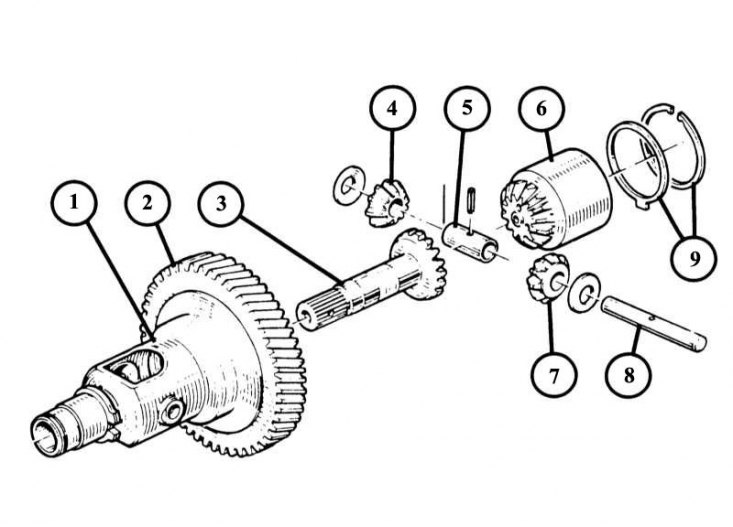
1 - differential housing; 2 - driven bevel gear; 3 - gearbox output shaft; 4 and 7 - satellite disks; 5 - spacer sleeve; 6 - planetary wheel; 8 - satellite axis; 9 - spacer ring and thrust ring.
The gearbox and the main gear with the differential mechanism are located in the same housing. The torque transmitted from the engine to the gearbox is directed via a small and a large toothed wheel to the main gear. The differential mechanism casing is screwed to the large toothed wheel. This casing contains 4 coupled bevel gears, two of which are connected to the drive shafts. As long as the car is driving straight, both front wheels rotate at the frequency of the large sprocket of the main gear. The bevel gears of the differential mechanism casing, which rotates at the same speed, on the contrary, are stationary. When turning, the outer wheel travels a longer distance than the inner one. In this case, the bevel gears come into action: the faster rotation of the outer wheel and its bevel gear affects the bevel gear on the inner side of the curve via both bevel gears, which turns correspondingly more slowly. This alignment is necessary, since it eliminates the spinning of the wheels when turning. However, the differential mechanism plays a negative role when the drive wheel slips on slippery ground. In this case, no force is transmitted to the other front wheel, and the car does not move.
View the original on the specified resource (www.RenaultBook.ru)