



Contents: Examination 🠛 Replacing the carbon adsorber 🠛 Replacing the solenoid valve 🠛 Replacement 🠛
Examination
Crankcase ventilation system
1. There are no specific procedures for checking the crankcase ventilation system. If there are problems (sometimes determined by contamination of the air filter element), check that the hoses are clean and not blocked.
1. This is obvious. Mark the location of the hoses before disconnecting them to avoid confusion during installation.
Exhaust emission control
1. An exhaust gas analyzer will be required (cO meter). The ignition system must be in good condition, the air filter element must be clean, and the engine must be in good condition.
2. Warm up the engine to normal operating temperature, then connect the exhaust gas analyzer according to the manufacturer's instructions.
3. Run the engine at 2500 rpm for approximately 30 seconds, then let it idle and check the CO level (refer to Specifications in the Chapter Maintenance). If the CO level corresponds to the data given in Specifications, the system is working properly.
4. If the CO level is higher than specified in Specifications, try to check the influence of the Lambda sensor by disconnecting its wiring. If the CO level increases when the sensor is disconnected, then the Lambda sensor is OK and the fault is in the catalytic converter. If disconnecting the sensor does not affect the CO level, then the sensor is faulty.
5. If you have a digital voltmeter, you can measure the output voltage of the Lambda sensor. The voltage should alternate between two limits: 625 - 1100 mV (rich mixture) and 0 - 80 mV (lean mixture).
6. Replace the Lambda sensor if it is faulty.
Lambda sensor
1. Jack up the front of the vehicle and support it on axle stands. Remove the engine undershield where applicable, then disconnect the sensor wiring.
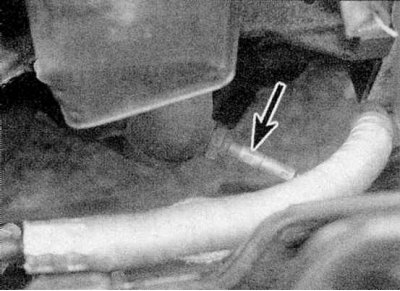
2a. Unscrew the sensor from the inlet pipe.
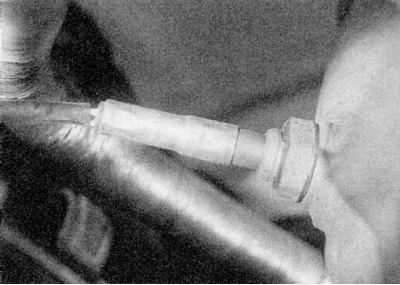
2b. Take it off (refer to the illustrations).
3. Clean the threads in the intake pipe and on the sensor.
4. Please note that if the wiring is broken, the sensor must be replaced. Do not attempt to repair it.
5. Apply high temperature anti-seize compound to the sensor threads. Screw the sensor in by hand and then tighten it completely.
6. Connect the sensor wiring, install the lower engine shield and lower the vehicle to the ground.
Catalytic converter
1. The catalytic converter is replaced as part of the exhaust system. Refer to section Removal and installation of the exhaust system from this Chapter.
Fuel vapor emission control
1. The solenoid valve should be open only under the following conditions: the engine is warm, the throttle valve is not closed.
2. Warm up the engine to normal temperature, then turn it off. Attach a vacuum gauge (measurement range 0 - 1000 mBar) to the hose between the adsorber and the solenoid valve. Connect a voltmeter to the terminals of the solenoid valve.
3. Start the engine and let it idle. The pressure gauge should not show any vacuum, and there should be no voltage on the solenoid valve coil.
4. If the pressure gauge registers a vacuum, although the voltmeter does not show any voltage, the solenoid valve may be stuck open. Temporarily disconnect the hoses from the valve and blow through it to remove carbon particles.
5. If the voltmeter shows voltage in idle mode, then there is a fault in the wiring or computer.
6. Press the accelerator slightly. Voltage should appear at the valve terminals for a moment and a vacuum should be registered.
7. If there is no vacuum even when there is voltage, then either there is a leak in the hoses or the valve is not opening.
8. If voltage does not appear, then there is a fault in the wiring or computer.
Replacing the carbon adsorber
1. Temporarily remove the electronic fuel injection control module from the right front of the engine without disconnecting the electrical wiring.
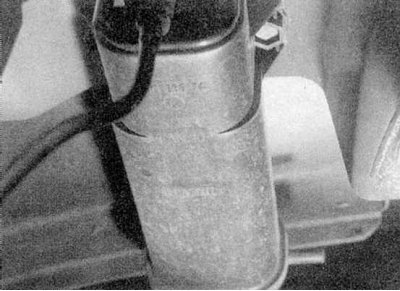
2. Disconnect and plug the hose coming from the top of the canister (refer to the accompanying illustration).
3. Set the handbrake, then jack up the front of the car and place it on axle stands.
4. Loosen and remove the mounting bolts between the front bumper and the fender fairing, then remove the canister from the engine compartment.
5. Please note that the canister may contain liquid fuel and/or fuel vapor.
6. Install the new canister in the reverse order of removal. Make sure the hoses are connected correctly.
Replacing the solenoid valve
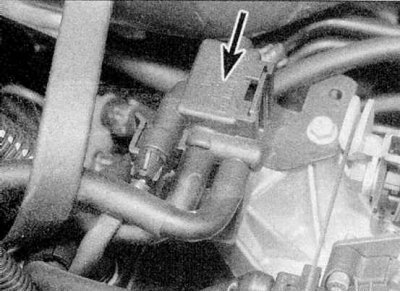
1. Depending on the engine, the solenoid valve may be located in the following places:
- a) E7J Engine - On top of the intake manifold, to the right of the throttle body (refer to the accompanying illustration).
- b) K7M engine - at the right end of the intake manifold
- c) F3R and F7R engines - on the front right side of the engine, on the same bracket as the fuel system control unit.
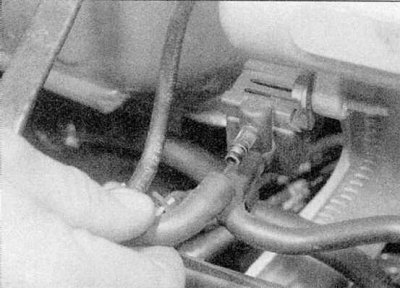
2a. Disconnect the hoses.
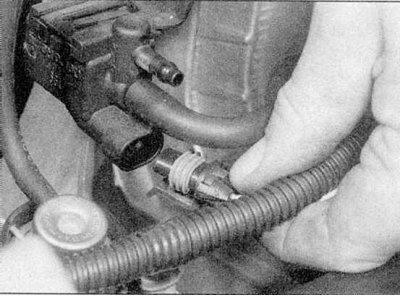
2b. Disconnect the multi-pin connector from the valve. Release the valve from its mountings and remove it.
3. Install the new valve in the reverse order of removal. Make sure the hoses are connected correctly.
Replacement
Exhaust Gas Recirculation
1. Warm up the engine to normal operating temperature (the cooling fan should turn on), then turn it off.
2. Disconnect the wiring from the EGR solenoid valve located on the left end of the cylinder head.
3. Apply 12V supply voltage to the valve.
4. Disconnect the vacuum reservoir hose from the valve, then connect the vacuum pump and create a vacuum of 300 mBar. Make sure the vacuum does not drop faster than 2 mBar per second.
5. Disconnect the vacuum pump, then start the engine and let it idle. Connect the vacuum pump and create a vacuum of 300 mBar; the engine should idle rough. If this is not the case, the valve should be replaced, but please note that Renault recommends cleaning the valve every 80,000 to 95,000 km (refer to Chapter Maintenance).
Exhaust gas recirculation valve (k7M engine)
1. Unscrew and remove the rod between the front suspension domes.
2. Remove the air intake duct between the air cleaner and the throttle body, referring to Part A of this Chapter.
3. Disconnect the crankcase ventilation hose from the valve cover and move it to the side.
4. Disconnect the gas pedal cable from the throttle body and move it to the side.
5. Disconnect the vacuum hose from the EGR valve, then disconnect the wiring.
6. Loosen the mounting bolts and remove the valve from the cylinder head. Remove the seal.
7. Install the new valve in the reverse order of removal, but use a new seal and tighten the mounting bolts to the specifications shown Specifications effort.
Exhaust gas recirculation valve (f7R engine)
1. Disconnect the vacuum hose from the valve, then disconnect the wiring.
2. From the back of the valve, release the clamp that secures the steel pipe to the valve body.
3. Unscrew the two mounting bolts and remove the valve. Remove the seal.
4. Install the new valve in the reverse order of removal, but use a new seal and tighten the mounting bolts to the specifications shown Specifications effort.