



All diesel models are also designed to meet stringent emissions requirements and are equipped with a crankcase ventilation system. In addition, some models can be equipped with a catalytic converter to reduce harmful emissions in the exhaust gases. To further reduce harmful emissions, an exhaust gas recirculation system is available.
Toxicity reduction systems operate as follows.
Petrol models
Crankcase ventilation system - E7J engine
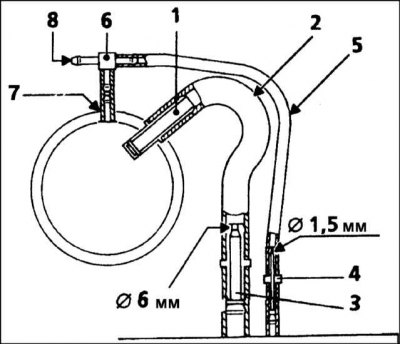
1 - Air filter inlet channel; 2 - Hose connecting the valve cover to the air filter; 3 - Large limiter; 4 - Small limiter; 5 - Hose connecting the valve cover to the intake manifold; 6 - T-connector; 7 - Inlet opening of the intake manifold; 8 - To the carbon adsorber
Crankcase ventilation system - K7M engine
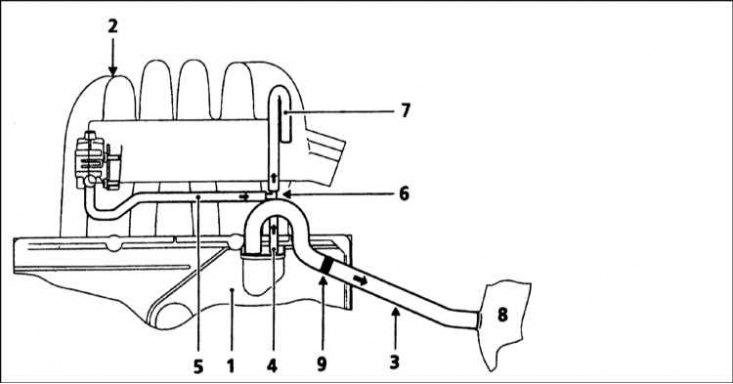
1 - Cylinder head; 2 - Inlet manifold; 3 - Crankcase ventilation hose to air duct; 4 - Hose connecting the valve cover to the intake manifold; 5 - Carbon adsorber valve hose; 6 - T-connector; 7 - Ventilation hose in the intake manifold; 8 - Air duct; 9 - Limiter diameter 5 mm
Crankcase ventilation system - F3R engine
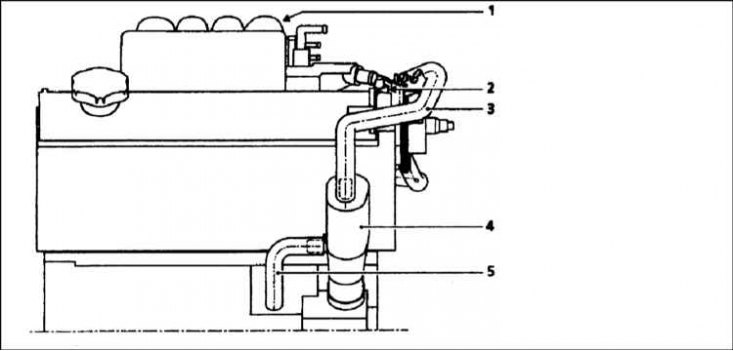
1 - Inlet manifold; 2 - Throttle body; 3 - Crankcase ventilation hose to throttle body; 4 - Oil separator; 5 - Crankcase ventilation hose to oil separator
Crankcase ventilation system - F7R engine
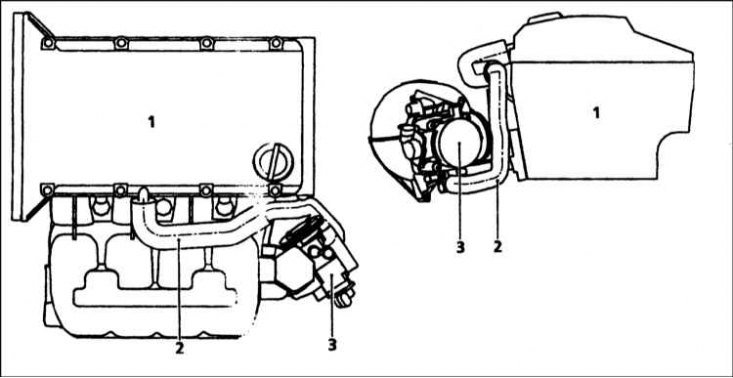
1 - Cylinder head; 2 - Crankcase ventilation hose to throttle body; 3 - Throttle body
To reduce the emission of unburned hydrocarbons from the crankcase to the atmosphere, the engine is sealed and crankcase oil vapors are drawn from the inside of the crankcase through a wire mesh oil separator into the intake air duct, and are then burned by the engine during normal combustion (refer to the illustrations).
At high vacuum in the pipeline (idling, slowing down) gases will be sucked out of the crankcase. At low vacuum in the pipeline (acceleration, full throttle) gases are forced out of the crankcase by the relatively higher pressure in the engine crankcase; if the engine is worn out, increased pressure in the engine crankcase (due to increased gas breakthrough) is the reason for the return of part of the flow under all pipeline conditions.
The crankcase ventilation hoses and restrictors must be cleaned periodically to ensure proper functioning of the system.
Monitoring exhaust emissions
To reduce the amount of pollutants released into the atmosphere, all models are equipped with a catalytic converter in the exhaust system. The system is a closed-loop type, in which the Lambda sensor in the exhaust system provides the ECU of the fuel injection/ignition system with constant feedback, allowing the electronic control unit to adjust the mixture, providing the best possible conditions for the catalyst to operate.
The Lambda sensor has a built-in heating element that is controlled by the ECU via the Lambda Sensor Relay to quickly bring the tip of the sensor to an efficient operating temperature. The tip of the sensor is sensitive to oxygen and sends a voltage to the ECU that varies depending on the amount of oxygen in the exhaust gases; if the inlet fuel-air mixture is too rich, the exhaust gases have low oxygen content, the sensor sends a low-voltage signal, the voltage increases, leaning the mixture and increasing the amount of oxygen in the exhaust gases. The maximum efficiency of the catalyst in neutralizing all major pollutants occurs when the fuel-air mixture is maintained in the chemically correct ratio for complete combustion of gasoline (14.7 parts air to 1 part fuel). The sensor output voltage at this point changes over a wide range, the ECU uses the voltage change as a signal to correct the air-fuel ratio by changing the fuel injection pulse width.
Fuel vapor recirculation control
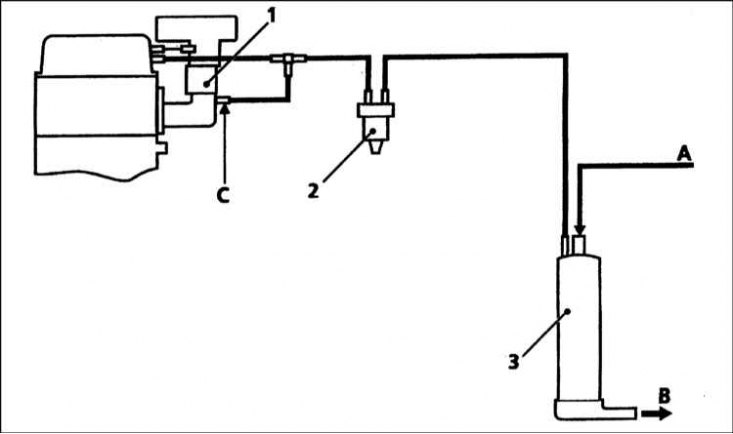
Fuel Evaporative Control System - E7J Engine
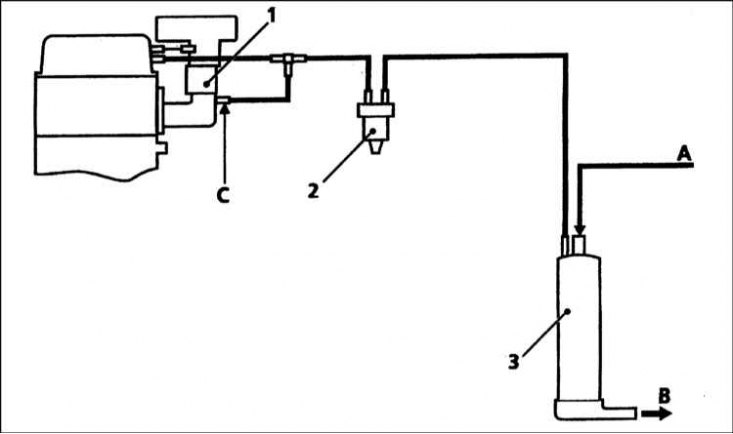
1 - Throttle body; 2 - Cleaning valve; 3 - Activated carbon adsorber; A - Ventilation hose from the fuel tank; B - Sapun; C - Vacuum behind the throttle valve
Fuel vapor recovery system - K7M engine
1 - Inlet manifold; 2 - Activated carbon adsorber; 3 - Cleaning valve; 4 - Recirculation pipe; 5 - Crankcase ventilation pipe; 6 - T-shaped connector of steam recirculation and crankcase ventilation pipes; 7 - Crankcase ventilation pipe; R - Pipe from the fuel tank; MA - Sapun
Fuel Evaporative Recovery System - F3R Engine (F7R similar)
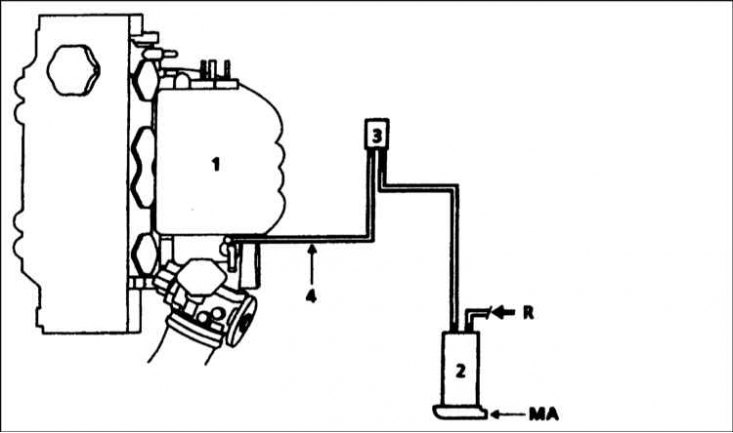
1 - Inlet manifold; 2 - Activated carbon adsorber; 3 - Cleaning valve; 4 - Recirculation pipe; R - Pipe from the fuel tank; MA - Sapun
To reduce the release of unburned hydrocarbons into the atmosphere, all models are also equipped with a fuel vapor recovery system (refer to the illustrations). The fuel filler cap is sealed and a charcoal canister is mounted on the front right side of the engine compartment. The charcoal canister collects vapors that form in the tank when the car is parked and stores them until they are removed (under the control of the ECU of ignition and fuel injection systems) through the purge valve into the intake air duct, and are then burned by the engine during normal combustion.
To ensure proper engine operation when the engine is cold and/or idling and to protect the catalytic converter from the effects of a rich mixture, the purge control valve does not open until the engine is warmed up under load, the valve then opens allowing vapor to pass into the intake tract.
Exhaust gas recirculation system - engine K7M 703
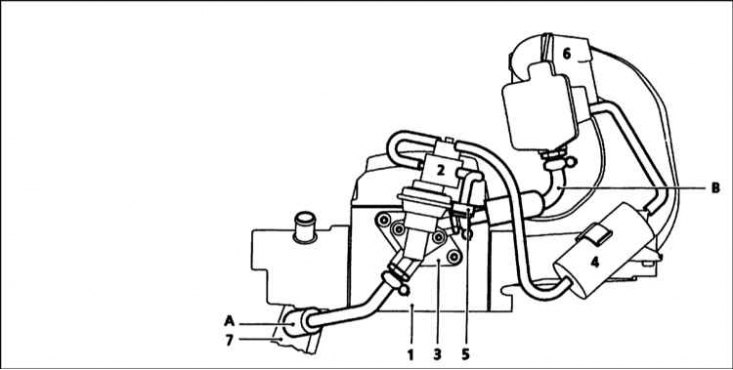
1 - Cylinder head; 2 - Exhaust gas recirculation solenoid valve; 3 - Fastening; 4 - Vacuum tank; 5 - Filter block; 6 - Inlet manifold; 7 - Exhaust manifold
Exhaust Gas Recirculation System - F7R Engine
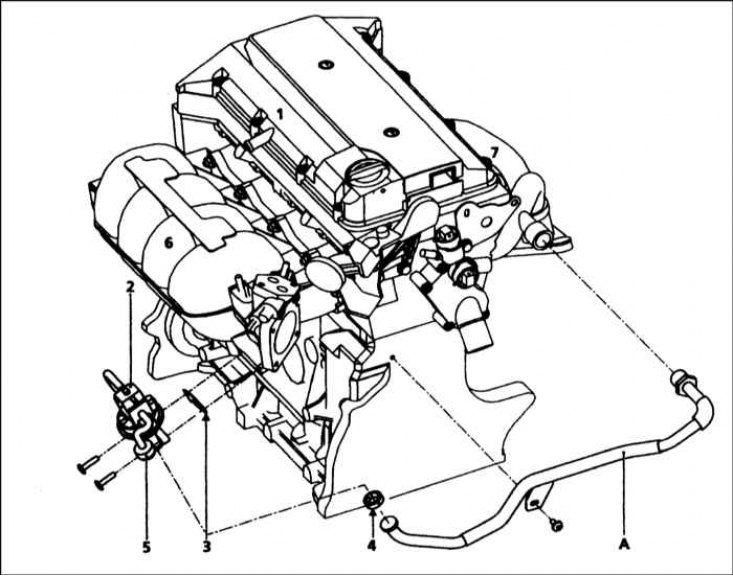
1 - Cylinder head; 2 - Recirculation electromagnetic valve; 3 - Sealing; 4 - Bracket; 5 - Filter block; 6 - Inlet manifold; 7 - Exhaust manifold; A - Pipe from the exhaust manifold to the exhaust gas recirculation valve; B - Pipe from the exhaust gas recirculation valve to the intake manifold
This system is installed on K7M and F7R engines and is designed to reduce the amount of nitrogen oxide in exhaust gases, lowering combustion temperatures (refer to the illustrations). This is achieved by feeding some of the exhaust gases from the intake ports in the cylinder head back into the intake manifold, where they are burned again. The exhaust gas recirculation (EGR) valve is located on the left wall of the cylinder head on the K7M engine; and on the front of the engine, near the throttle body, on F7R engines.
Diesel models
Typical crankcase ventilation system - F8Q 620 models
Source link is located on www.RenaultBook.ru
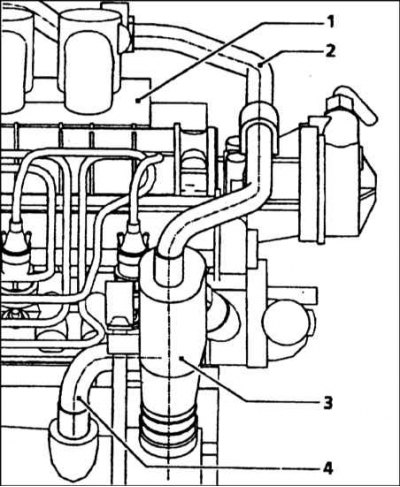
1 - Inlet manifold; 2 - Hose to the intake manifold; 3 - Oil separator; 4 - Return pipe to the tray
To reduce the emission of unburned hydrocarbons from the crankcase to the atmosphere, the engine is sealed and crankcase gases and oil vapors are drawn from the inside of the crankcase through a wire mesh oil separator into the intake port, and are then burned by the engine during normal combustion (refer to the illustrations).
The system hoses must not be clogged, since the minimum vacuum in the intake manifold will remain constant at all engine operating modes.
Monitoring exhaust emissions
To reduce the amount of pollutants emitted into the atmosphere, an uncontrolled catalytic converter is installed in the exhaust system. The catalytic converter operates autonomously in the exhaust system and does not have a Lambda sensor, as in gasoline models.
Exhaust Gas Recirculation System - F8Q Engine
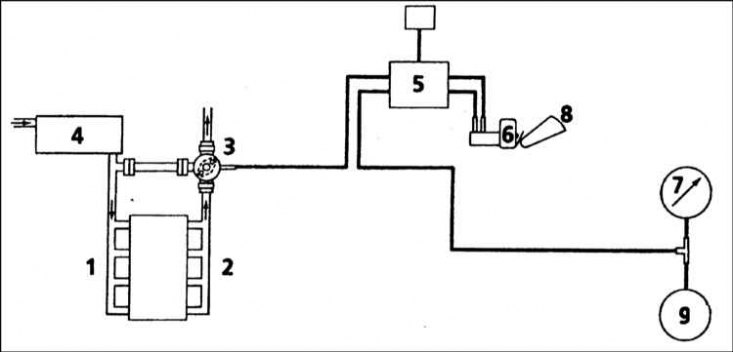
1 - Inlet manifold; 2 - Exhaust manifold; 3 - Exhaust gas recirculation valve; 4 - Air filter; 5 - Electromagnetic channel for exhaust gas recirculation; 6 - Fuel pump microswitch; 7 - Vacuum pump; 8 - Fuel pump load lever; 9 - Brake booster
Exhaust Gas Recirculation (EGR) System
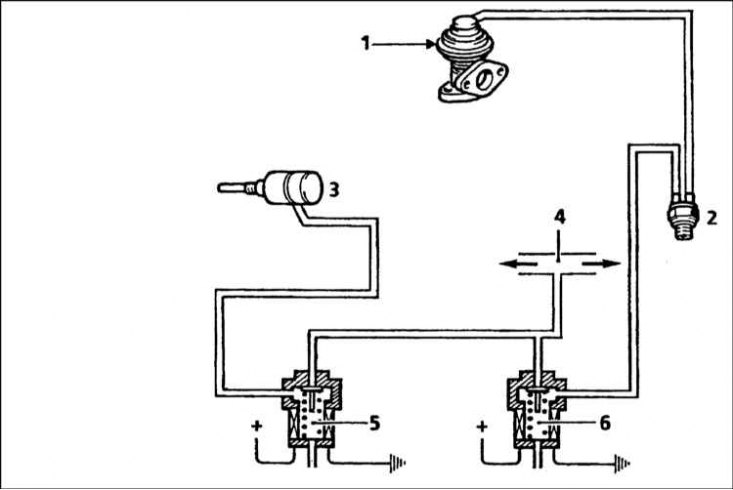
1 - EGR valve; 2 - Thermovalve; 3 - Fast idle speed vacuum activator; 4 - Vacuum between vacuum pump and brake booster; 5 - Solenoid valve of fast idle speed; 6 - EGR solenoid valve
This system returns a small amount of exhaust gases to the intake air duct, where it is then involved in the combustion process (refer to the accompanying illustration), as a result, the level of nitrogen oxides in the exhaust gas that is emitted into the atmosphere is reduced.
The volume of circulating exhaust gases is controlled by the vacuum obtained from the brake booster vacuum pump through an electromagnetic unit controlled by the pre-heating system. The vacuum-controlled valve is mounted on the exhaust manifold.
On the F8Q 620 engine, the solenoid valve is controlled by a micro switch (which is also used to disable the pre-heating function), installed on the fuel pump (refer to Chapter Engine electrical equipment). Power is supplied to the valve winding through a thermal switch built into the coolant temperature sensor.
On turbocharged F8Q engines, the solenoid valve is controlled by the electronic control module, which also controls injection timing and fast idle speed. On the F9Q engine, the solenoid valve is controlled by the engine management system.
A thermostat valve in the vacuum supply hose, or a control signal from the ECU, stops the vacuum supply until the engine warms up to normal operating temperature.
On F8Q turbocharged engines, the solenoid valve action is dependent on the following parameters: air temperature, coolant temperature, altitude, accelerator position, vehicle acceleration and engine speed. Power to the valve is cut off in the following cases: air temperature is below 10°C, coolant temperature is below 40°C, engine speed is more than 3000 rpm. Power to the solenoid valve is cut off after 35 seconds of engine idling (at zero vehicle speed). Once the speed exceeds 40 km/h, the exhaust gas recirculation system starts working again.
On F9Q engines, the system is controlled directly by the engine management system.
Catalytic converter
Warning! To ensure long service life and satisfactory operation of the catalytic converter, certain precautions must be observed. These are listed in Section Catalytic Converter - General Description and Precautions this Chapter.